What Is a Grain Belt Conveyor?
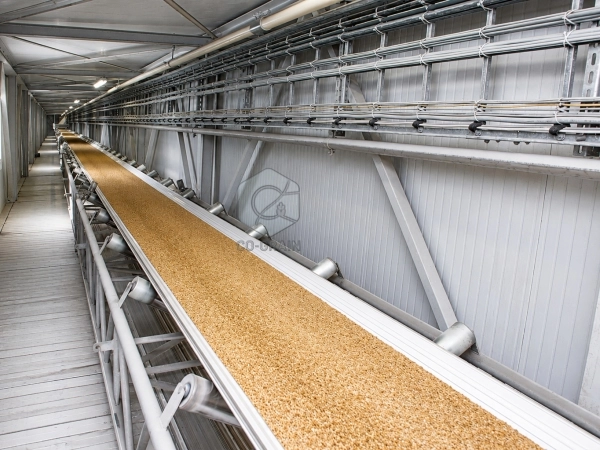
A grain belt conveyor moves bulk grain on a continuous belt supported by rollers or another confirmed support structure. It is commonly selected for horizontal and longer-distance routes where gentle handling, visible material flow and flexible plant layout are priorities.
Co-Grain configures the belt width, speed, support arrangement, loading zone, discharge, tensioning, cleaning and enclosure according to the grain, capacity, distance, inclination, climate and dust-control requirement.
Typical Applications
- Truck receiving and grain-yard transfer
- Cleaner or dryer connection
- Warehouse and silo-area horizontal conveying
- Long-distance transfer between plant buildings
- Grain dispatch and loading routes
- Gentle transfer for paddy, seeds and other damage-sensitive crops
Typical process:
Process Flow: Receiving / Processing Equipment > Belt Conveyor > Elevator / Silo / Loading Point
How It Works
The drive pulley moves the endless belt. Grain is loaded through a controlled feed chute and travels on the carrying side to the discharge pulley or a selected intermediate discharge device. The return belt travels back to the loading point.
Loading must be centered and controlled to reduce spillage and belt misalignment. Belt speed, trough shape and material depth influence capacity and grain behavior. The transition points, pulley arrangement, take-up system and belt cleaner must be coordinated for reliable operation.
Main Product Advantages
Relatively Gentle Grain Handling
The belt carries grain on a continuous surface, which can reduce repeated dragging and impact when loading, speed and discharge are correctly designed.
Suitable for Longer Routes
Belt conveyors are commonly considered for medium- and long-distance horizontal transfer. The economic route depends on capacity, supports, weather protection and number of transfer points.
Flexible Enclosure Options
The conveyor may be open, covered or enclosed according to the confirmed environment and dust-control target. An open conveyor should not be described as dust-free.
Easy Process Visibility
The belt route can provide accessible inspection of loading, belt tracking and discharge, subject to guards and safe access design.
Multiple Discharge Options
Head discharge is standard for many routes. Plough discharge or other intermediate discharge arrangements may be considered when multi-point delivery is required.
Configuration Options
- Flat or troughed carrying belt
- Horizontal or technically confirmed inclined layout
- Fixed or movable arrangement where within the actual supply scope
- Open, covered or enclosed construction
- Head discharge or selected intermediate discharge
- Manual or automatic take-up arrangement
- Primary and secondary belt-cleaning options
- Skirting and impact support at loading points
- Weather cover, walkway and maintenance platform
- Fixed-speed or variable-speed operation
- Belt misalignment, speed and blockage monitoring
Applicable Materials and Projects
The conveyor can be evaluated for paddy, corn, wheat, soybeans, seeds and other compatible bulk grains. It is used in grain depots, drying plants, silo complexes, rice mills, flour mills, feed plants and bulk loading facilities.
Wet, sticky or highly dusty materials require additional review of the belt surface, cleaner, chute and enclosure.
Selection Information Required
- Material, bulk density, moisture and impurities
- Required normal and peak capacity
- Horizontal distance and elevation difference
- Proposed inclination
- Loading and discharge positions
- Number of transfer or discharge points
- Indoor or outdoor environment
- Wind, rain, corrosion and temperature conditions
- Grain-damage and dust-control requirements
- Operating hours and start frequency
- Walkway, support and maintenance requirements
- Voltage, controls and connected equipment
Safety and Maintenance
The final design may include belt misalignment switches, speed monitoring, pull-cord emergency stops, chute blockage detection and guards around pulleys and rotating parts. Operators should inspect belt tracking, tension, splice condition, rollers, pulleys, cleaners, skirting and accumulated grain.
Safe isolation is required before cleaning or maintenance.
FAQ
Is a belt conveyor suitable for paddy and seeds?
It can provide relatively gentle transfer, but loading impact, belt speed, drop height and discharge chute design must be controlled for the actual crop.
Can a belt conveyor operate outdoors?
Yes, when covers, drainage, corrosion protection, wind conditions, electrical protection and maintenance access are designed for the site.
Can it discharge at several positions?
Intermediate plough or other discharge arrangements may be considered. The belt, enclosure and route control must be designed around the number and position of outlets.
What causes belt misalignment?
Common contributors include off-center loading, incorrect tension, pulley or roller alignment, material buildup and damaged components. Monitoring does not replace correct mechanical setup.
When should an enclosed belt conveyor be selected?
It is considered when weather protection, dust containment, material protection or cleaner plant appearance requires a more enclosed route.