What Is an Air Cushion Belt Conveyor?
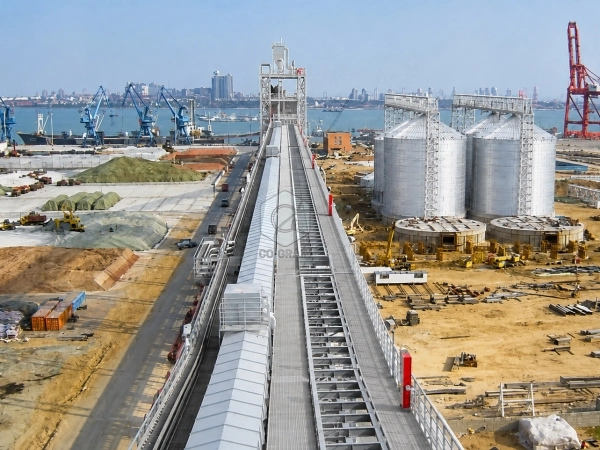
An air cushion belt conveyor supports the carrying belt on a thin layer of pressurized air above a shaped air chamber. A fan supplies air through designed openings in the chamber, allowing the loaded belt to travel with reduced direct contact with carrying rollers in the air-supported section.
The system is considered for continuous grain transfer where stable belt support, enclosure and longer conveying routes are important. Actual power, maintenance and operating advantages depend on belt width, capacity, route, fan duty, air-chamber design and operating condition; they should not be stated as fixed percentages without Co-Grain test data.
Typical Applications
- Commercial grain-depot horizontal transfer
- Long silo-gallery or ground-level routes
- Connections between receiving, drying and silo storage
- Large grain processing and dispatch facilities
- Enclosed outdoor conveying lines
- Multi-point feed or discharge only where the selected design supports it
Typical flow:
Process Flow: Receiving / Elevator > Air Cushion Belt Conveyor > Silo Distribution / Storage / Dispatch
How It Works
The fan sends air into a shaped chamber below the carrying belt. Air passes through a calculated pattern of openings and forms a supporting film between the belt and chamber. The drive pulley moves the belt while grain travels to the discharge.
Stable performance requires coordinated chamber geometry, air-hole distribution, fan pressure, belt tension, loading and sealing. Dust or grain entering the chamber can affect the air layer, so cleaning and inspection provisions are important.
Main Product Advantages
Smooth Belt Support
The air layer provides continuous support along the chamber and can promote stable belt movement when the air system and loading are correctly adjusted.
Suitable for Selected Longer Routes
The conveyor can be considered for large storage and handling projects with continuous horizontal transfer. Route economics depend on the full mechanical, structural and electrical scope.
Enclosed Configuration
The air chamber and housing can form a compact enclosed route that supports weather protection and controlled aspiration at transfer points.
Reduced Carrying-Side Roller Components
The air-supported section uses fewer conventional carrying rollers. The drive, return, transition and selected support sections still contain mechanical components requiring maintenance.
Plant Automation Integration
Fan status, air pressure, belt speed, belt alignment, motor load and downstream readiness can be coordinated through the plant PLC.
Configuration Directions
- Single-air-cushion or other confirmed support structure
- Covered, semi-enclosed or fully enclosed housing
- Horizontal or technically confirmed slight-incline route
- Single or selected multiple feed/discharge points
- Carbon-steel, galvanized or specified protective finish
- Air fan, chamber and distribution-hole configuration
- Head and tail cleaning arrangements
- Fixed or variable belt speed
- Aspiration connections at loading and discharge
- Walkway, access doors and inspection points
Any double-air-cushion, negative-pressure or multi-point special structure should be published only when Co-Grain confirms actual supply capability.
Selection Information Required
- Grain, bulk density, moisture and dust condition
- Required normal and peak capacity
- Conveying distance and elevation profile
- Indoor or outdoor environment
- Number and position of feed/discharge points
- Operating hours and load profile
- Dust-control and enclosure requirement
- Local power supply and energy target
- Maintenance access and cleaning plan
- Automation, monitoring and system-interface requirements
Operation and Maintenance
Routine inspection should cover the belt, chamber surface, air openings, fan, filters where used, seals, loading zone, cleaners, pulleys, return supports and accumulated grain. Operators should verify fan and airflow condition before loaded operation according to the approved startup sequence.
Safety devices may include belt misalignment, speed, blockage, air-pressure, motor-overload and emergency-stop monitoring.
FAQ
How is an air cushion conveyor different from a roller belt conveyor?
Its carrying belt is supported mainly by an air layer over a shaped chamber rather than conventional carrying rollers along that section.
Does it always use less electricity?
No fixed conclusion should be made without comparing conveyor length, load, belt, fan duty, drive efficiency and operating condition.
Can grain enter the air chamber?
Poor sealing, loading or cleaning can allow dust and grain accumulation. Chamber access and routine cleanout must be included in the maintenance plan.
Can it be fully enclosed?
Yes, selected designs can use enclosed housings. The exact sealing, ventilation, dust aspiration and access arrangement must be confirmed.
When is a conventional belt conveyor more suitable?
For shorter routes, lower duty or simpler plants, a conventional belt conveyor may offer a more practical balance of cost, maintenance and local service.