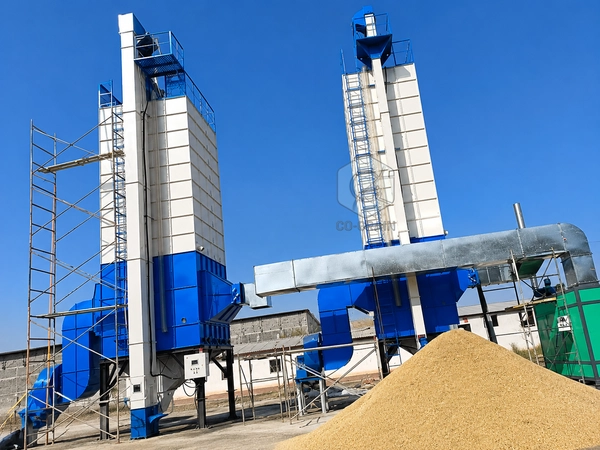
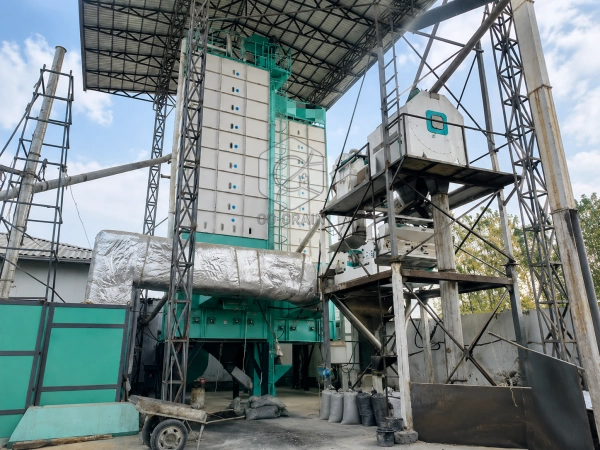
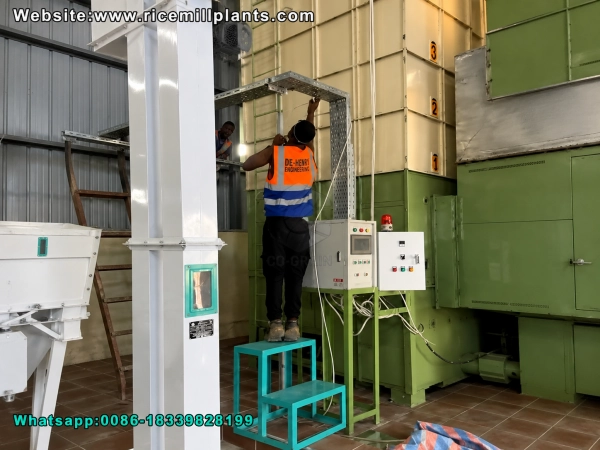
A paddy dryer is a grain drying machine specifically configured to reduce moisture in harvested paddy before storage or rice milling. It uses controlled airflow, heat, grain movement and drying time to remove moisture while managing uniformity and protecting the condition of the rice kernel.
For a commercial rice mill, the dryer should not be selected as an isolated machine. Its capacity and operating sequence must be coordinated with paddy receiving, pre-cleaning, wet-grain buffering, cooling, dried-paddy storage and the rice mill’s production schedule.
A paddy dryer moves controlled drying air through wet paddy. Thermal energy supports evaporation, airflow removes the released water vapor, and grain movement, tempering and discharge control determine how evenly and gently the moisture is reduced.
Why Does Paddy Need to Be Dried?
Fresh paddy is a biological material whose condition continues to change after harvest. Its moisture may be high or uneven because of rice variety, field conditions, weather, harvesting method and the time between harvesting and drying.
If wet paddy is held without appropriate moisture and temperature management, the risk of heating, mold development, respiration losses, discoloration and other quality deterioration can increase. Timely drying helps move the paddy toward a condition suitable for its planned storage or processing stage.
Commercial paddy drying supports four main objectives:
- Prepare harvested paddy for the intended storage period.
- Provide more consistent raw material for rice milling.
- Reduce the risks associated with holding wet grain after harvest.
- Give rice mills and collection centers more flexibility during concentrated harvest intake.
The objective is not to make paddy as dry as possible. The objective is controlled moisture reduction to a project-specific target while maintaining the quality required for storage and milling.
How Does a Paddy Dryer Work?
Paddy drying is a heat-and-mass-transfer process. Heated air passes through the grain mass and supplies energy for evaporation. Moisture moves from inside the kernel toward its surface, becomes water vapor and leaves the dryer with the exhaust air.
The basic process is:
Wet Paddy > Controlled Heated Air > Moisture Migration and Evaporation > Humid-Air Exhaust > Tempering or Cooling > Dried Paddy
Effective drying requires a balance between:
- Paddy variety and kernel condition
- Initial and target moisture
- Drying-air temperature and airflow
- Grain depth and air distribution
- Drying time and grain residence time
- Grain circulation or movement
- Tempering and cooling strategy
- Ambient temperature and humidity
- Heat-source performance
- Required storage and milling quality
Increasing air temperature alone does not guarantee better performance. Excessively aggressive or uneven drying may create large moisture and temperature gradients inside the kernels, increasing stress and the risk of fissuring.
Paddy Drying Process in a Commercial Rice Mill
A complete paddy drying section normally includes several coordinated stages.
1. Paddy Receiving
Fresh paddy arrives by truck, tractor or other bulk transport. A receiving pit or hopper accepts the grain and provides controlled feeding into the handling line. Depending on the project, this section may include a receiving conveyor, bucket elevator, feeding equipment and dust-control connection.
Receiving capacity should be based on peak harvest deliveries, not only average daily intake.
2. Paddy Pre-Cleaning
Fresh paddy may contain straw, stalks, leaves, clods, dust and other field impurities. A pre-cleaner removes excessive foreign material before the grain reaches the dryer.
A typical sequence is:
Receiving Pit > Bucket Elevator > Paddy Pre-Cleaner > Wet-Paddy Buffer
Pre-cleaning helps stabilize grain flow and airflow, protects conveying equipment and prevents the dryer from using energy and capacity to process unnecessary material.
3. Wet-Paddy Buffering
The receiving rate and dryer processing rate are rarely identical. Several trucks may arrive within a short period, while a batch dryer follows a defined cycle or a continuous dryer requires stable feeding.
A wet-grain buffer silo or hopper provides temporary process storage between cleaning and drying. It can balance intake, reduce unloading interruptions and provide more controlled dryer feeding.
Wet paddy should not be treated as stable stored grain. Allowable holding time depends on moisture, temperature, cleanliness and local conditions, so buffer sizing and operating rules must be confirmed for the project.
4. Dryer Feeding and Distribution
Bucket elevators, chain conveyors, belt conveyors or other suitable equipment transfer cleaned wet paddy to the dryer. The feed rate and distribution arrangement should match the dryer design so the grain enters evenly and the required grain level is maintained.
5. Controlled Paddy Drying
The heat source supplies thermal energy, fans generate airflow and the air-distribution system moves drying air through the paddy. Moisture is progressively removed while the control system manages confirmed operating variables such as temperature, grain level, circulation and discharge.
6. Tempering, Conditioning and Cooling
Tempering allows moisture inside the kernel to redistribute after a drying stage. In some processes, alternating drying and tempering can support more uniform moisture reduction and reduce internal stress.
Depending on dryer design, cooling may occur inside the dryer or in separate equipment. Hot paddy should not automatically be treated as ready for storage; grain temperature, moisture uniformity and storage conditions must also be considered.
7. Dried-Paddy Storage
After drying and cooling, paddy can be transferred through conveyors and bucket elevators to storage silos. Storage creates a production buffer between drying and milling, allowing the rice mill to draw grain according to its own operating schedule.
8. Rice Milling
Dried, properly managed paddy is then supplied to the rice milling line. The process may include cleaning, destoning, husking, paddy separation, whitening, polishing, grading, color sorting and packing according to the selected plant configuration.
The complete production chain becomes:
Paddy Receiving > Pre-Cleaning > Wet Buffering > Drying > Cooling > Paddy Storage > Rice Milling
Why Is Paddy Drying Different from General Grain Drying?
Different grains respond differently to drying. Paddy is especially sensitive because the kernel will later undergo husking and milling, where existing internal damage may become visible as broken rice.
When the kernel surface dries much faster than its interior, or when rapid heating and cooling create strong internal gradients, stress can develop. This stress may produce fissures that weaken the kernel even if the paddy still appears intact before milling.
For a rice mill, the goal is therefore not maximum water removal in the shortest possible time. It is controlled moisture reduction with suitable airflow, temperature, residence time, tempering and cooling so the paddy reaches the required condition for storage and milling.
How Can Paddy Drying Affect Broken Rice and Milling Yield?
Drying is one of several post-harvest factors that can influence kernel fissuring and subsequent breakage. Harvest maturity, field drying, delays before drying, moisture variation, handling impact, storage and milling settings can also contribute.
If paddy develops fissures, weakened kernels may break during husking, whitening, polishing or conveying. A dryer should therefore be evaluated on more than nominal throughput.
Rice mill buyers should consider:
- Drying and moisture uniformity
- Temperature and airflow control
- Grain residence time or batch cycle
- Grain circulation and mechanical handling
- Tempering and cooling arrangements
- Moisture measurement and sampling
- Automation and batch records where required
- Final head-rice and milling-quality objectives
Drying equipment cannot guarantee a specific milling yield by itself because many variables affect the result. However, a properly configured and operated dryer is an important part of quality-oriented paddy management.
What Is the Best Final Moisture for Paddy?
There is no single target that should automatically be applied to every project. The appropriate final moisture depends on paddy variety, storage duration, grain temperature, ambient humidity, silo management, milling schedule and buyer or market requirements.
A professional proposal should clearly define the design basis:
Initial Moisture > Required Moisture Reduction > Target Moisture and Grain Temperature > Planned Storage or Milling
This information is essential when comparing dryer capacities. Two quotations that state the same nominal tonnage may be based on different moisture-reduction assumptions.
What Is the Best Paddy Drying Temperature?
There is no universal air temperature suitable for every paddy, dryer and operating condition. The appropriate setting depends on rice variety, initial moisture, dryer design, airflow, drying stage, residence time, tempering strategy and required final quality.
The dryer should provide adequate process control rather than relying on high temperature to create an attractive capacity claim. Temperature recommendations should be confirmed for the actual paddy and equipment configuration.
Batch Paddy Dryer vs. Continuous Paddy Dryer
Commercial paddy drying systems commonly use batch or continuous-flow arrangements.
1. Batch Paddy Dryer
A batch dryer processes a defined quantity during each cycle:
Loading > Drying or Circulation > Tempering or Cooling > Discharging > Next Batch
Batch dryers are useful where daily intake varies, several varieties or lots are handled, seasonal operation is common or individual batches require separate management. Multiple batch dryers can be operated in parallel or in stages to increase flexibility.
2. Continuous Paddy Dryer
A continuous-flow dryer receives wet paddy and discharges dried paddy continuously after stable operation is established:
Continuous Feeding > Drying and Optional Cooling > Controlled Continuous Discharge
Continuous drying is generally considered for higher throughput, stable raw-material intake, longer operating periods and integration with large rice mills, collection centers or storage projects.
Batch vs. Continuous Paddy Dryer Comparison
| Selection Factor | Batch Paddy Dryer | Continuous Paddy Dryer |
| Operating method | Separate drying cycles | Continuous feeding and discharge |
| Production flexibility | High; units can be scheduled by batch | Best with stable material flow |
| Lot or variety changes | Easier to separate and manage | Requires coordinated production planning |
| Typical project fit | Flexible farms, collection centers and small- to medium-scale mills | Medium- to large-scale commercial plants |
| Buffer requirement | Recommended to balance intake and loading | Important for stable continuous feeding |
| Automation | Available according to configuration | Well suited to centralized automation |
| Throughput basis | Depends strongly on complete cycle time and batches per day | Depends on stable hourly flow and moisture reduction |
Neither configuration is automatically better. Selection should be based on actual paddy intake, moisture range, operating schedule, project scale, required flexibility and downstream rice-mill demand.
How to Choose Paddy Dryer Capacity
Dryer capacity should not be selected from rice-mill capacity alone. The following information is required.
Wet-Paddy Intake
Confirm average and peak daily intake during harvest, truck delivery patterns and the quantity that must be dried within the available time.
Initial and Target Moisture
Dryer workload depends on the amount of water to be removed. Capacity claims should be compared on the same moisture basis.
For wet-basis moisture expressed as decimals, an approximate water-removal mass balance is:
Water removed = Wet paddy mass x (Initial moisture – Final moisture) / (1 – Final moisture)
This estimates the mass of water removed; it does not determine dryer size or cycle time by itself.
Complete Batch Cycle or Continuous Residence Time
For a batch dryer, include loading, drying, tempering or cooling and discharge. For continuous equipment, confirm the design flow, residence time and stable operating conditions.
Daily Operating Hours
An installation operating one shift requires a different capacity strategy from a plant running for extended hours. Allow for start-up, cleaning, changeover, inspection and maintenance.
Number of Dryer Units
Several smaller batch units may provide lot separation, staged operation and partial availability during maintenance. One larger system may simplify some interfaces. The choice depends on the project workflow.
Buffering, Storage and Rice-Mill Capacity
The drying section must coordinate with wet-paddy buffering, dried-paddy storage, conveying rates and the mill’s actual paddy demand. A bottleneck outside the dryer can limit the output of the complete plant.
Example: Matching a Paddy Dryer with a Rice Mill
Consider a rice mill planned around a stated daily paddy-processing capacity. A simple calculation such as multiplying dryer batch loading by the expected number of batches may be useful as an early check, but it is not a final equipment selection.
The engineer must still confirm:
- Initial and target moisture
- Actual complete cycle under design conditions
- Workable batches per day
- Local temperature and humidity
- Heat-source output and fuel supply
- Harvest receiving schedule
- Wet and dry buffer capacity
- Rice-mill operating hours
- Required reserve or maintenance strategy
This is why the same nominal batch dryer may be suitable for one rice mill but not another with the same stated daily milling capacity.
Why Integrate the Paddy Dryer, Silos and Rice Mill?
A coordinated commercial system may follow:
Truck Receiving > Receiving Pit > Bucket Elevator > Paddy Pre-Cleaner > Wet-Paddy Buffer > Paddy Dryer > Dry-Paddy Silos > Rice Mill
Wet buffering separates truck intake from dryer loading. Dried-paddy storage separates dryer discharge from milling. These process buffers allow the three sections to operate on schedules suited to their individual functions.
Post-dryer storage can support:
- More independent drying and milling schedules
- Separation of selected paddy batches or varieties
- A more stable supply of conditioned paddy to the mill
- Better management of concentrated harvest intake
- Integration with silo aeration and condition monitoring
Silo capacity should therefore be planned together with dryer and rice-mill capacity.
What Equipment Is Needed for a Complete Paddy Drying System?
| System Section | Typical Equipment or Function |
| Receiving | Receiving pit, hopper, feeder and receiving conveyor |
| Pre-cleaning | Paddy pre-cleaner and optional aspiration connection |
| Vertical conveying | Bucket elevator selected for the required capacity and lift |
| Horizontal conveying | Chain, belt or other confirmed conveyor type |
| Wet buffering | Wet-grain buffer silo or hopper with controlled discharge |
| Drying | Batch or continuous paddy dryer |
| Heat supply | Furnace, burner, steam heat exchanger or other confirmed system |
| Tempering and cooling | Integrated or separate process according to dryer design |
| Dry storage | Paddy storage silo with suitable aeration and monitoring |
| Silo filling and discharge | Elevator, conveyor, distributor, outlets and collection conveyor |
| Monitoring and automation | Moisture, temperature, level and selected PLC control functions |
Not every project requires every component. Equipment should be included only when it supports the actual operating process.
What Heat Source Can a Paddy Dryer Use?
Depending on dryer design and local energy conditions, possible heat sources may include biomass, natural gas, liquid fuel, steam or another approved thermal system.
Selection should consider:
- Local fuel availability and seasonal supply
- Fuel quality and operating cost
- Required heat output and control response
- Emissions and environmental requirements
- Maintenance capability and spare parts
- Direct or indirect heating arrangement
- Dryer airflow and operating schedule
Heat-source selection should be completed as part of system engineering, not added after the dryer has been selected.
How to Manage Energy Use During Paddy Drying
Energy consumption is influenced by the amount of water removed and the efficiency of the complete process. Important factors include initial moisture, target moisture, ambient conditions, dryer loading, airflow, insulation, heat loss, heat-source efficiency, operating continuity, control settings and maintenance condition.
Practical priorities include:
- Avoid unnecessary overdrying.
- Keep the dryer loaded and operated within its confirmed design range.
- Maintain fans, ducts, screens, burners or furnaces and grain-discharge components.
- Reduce avoidable air leakage and heat loss.
- Coordinate receiving and buffering to limit unnecessary stops.
- Use representative moisture measurements to support discharge decisions.
The lowest purchase price does not necessarily produce the lowest lifecycle drying cost.
Common Paddy Dryer Selection Mistakes
Selecting Only by Tons per Batch
Nominal loading does not equal daily throughput. The complete cycle and workable number of batches must be confirmed.
Ignoring the Moisture-Reduction Basis
A capacity cannot be meaningfully evaluated without initial and target moisture and the related operating conditions.
Ignoring Wet-Grain Buffering
A correctly sized dryer can still create a receiving bottleneck if trucks arrive faster than grain can be cleaned and loaded.
Focusing Only on Drying Speed
Paddy quality depends on more than fast water removal. Uniformity, grain stress, tempering, cooling and milling objectives also matter.
Selecting the Dryer Separately from the Rice Mill
The dryer, heat source, conveyors, silos and mill should follow one coordinated capacity and operating plan.
Comparing Quotations with Different Assumptions
Suppliers may use different moisture, cycle-time, fuel, climate or cooling assumptions. Compare proposals on the same technical basis.
Paddy Drying in Humid or Tropical Regions
Rice-producing regions with high humidity, frequent rainfall or concentrated seasonal intake require careful planning around the complete post-harvest process.
Particular attention should be given to rapid receiving, pre-cleaning, short-term wet buffering, reliable heat supply, controlled drying, dried-paddy storage, aeration, monitoring and a practical backup operating strategy.
Local climate should be included in the design basis because ambient conditions can influence actual dryer performance and storage management.
Frequently Asked Questions About Paddy Dryers
What is a paddy dryer?
A paddy dryer is equipment configured to reduce excess moisture in harvested paddy under controlled airflow, heating and grain-handling conditions before storage or rice milling.
Why should paddy be dried before milling?
Drying prepares wet paddy for controlled storage or processing. Moisture condition and drying history can also influence kernel condition and subsequent milling performance.
Can wet paddy go directly into a rice mill?
This depends on the paddy condition and processing requirements. Paddy with excessive or unsuitable moisture should be appropriately managed before milling.
What final moisture should paddy reach?
The target depends on paddy variety, storage duration, local climate, grain temperature, storage system, milling schedule and buyer requirements. Both initial and target moisture should be stated in the dryer proposal.
What temperature should a paddy dryer use?
There is no universal setting. Dryer design, variety, moisture, airflow, residence time, drying stage and quality objective all influence the suitable operating temperature.
Is a batch or continuous dryer better for paddy?
Batch dryers provide flexible lot management, while continuous dryers are well suited to stable, higher-throughput operation. The correct choice depends on intake and production strategy.
Can a paddy dryer increase broken rice?
Drying conditions can contribute to kernel fissuring if thermal or moisture stress is excessive. Many other harvest, storage, handling and milling factors also affect broken rice, so controlled system operation is important.
Does paddy need cleaning before drying?
Pre-cleaning is generally recommended when incoming paddy contains straw, dust and foreign material that may interfere with grain flow, airflow or downstream equipment.
Does a paddy dryer need a buffer silo?
Not every installation requires one, but wet buffering is valuable when receiving and dryer rates differ or when truck arrivals are concentrated.
Can a paddy dryer connect directly to a rice mill?
Yes, but commercial projects often benefit from dried-paddy storage between drying and milling so the sections can operate more independently.
What size dryer is required for a rice mill?
There is no universal one-to-one match. Selection requires wet-paddy intake, initial and target moisture, cycle time or continuous flow rate, operating hours, buffer capacity, storage and mill demand.
Project Example: Integrated Paddy Drying, Storage and Milling in Ghana
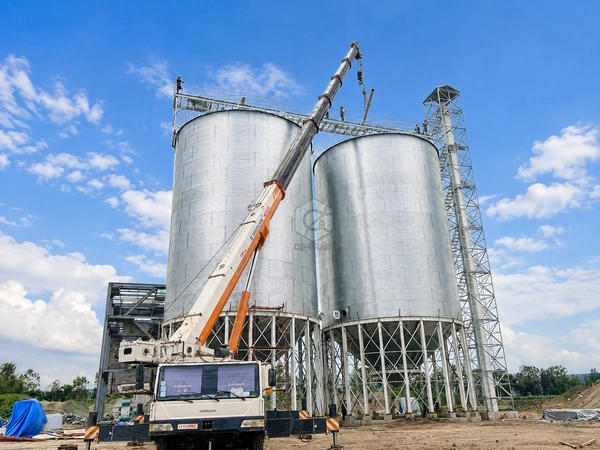
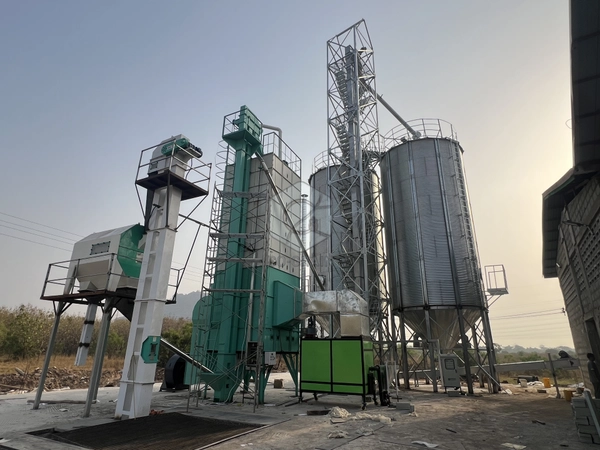
A documented Co-Grain project in Ghana combines a 15-ton-per-batch paddy dryer, two 100-ton grain silos and a 60-ton-per-day rice mill plant.
The process relationship is:
Paddy Receiving > Cleaning > Batch Drying > Buffer Storage > Rice Milling
The value of the configuration is not a universal capacity formula. It is an example of planning moisture reduction, storage buffering and rice processing as one coordinated system. The detailed project case should be linked from this article so buyers can review the confirmed configuration in context.
How Co-Grain Approaches Paddy Drying Projects
Co-Grain treats the paddy dryer as part of the complete raw-material preparation and rice-processing system. Depending on the confirmed scope, a project can integrate receiving, pre-cleaning, wet buffering, drying, heating, cooling, conveying, paddy storage, monitoring, automation and rice milling.
The engineering process begins with the customer’s paddy characteristics, moisture conditions, capacity, heat source, site layout and operating objectives. Equipment is then coordinated around the required grain flow instead of being selected as unrelated machines.