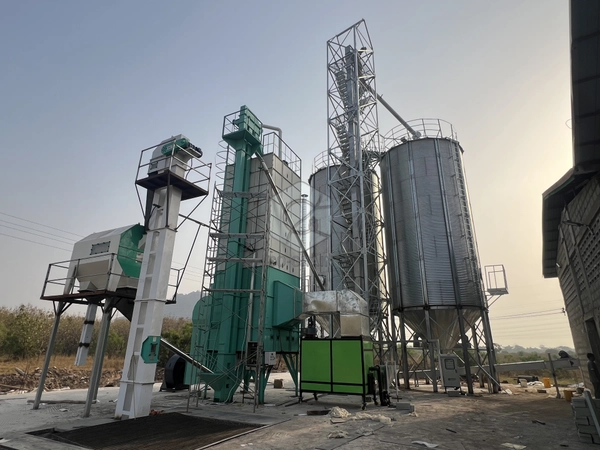
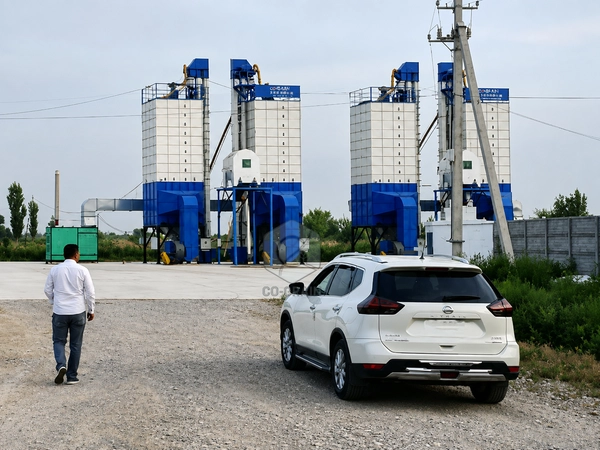
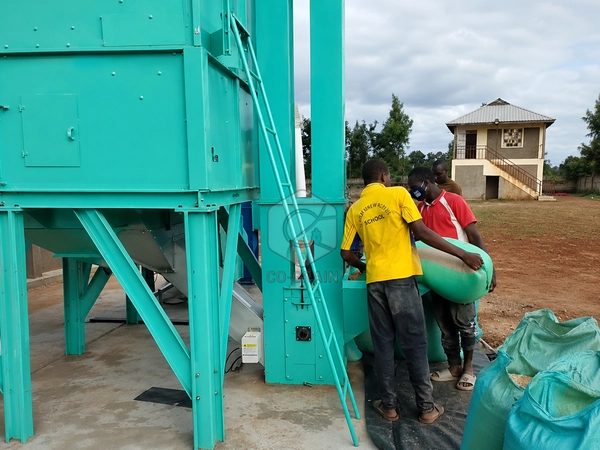
A grain dryer is a machine or integrated system used to reduce moisture in harvested grain before storage, transportation or further processing. It uses controlled airflow, heat and grain movement to remove moisture while managing drying uniformity, product quality and energy use.
Commercial grain drying is rarely an isolated step. The dryer normally works with receiving, pre-cleaning, wet-grain buffering, conveying, cooling and storage equipment. Selecting the right dryer therefore requires an understanding of the complete grain flow, not only the dryer model.
Why Does Harvested Grain Need Drying?
Freshly harvested paddy, corn, wheat and other grains may contain more moisture than is suitable for their intended storage or processing conditions. Without adequate moisture and temperature management, wet grain may face heating, mold development, respiration losses, insect activity and quality deterioration.
The required final moisture is not the same for every project. It depends on grain type, storage duration, climate, silo system, buyer specification and downstream process.
How Does a Grain Dryer Work?
Drying air supplies energy for evaporation, moisture moves from inside the kernel toward the surface and airflow carries water vapor out of the drying section. Successful drying balances temperature, airflow, drying time and grain movement.
- Grain type and variety
- Initial and target moisture
- Throughput and operating hours
- Ambient temperature and humidity
- Air temperature, airflow and distribution
- Grain depth, residence time and discharge rate
- Heat-source performance and control response
- Storage or processing quality requirements
Raising temperature alone does not guarantee better results. Aggressive or uneven drying may contribute to cracking, overdrying, uneven moisture and unnecessary energy use.
Complete Commercial Grain Drying Process
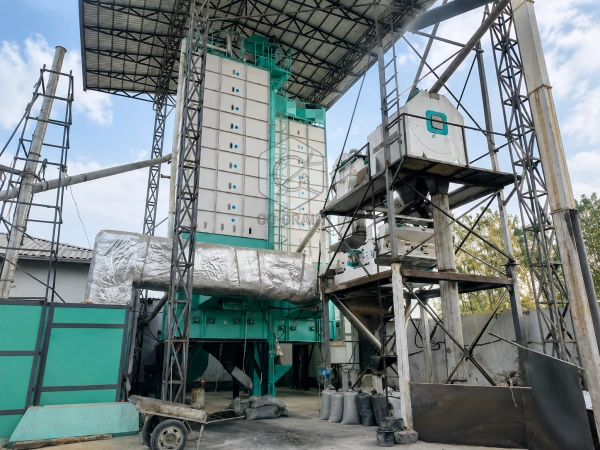
Main Components of a Grain Dryer
| Component | Main function |
|---|---|
| Grain feeding system | Controls supply and distribution of wet grain entering the dryer. |
| Drying chamber | Holds or moves grain through the drying zone and supports air contact. |
| Heat source | Supplies thermal energy through the confirmed fuel or heating arrangement. |
| Fans and hot-air system | Generates and delivers the required drying airflow. |
| Air-distribution section | Distributes air through the grain mass as evenly as the design allows. |
| Exhaust section | Releases moisture-laden air from the process. |
| Discharge system | Controls grain flow, residence time and dried-grain removal. |
| Cooling section | Reduces grain temperature where cooling is included. |
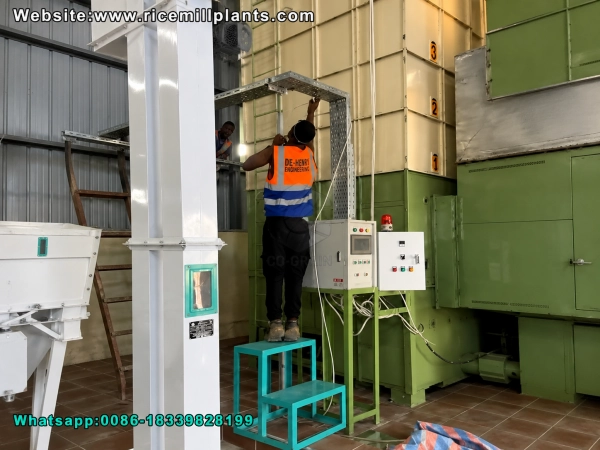
| Sensors and controls | Monitor selected process conditions and safety signals. |
Why Is Pre-Cleaning Important?
Wet grain from the field may contain straw, husks, leaves, dust, clods and other foreign material. Excessive impurities can interfere with grain movement, airflow and heat distribution while adding unnecessary load to elevators, conveyors and the dryer.
Cleaner selection should consider grain, impurity type, capacity and required separation. Aspiration and dust-control connections may be needed where light material and dust are significant.
Why Use a Wet-Grain Buffer Silo?
Receiving and drying rates are rarely perfectly synchronized. Multiple trucks may arrive in a short period while the dryer follows a controlled loading or continuous-feeding schedule.
Stabilize dryer feeding
The buffer converts irregular truck deliveries into a more consistent flow toward the dryer.
Reduce truck waiting
The receiving line can continue for a period when the dryer cannot accept grain immediately.
Protect wet grain
Holding time must be controlled according to moisture, temperature, cleanliness and local conditions.
Types of Grain Dryers
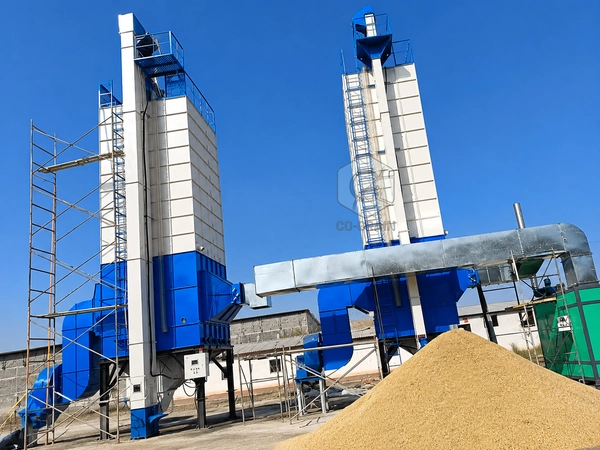
Batch Grain Dryer
Processes a defined quantity during separate cycles:
Loading → Drying → Tempering / Cooling → Discharge → Next Batch
Useful for variable intake, lot separation, rice mills, farms and flexible small-to-medium projects.
Continuous-Flow Dryer
Receives wet grain and discharges dried grain continuously:
Continuous Feeding → Drying → Optional Cooling → Controlled Discharge
Often considered for stable, high-throughput intake and larger storage or processing systems.
Airflow arrangements
Depending on the equipment design, dryers may use mixed-flow, cross-flow or other airflow patterns. The appropriate arrangement depends on grain, capacity and quality requirements.
Batch vs. Continuous-Flow Dryer
| Selection factor | Batch dryer | Continuous-flow dryer |
|---|---|---|
| Operating mode | Separate drying cycles | Continuous feeding and discharge |
| Flexibility | Well suited to changing batches and schedules | Best matched to stable material flow |
| Batch separation | Easier to manage lots separately | Requires coordinated transitions |
| Typical project scale | Flexible small- and medium-scale projects | Medium- and large-scale commercial plants |
| System integration | Can operate alone or in multiple units | Commonly integrated with larger receiving and storage systems |
| Automation | Available according to configuration | Well suited to centralized process control |
Neither type is automatically better. The suitable choice depends on capacity, moisture reduction, operating schedule, grain characteristics, layout and downstream process.
What Grains Can Be Dried?
Paddy Rice
Manage temperature, airflow, drying rate, tempering and cooling with attention to kernel quality and rice-milling requirements.
Corn / Maize
High and variable harvest moisture requires stable flow, adequate heat and airflow, controlled discharge and effective cooling.
Wheat
Coordinate drying with pre-cleaning, dust management, cooling and the intended storage, flour-milling or seed application.
Barley and Sorghum
Confirm material properties, moisture conditions and final use before accepting a nominal capacity.
Soybeans
Check flowability, quality requirements, moisture range and handling speed.
Seeds
Gentler temperature and airflow may be needed to protect viability.
Why Is Moisture Control Important?
The objective is not simply to make grain as dry as possible. Overdrying reduces saleable weight and wastes energy, while insufficient or uneven drying can create storage risks.
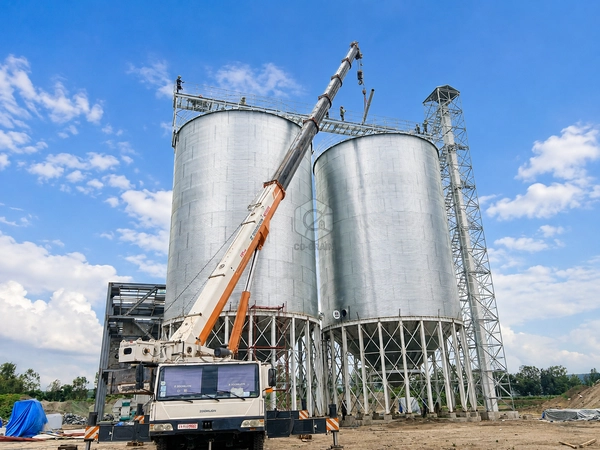
How Is a Grain Dryer Connected to Storage Silos?
For multiple silos, route-control equipment directs grain to the required storage unit. The system may also include dry-grain buffering, weighing, aeration, temperature monitoring, level detection and PLC control.
Post-dryer handling capacity should match the dryer discharge strategy. Undersized conveying or storage interfaces can interrupt dryer operation even when the dryer itself has adequate capacity.
How to Choose the Right Grain Dryer
Example: Matching Dryer and Rice Mill
A rice mill may be planned around a stated paddy-processing rate, but the dryer must also account for initial moisture, target moisture, cycle duration, batches per day, harvest peaks, buffer capacity, storage strategy and local weather.
A bottleneck in receiving, conveying, heating, cooling or storage can limit the output of the complete plant.
Grain Dryer or Complete Drying System?
Grain dryer
The machine that performs moisture reduction through controlled heat and airflow.
Complete drying system
Connects receiving, cleaning, buffering, heating, drying, cooling, conveying and storage.
Commercial integration
Each section must match the required grain flow, capacity and operating sequence.
- Receiving and controlled feeding
- Pre-cleaning and dust-management connections
- Wet-grain buffering
- Batch or continuous-flow drying
- Heating and hot-air generation
- Tempering and cooling
- Bucket Elevators and conveyors
- Storage silos and aeration
- Condition monitoring and electrical automation
Common Selection Mistakes
- Choosing only by model or nameplate capacity
- Ignoring initial and target moisture
- Comparing T/Batch, T/H and T/Day as if they were equivalent
- Ignoring wet-grain buffering
- Ignoring heat-source capacity and climate
- Undersizing dry conveying or storage interfaces
- Focusing on temperature instead of uniformity and quality
- Selecting the dryer separately from the complete plant
Frequently Asked Questions
What is a grain dryer used for?
A grain dryer reduces excess moisture in harvested grain so it can be prepared for intended storage, transportation or processing conditions.
How does a grain dryer remove moisture?
Controlled drying air passes through grain. Thermal energy supports evaporation and airflow carries water vapor out of the drying section.
What is the difference between batch and continuous drying?
A batch dryer processes a defined quantity through separate cycles. A continuous-flow dryer receives wet grain and discharges dried grain continuously after stable operation.
Can the same dryer be used for paddy, corn and wheat?
Some dryers can process several grains, but temperature, airflow, residence time, discharge and control settings must suit each material.
Does grain need to be cleaned before drying?
Pre-cleaning is generally recommended when incoming grain contains significant straw, dust or foreign material.
Can a grain dryer connect directly to storage silos?
Yes. Conveyors, Bucket Elevators and silo-filling equipment commonly transfer cooled dried grain to selected silos.
How is grain dryer capacity calculated?
Capacity depends on wet-grain intake, initial and target moisture, water removal, drying time, operating hours, dryer type and process schedule.
What information is needed before selecting a dryer?
Provide grain type, end use, capacity, initial and target moisture, location, heat source, operating hours, storage requirement and site layout.
Key Takeaway
A grain dryer should be selected as part of a complete grain-drying system:
Co-Grain coordinates grain characteristics, moisture reduction, capacity, heat source, conveying, storage, monitoring and automation instead of treating the dryer as an isolated machine.
Discuss Your Project
Need a Complete Grain Drying & Storage Solution?
Co-Grain provides turnkey grain drying plants, grain storage silos, cleaning, conveying, and automation systems for modern grain handling facilities. Our equipment includes batch and continuous grain dryers, paddy dryers, grain cleaners, bucket elevators, chain conveyors, and belt conveyors.
From engineering design and equipment manufacturing to installation and commissioning, we deliver reliable, customized solutions for paddy rice, maize, wheat, barley, sorghum, and other grains.
Talk to Co-Grain
Planning a new project or upgrading an existing facility? Contact us for a customized solution and free quotation.
Henan Co-Grain Machinery Engineering Co., Ltd.
Email: info@ricemillplants.com
WhatsApp: 0086 18339828199