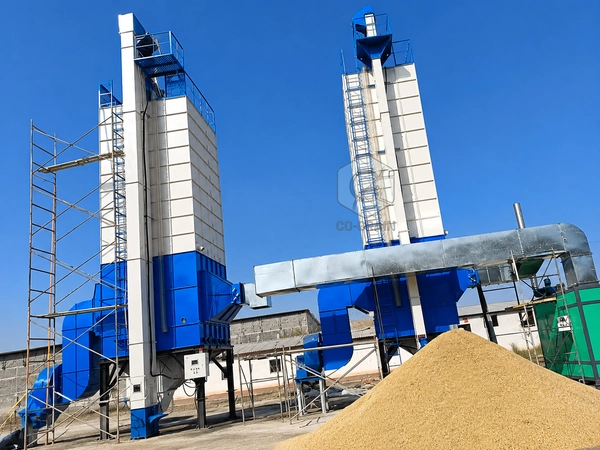
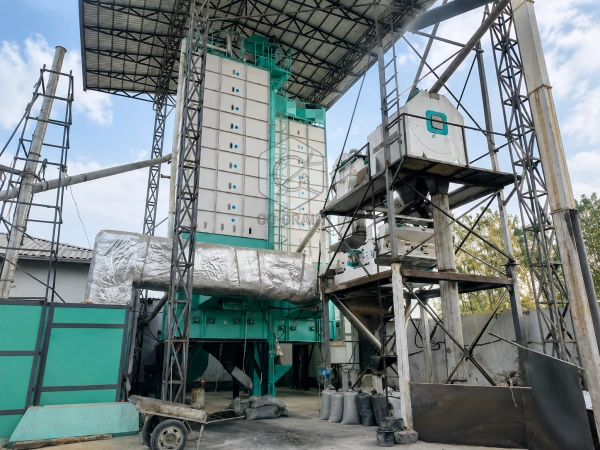
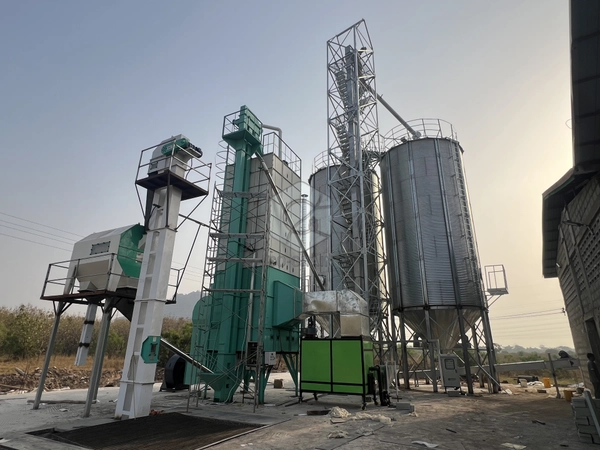
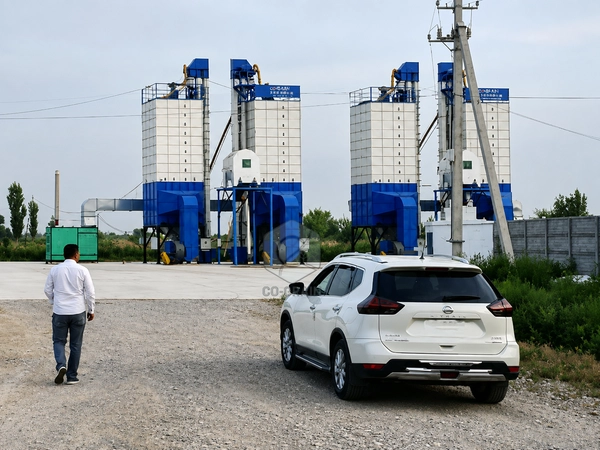
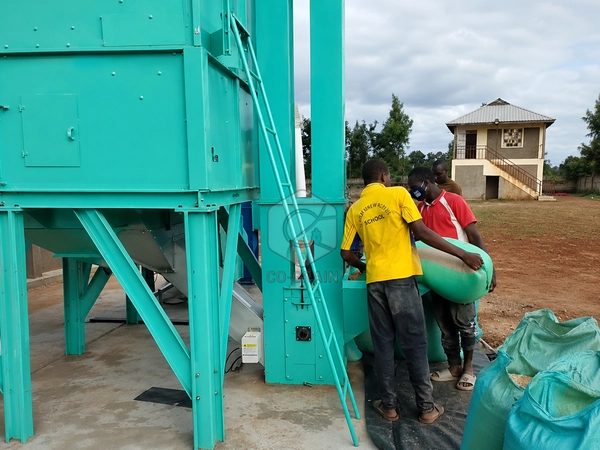
A paddy dryer is a grain drying machine configured to reduce moisture in harvested paddy before storage or rice milling. It uses controlled airflow, heat, grain movement and drying time to remove moisture while managing uniformity and protecting the rice kernel.
For a commercial rice mill, the dryer should not be selected as an isolated machine. Its capacity and operating sequence must coordinate with paddy receiving, pre-cleaning, wet-grain buffering, cooling, dried-paddy storage and the rice mill’s production schedule.
How a Paddy Dryer Works
Heated air supplies energy for evaporation, airflow removes water vapor and grain movement, tempering and discharge control determine how evenly and gently moisture is reduced.
Increasing air temperature alone does not guarantee better performance. Uneven or aggressive drying can increase internal stress and fissuring.
Why Does Paddy Need to Be Dried?
Fresh paddy continues to change after harvest. Moisture may be high or uneven because of variety, field conditions, weather, harvesting method and the time before drying.
- Prepare paddy for the planned storage period
- Provide more consistent raw material for rice milling
- Reduce risks associated with wet-grain holding
- Give rice mills and collection centers flexibility during harvest peaks
The objective is controlled moisture reduction to a project-specific target, not making paddy as dry as possible.
Commercial Paddy Drying Process
Why Is Pre-Cleaning Important?
Incoming paddy may contain straw, stalks, leaves, clods, dust and other impurities. Pre-cleaning helps stabilize flow and airflow, protect conveying equipment and prevent the dryer from using energy on unnecessary material.
Typical sequence
Receiving Pit → Bucket Elevator → Paddy Pre-Cleaner → Wet-Paddy Buffer
Process benefits
- More stable grain flow
- Better air distribution
- Lower dust load
- Reduced blockage risk
Before the dryer
Commercial systems generally use Receiving → Pre-Cleaning → Buffering → Drying rather than direct truck-to-dryer feeding.
Why Use a Wet-Paddy Buffer?
Receiving and dryer processing rates are rarely identical. Several trucks may arrive within a short period, while a batch dryer follows a defined cycle or a continuous dryer requires stable feeding.
| Without a buffer | With a wet-paddy buffer |
|---|---|
| Truck intake and dryer loading must be synchronized closely. | Receiving can fill the buffer while the buffer feeds the dryer independently. |
| Receiving interruptions can stop the dryer. | Buffering reduces unloading interruptions and supports planned feeding. |
Wet paddy is not stable long-term storage. Allowable holding time depends on moisture, temperature, cleanliness and local conditions.
Dryer Feeding and Conveying
Bucket Elevator
Used when cleaned wet paddy must be lifted to an elevated dryer inlet.
Drag Chain Conveyor
Suitable for enclosed horizontal or slightly inclined routes and shared buffer systems.
Belt Conveyor
Worth evaluating for longer, relatively gentle transfer where grain damage is important.
Screw Conveyor
Useful for short, compact and controlled feeding from a hopper or buffer outlet.
Selection should balance:
How Drying Can Affect Broken Rice
Paddy will later undergo husking and milling, where internal damage can become visible as broken rice. When the kernel surface dries much faster than its interior, or rapid heating and cooling create strong gradients, stress and fissures may develop.
A dryer cannot guarantee a specific milling yield by itself. Harvest maturity, field drying, storage, handling and milling settings also contribute.
Final Moisture and Drying Temperature
There is no universal final moisture or air temperature for every paddy project. The design basis should state:
Suitable temperature depends on paddy variety, initial moisture, dryer design, airflow, drying stage, residence time, tempering strategy and final quality objectives. High temperature should not be used simply to create an attractive capacity claim.
Batch vs. Continuous Paddy Dryer
| Selection factor | Batch paddy dryer | Continuous paddy dryer |
|---|---|---|
| Operating method | Separate drying cycles | Continuous feeding and discharge |
| Production flexibility | High; units can be scheduled by batch | Best with stable material flow |
| Lot or variety changes | Easier to separate and manage | Requires coordinated planning |
| Typical project fit | Flexible farms, collection centers and small-to-medium mills | Medium-to-large commercial plants |
| Buffer requirement | Recommended to balance intake and loading | Important for stable continuous feeding |
| Throughput basis | Complete cycle time and batches per day | Stable hourly flow and moisture reduction |
Neither configuration is automatically better. Select according to paddy intake, moisture range, operating schedule, project scale, flexibility and rice-mill demand.
How to Choose Paddy Dryer Capacity
Why Integrate Dryer, Silos and Rice Mill?
Wet buffering separates truck intake from dryer loading. Dried-paddy storage separates dryer discharge from milling. These buffers allow each section to operate according to its own schedule while maintaining a coordinated material flow.
- More independent drying and milling schedules
- Separation of paddy batches or varieties
- More stable conditioned-paddy supply
- Better harvest-intake management
- Integration with silo aeration and monitoring
Equipment for a Complete Paddy Drying System
| System section | Typical equipment or function |
|---|---|
| Receiving | Receiving pit, hopper, feeder and receiving conveyor |
| Pre-cleaning | Paddy pre-cleaner and optional aspiration |
| Vertical conveying | Bucket Elevator selected for capacity and lift |
| Horizontal conveying | Chain, belt or other confirmed conveyor type |
| Wet buffering | Wet-grain buffer silo or hopper with controlled discharge |
| Drying | Batch or continuous paddy dryer |
| Heat supply | Furnace, burner, steam heat exchanger or approved system |
| Tempering and cooling | Integrated or separate process |
| Dry storage | Paddy silo with suitable aeration and monitoring |
| Automation | Moisture, temperature, level and selected PLC functions |
Heat Sources and Energy Management
Possible heat sources include biomass, natural gas, liquid fuel, steam or another approved thermal system. Selection should consider local fuel availability, quality, cost, heat output, control response, emissions, maintenance and the direct or indirect heating arrangement.
- Avoid unnecessary overdrying.
- Operate within the confirmed design range.
- Maintain fans, ducts, screens, burners and discharge components.
- Reduce air leakage and heat loss.
- Coordinate receiving and buffering to limit unnecessary stops.
- Use representative moisture measurements for discharge decisions.
Paddy Drying in Humid or Tropical Regions
High humidity, rainfall and concentrated seasonal intake require planning around rapid receiving, pre-cleaning, short-term wet buffering, reliable heat supply, controlled drying, dried-paddy storage, aeration, monitoring and a practical backup strategy.
Local climate should be included in the design basis because ambient conditions influence dryer performance and storage management.
Project Example: Ghana
15 T/batch paddy dryer
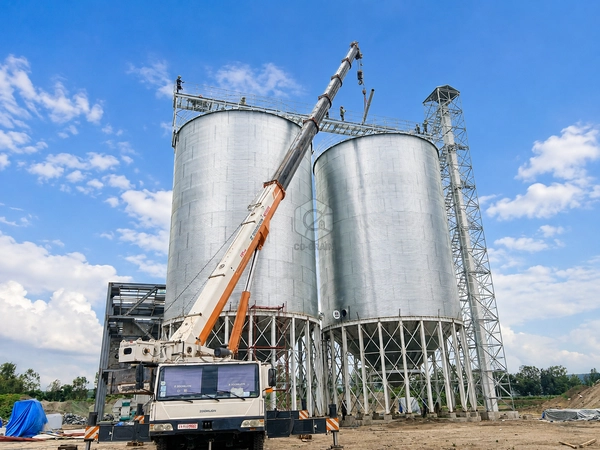
2 × 100 T grain silos
60 T/day rice mill plant
Paddy Receiving → Cleaning → Batch Drying → Buffer Storage → Rice Milling
The example shows how storage can separate dryer cycles from mill demand; it is not a universal capacity formula.
Common Paddy Dryer Selection Mistakes
- Selecting only by tons per batch
- Ignoring the moisture-reduction basis
- Ignoring wet-grain buffering
- Focusing only on drying speed
- Selecting the dryer separately from the rice mill
- Comparing quotations with different technical assumptions
- Ignoring conveying, storage and heat-source capacity
- Failing to consider climate and allowable wet-grain holding time
Frequently Asked Questions
What is a paddy dryer?
It is equipment configured to reduce excess moisture in harvested paddy under controlled airflow, heating and grain-handling conditions before storage or rice milling.
Why should paddy be dried before milling?
Drying prepares wet paddy for controlled storage or processing. Moisture condition and drying history can also influence kernel condition and milling performance.
What final moisture should paddy reach?
The target depends on variety, storage duration, local climate, grain temperature, storage system, milling schedule and buyer requirements.
What temperature should a paddy dryer use?
There is no universal setting. Variety, moisture, airflow, residence time, drying stage and quality objectives determine the suitable operating temperature.
Is a batch or continuous dryer better for paddy?
Batch dryers provide flexible lot management, while continuous dryers suit stable, higher-throughput operation. The correct choice depends on the intake and production strategy.
Can a paddy dryer increase broken rice?
Excessive thermal or moisture stress can contribute to fissuring, but harvest, storage, handling and milling factors also affect broken rice.
Does a paddy dryer need a buffer silo?
Not every installation requires one, but wet buffering is valuable when receiving and dryer rates differ or truck arrivals are concentrated.
Can a paddy dryer connect directly to a rice mill?
Yes, but commercial projects often benefit from dried-paddy storage so drying and milling can operate more independently.
What size dryer is required for a rice mill?
Selection requires wet-paddy intake, moisture reduction, cycle time or continuous flow, operating hours, buffer capacity, storage and mill demand.
Key Takeaway
A paddy dryer should be selected as part of the complete rice-processing system, not as an isolated machine.
Co-Grain coordinates paddy characteristics, moisture conditions, capacity, heat source, site layout, conveying, storage, monitoring and automation around the required grain flow.
Discuss Your Project
Need a Complete Grain Drying & Storage Solution?
Co-Grain provides turnkey grain drying plants, grain storage silos, cleaning, conveying, and automation systems for modern grain handling facilities. Our equipment includes batch and continuous grain dryers, paddy dryers, grain cleaners, bucket elevators, chain conveyors, and belt conveyors.
From engineering design and equipment manufacturing to installation and commissioning, we deliver reliable, customized solutions for paddy rice, maize, wheat, barley, sorghum, and other grains.
Talk to Co-Grain
Planning a new project or upgrading an existing facility? Contact us for a customized solution and free quotation.
Henan Co-Grain Machinery Engineering Co., Ltd.
Email: info@ricemillplants.com
WhatsApp: 0086 18339828199