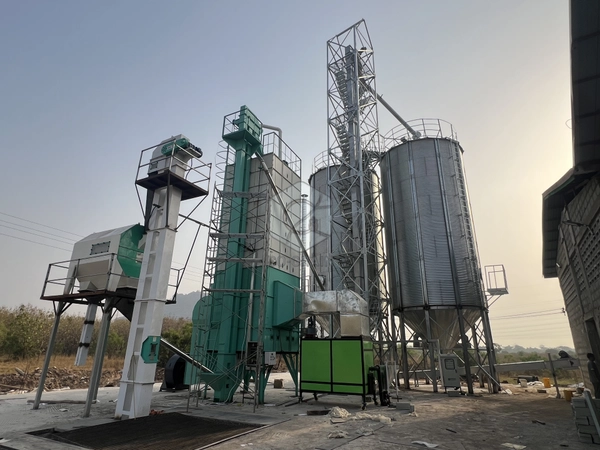
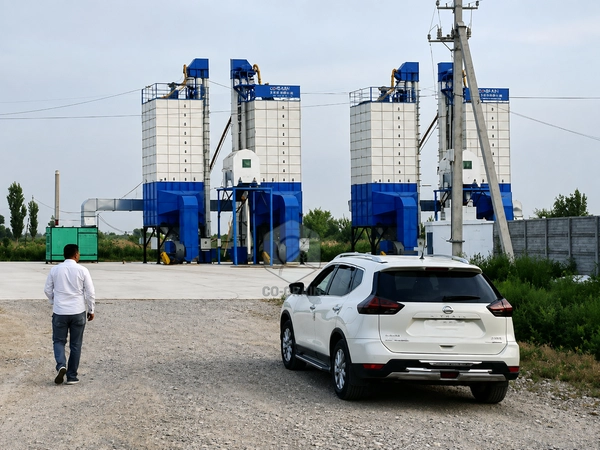
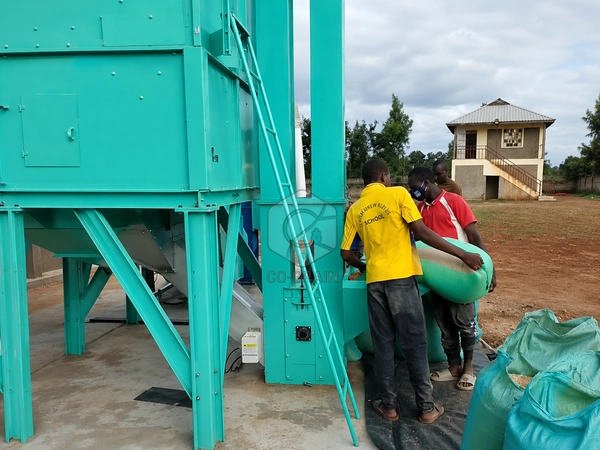
A complete grain drying and storage system connects grain receiving, pre-cleaning, wet grain buffering, drying, conveying and silo storage into one coordinated process.
Instead of operating each machine independently, the system balances irregular harvest-season grain intake with controlled drying and safe downstream storage.
A typical commercial process is:
Truck Receiving → Pre-Cleaning → Wet Grain Buffer Silo → Grain Dryer → Bucket Elevator → Silo Filling & Distribution → Grain Storage
Depending on the project, the system can also integrate aeration, temperature monitoring, silo discharge and automation, or connect directly with a rice mill, flour mill, feed mill or other grain-processing plant.
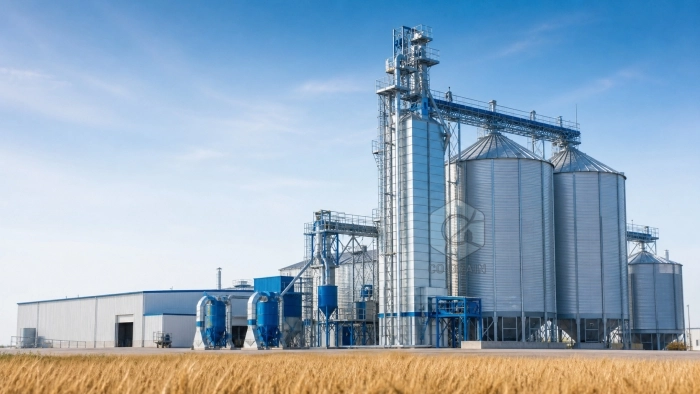
What Is a Grain Drying and Storage System?
A grain drying and storage system is an integrated post-harvest handling system designed to receive wet grain, remove impurities, reduce moisture and transfer the dried grain into suitable storage.
Typical raw materials include:
- Paddy
- Corn / maize
- Wheat
- Barley
- Sorghum
- Soybeans
- Other grains and seeds
A complete system normally consists of several interconnected sections rather than one machine.
The basic relationship is:
- Receiving
- Cleaning
- Wet Grain Buffering
- Drying
- Dry Grain Conveying
- Storage
For larger facilities, the process may extend further:
Receiving → Cleaning → Buffer → Drying → Storage → Aeration & Monitoring → Silo Discharge → Processing / Shipment
The purpose is to create a stable grain flow from harvest intake to final storage or processing.
How Does a Complete Grain Drying System Work?
Wet grain arriving from farms is first received and pre-cleaned.
The cleaned grain enters a wet grain buffer silo, which balances irregular truck arrivals with the dryer’s controlled processing rate.
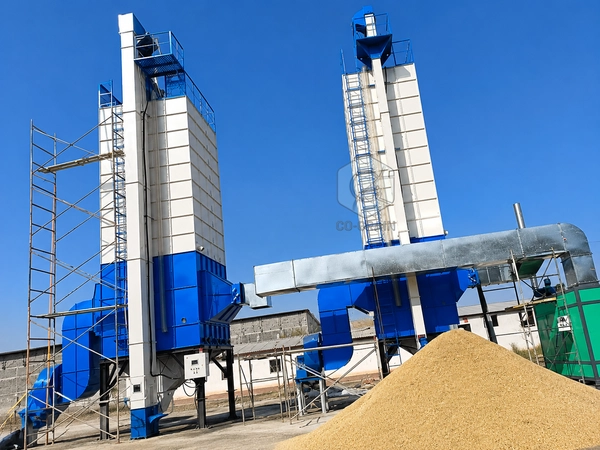
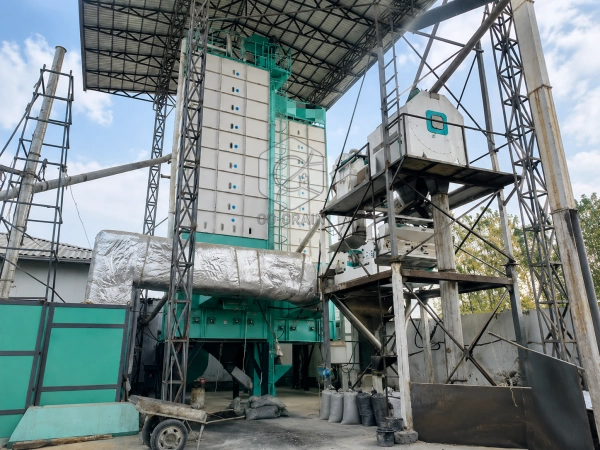
The grain is then transferred to a batch or continuous grain dryer, where controlled airflow and heat reduce moisture.
After drying, bucket elevators and conveyors transfer the grain to selected storage silos.
Inside the silos, aeration and monitoring systems help manage grain condition until the grain is discharged for processing or shipment.
The complete process can therefore be summarized as:
- Wet Grain
- → Receive
- → Clean
- → Buffer
- → Dry
- → Convey
- → Store
- → Discharge / Process
1. Grain Receiving
The drying process begins before grain reaches the dryer.
Freshly harvested grain may arrive by:
- Truck
- Tractor
- Farm trailer
- Other bulk transportation
A commercial grain plant normally uses a Receiving Pit or Receiving Hopper.
The truck unloads grain into the receiving section, where feeding equipment transfers it toward the pre-cleaning system.
Typical arrangement:
Truck → Receiving Pit → Conveyor → Bucket Elevator
The receiving system should be designed according to the peak intake rate, not simply the average daily dryer capacity.
Why Can Receiving Capacity Be Higher Than Dryer Capacity?
This is common in commercial grain plants.
For example, several trucks may arrive within one hour, but the dryer is designed to process grain continuously over many hours.
Therefore:
- Peak Receiving Rate > Average Dryer Rate
does not necessarily mean the dryer is undersized.
The system uses buffer storage to balance these different operating rates.
This is an important principle in grain drying plant design.
2. Grain Pre-Cleaning
Freshly harvested grain may contain:
- Straw
- Leaves
- Stalks
- Chaff
- Dust
- Large impurities
- Small impurities
- Other foreign material
These materials should normally be reduced before drying.
A typical process is:
Receiving → Bucket Elevator → Pre-Cleaner
Depending on the project, the cleaning section may use:
- Rotary cleaner
- Vibrating cleaner
- Drum cleaner
- Aspiration system
- Other grain-cleaning equipment
Why Is Pre-Cleaning Important Before Drying?
Pre-cleaning can improve the overall drying process in several ways.
More Stable Grain Flow
Large impurities can interfere with elevators, conveyors and dryer feeding.
Better Airflow Conditions
Excessive straw, dust and light material can interfere with airflow through the grain.
Reduced Unnecessary Drying Load
There is little value in heating and conveying material that should have been removed before the dryer.
Better Downstream Storage
Cleaner grain is generally easier to manage in the storage system.
For these reasons, commercial drying plants commonly use:
Receiving → Pre-Cleaning → Buffering → Drying
instead of sending freshly harvested grain directly into the dryer.
3. Wet Grain Buffer Silo
The Wet Grain Buffer Silo is one of the most important components between receiving and drying.
Its function is simple:
Separate irregular grain receiving from controlled dryer feeding.
During harvest season, trucks may arrive unevenly.
The dryer, however, operates according to a defined batch cycle or continuous throughput.
The buffer silo absorbs this difference.
Typical flow:
Pre-Cleaner → Wet Grain Buffer Silo → Grain Dryer
Why Does a Grain Drying Plant Need a Buffer Silo?
Consider a plant where trucks arrive rapidly during the morning.
Without a buffer:
Truck → Dryer
The receiving section may have to stop whenever the dryer cannot immediately accept more grain.
With a buffer:
Truck → Receiving → Cleaner → Buffer
while simultaneously:
Buffer → Dryer
The two operations can work more independently.
This can help:
- Reduce truck waiting time
- Maintain dryer feeding
- Improve plant scheduling
- Reduce start-stop operation
- Manage harvest-season peaks
How Large Should the Wet Grain Buffer Be?
There is no universal buffer capacity.
It should be calculated according to:
- Peak receiving capacity
- Dryer capacity
- Number of dryers
- Truck arrival pattern
- Grain moisture
- Daily operating hours
- Maximum acceptable wet-grain holding time
The buffer should therefore be treated as an engineering component rather than simply an optional storage bin.
4. Grain Conveying Before Drying
Grain must be transferred between receiving, cleaning, buffering and drying equipment.
Depending on layout, the system may use:
- Bucket Elevator
Used for vertical grain lifting.
Typical applications:
Receiving → Cleaner
Buffer Silo → Grain Dryer
Chain Conveyor
Used for horizontal or slightly inclined bulk grain transfer.
Belt Conveyor
Suitable for horizontal conveying where gentle handling or longer-distance transfer is required.
Screw Conveyor
Can be used for appropriate short-distance feeding or silo discharge applications.
The conveying equipment should be selected according to:
Capacity + Grain Type + Distance + Elevation + Layout + Grain Damage Requirements
5. Grain Drying
After pre-cleaning and buffering, wet grain enters the dryer.
The dryer uses controlled airflow and thermal energy to reduce moisture.
The basic mechanism is:
Wet Grain + Controlled Heated Air
- Moisture Transfer
- Moist Air Exhaust
- Dried Grain
The exact drying conditions depend on:
- Grain type
- Initial moisture
- Target moisture
- Dryer design
- Ambient conditions
- Heat source
- Required final grain quality
Batch or Continuous Grain Dryer?
A complete drying and storage plant can use either.
- Batch Dryer
Typical cycle:
Loading → Drying → Cooling → Discharge
Batch drying can be suitable for:
- Paddy
- Variable grain intake
- Multiple grain varieties
- Small and medium plants
- Projects requiring flexible batch management
- Continuous Grain Dryer
Typical process:
Continuous Feeding → Drying → Cooling → Continuous Discharge
Continuous dryers are particularly suitable for:
- High throughput
- Stable grain intake
- Large commercial storage facilities
- Long operating hours
- Centralized automation
The dryer type should match the complete plant operating strategy.
6. Heat Supply System
The dryer requires a reliable heat source.
Depending on project location and equipment configuration, possible energy sources can include:
- Biomass
- Natural gas
- Diesel
- Steam
- Other suitable thermal systems
Heat-source selection should consider:
- Local fuel availability
- Fuel price
- Dryer capacity
- Required drying temperature
- Automation
- Maintenance
- Local environmental requirements
- Operating cost
The heat system should be sized together with the dryer.
Why Should Heat Source Be Considered Early?
A common mistake is selecting the dryer first and asking about the heat source later.
But the heat system directly affects:
- Dryer operation
- Fuel cost
- Plant layout
- Infrastructure
- Automation
- Maintenance requirements
For example, a biomass-based drying plant requires different supporting equipment and space from a natural-gas system.
Therefore:
- Dryer + Heat Source
should be planned together.
7. Cooling and Moisture Verification
Depending on the dryer and process, dried grain may require cooling before storage.
Before grain enters a storage silo, the operator should consider:
- Final moisture
- Grain temperature
- Moisture uniformity
- Storage duration
The objective is to ensure that the grain entering storage is suitable for the intended storage conditions.
Drying should therefore not be treated as complete simply because grain has left the drying chamber.
8. Dry Grain Conveying
After drying, grain must be transported to storage.
A common system is:
Grain Dryer → Horizontal Conveyor → Bucket Elevator → Silo-Top Conveyor
The bucket elevator lifts the dried grain to the required silo-top elevation.
A horizontal conveyor then distributes it across the silo group.
This creates the connection between:
- Drying System
- Storage System
9. Silo Filling and Distribution System
For a plant with several storage silos, one elevator can feed a silo-top distribution conveyor.
Typical flow:
- Grain Dryer
- Bucket Elevator
- Silo-Top Chain Conveyor
- Distribution Point
- Selected Silo
For example, a project may contain:
- 1 Bucket Elevator + 1 Top Conveyor + 4–6 Grain Silos
The distribution system allows grain to be directed to the required silo according to:
- Grain variety
- Moisture
- Quality
- Batch
- Storage plan
This is more efficient than designing an independent elevator for every silo in many project configurations.
10. Grain Storage Silos
After drying, grain is transferred into storage silos.
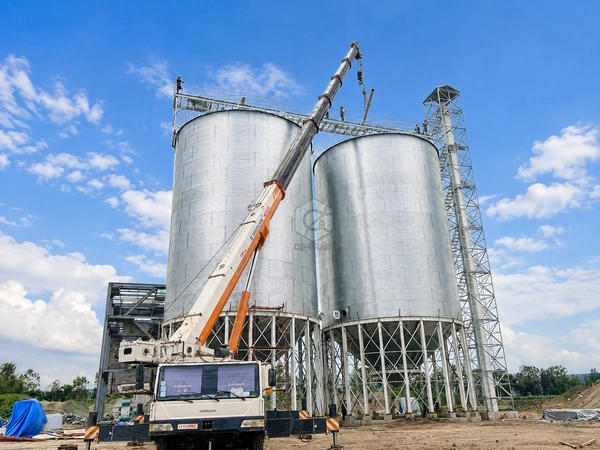
Commercial grain silos are commonly manufactured from galvanized corrugated steel and can be configured in different capacities.
Silo capacity should be determined according to:
- Harvest volume
- Dryer throughput
- Grain turnover
- Storage duration
- Number of grain varieties
- Downstream processing capacity
- Shipment schedule
The total storage requirement is not necessarily equal to one day’s dryer capacity.
In many projects, storage must cover several days or considerably longer periods.
What Equipment Is Used in a Grain Storage Silo?
A complete silo is more than a steel cylinder.
Depending on the project, it can integrate:
- Silo body
- Roof
- Access ladders and platforms
- Grain inlet
- Grain outlets
- Aeration system
- Temperature monitoring
- Level monitoring
- Ventilation
- Sweep auger
- Discharge conveyor
Safety accessories
These components support safe operation and grain management.
11. Silo Aeration
Aeration systems move ambient or conditioned air through stored grain.
Their purpose is different from the grain dryer.
A dryer is designed to remove substantial moisture.
An aeration system is primarily used to help manage grain temperature and storage conditions.
Therefore:
- Drying ≠ Aeration
Aeration should not be treated as a replacement for proper drying when grain contains excessive moisture.
12. Grain Temperature Monitoring
Stored grain is a biological bulk material.
Temperature changes inside the grain mass can indicate developing storage problems.
Commercial silos may therefore use temperature-monitoring cables or sensors.
Operators can use this information together with grain-management procedures to identify abnormal conditions and decide when aeration or other action may be required.
13. Silo Discharge System
When grain is required for processing or shipment, it must leave the silo in a controlled way.
For flat-bottom silos, the system may include:
Gravity Discharge → Central Outlet → Conveyor
After most grain has discharged by gravity, a Sweep Auger can help move the remaining grain toward the central outlet.
Typical process:
- Stored Grain
- Central Discharge
- Sweep Auger for Remaining Grain
- Under-Silo / External Conveyor
- Bucket Elevator or Processing Plant
This completes the storage cycle.
- Complete Grain Flow
The entire commercial system can now be understood as:
- Truck Receiving
- Receiving Pit
- Bucket Elevator
- Pre-Cleaner
- Wet Grain Buffer Silo
- Grain Dryer
- Dry Grain Conveyor
- Bucket Elevator
- Silo Filling & Distribution
- Storage Silos
- Aeration & Monitoring
- Silo Discharge
- Processing / Shipment
This is a Grain Drying & Storage System.
The dryer is only one part of it.
Why Is System Capacity Balance Important?
Every section has its own capacity requirement.
For example:
- Receiving: High peak capacity
- Cleaner: Must support receiving/transfer strategy
- Buffer: Stores temporary wet grain
- Dryer: Controlled processing capacity
- Elevator: Supports dryer and silo flow
- Storage: Provides long-term or production buffer
These capacities do not need to be identical.
They need to be coordinated.
A high-capacity dryer connected to an undersized elevator will not achieve its intended throughput.
Likewise, a large receiving pit does not solve the problem if wet buffer capacity is insufficient.
- Example Capacity Relationship
Consider a simplified commercial plant:
- Truck Receiving: High short-term intake
- Wet Grain Buffer: Absorbs receiving peaks
- Dryer: Stable controlled operation
- Storage Silos: Accumulate dried grain
The buffer system transforms:
- Variable Grain Flow
into:
- Controlled Grain Flow
This is one of the key engineering principles behind a well-designed drying and storage plant.
Grain Drying & Storage for Paddy
For paddy, the system may continue directly into rice processing:
- Paddy Receiving
- → Pre-Cleaning
- → Wet Paddy Buffer
- → Paddy Dryer
- → Paddy Storage
- → Rice Mill
The drying section should consider rice quality and downstream milling requirements.
- Grain Drying & Storage for Corn
A commercial corn storage plant may use:
- Corn Receiving
- → Pre-Cleaning
- → Wet Corn Buffer
- → Continuous Grain Dryer
- → Large Storage Silos
- → Shipment / Feed Mill / Further Processing
Large corn projects often place greater emphasis on:
- High receiving capacity
- Continuous drying
- Large silo storage
- Automated conveying
- Grain Drying & Storage for Wheat
For wheat, the system can be designed around:
Receiving → Cleaning → Drying When Required → Storage → Flour Mill / Shipment
Drying requirements depend on harvest moisture and planned storage conditions.
Example: 60 T/D Rice Mill Project in Ghana
A practical example is a Co-Grain project in Ghana configured with:
- Item Configuration
- Raw Material Paddy
- Paddy Dryer 15 T/Batch
- Grain Silos 2 × 100 T
- Rice Mill 60 T/D
Application Paddy drying, storage and rice processing
The overall process is:
- Fresh Paddy
- → Pre-Cleaning
- → 15 T/Batch Paddy Drying
- → 2 × 100 T Paddy Storage
- → 60 T/D Rice Milling
In this project, the storage section creates a buffer between the dryer and rice mill.
The dryer can operate according to its drying cycles, while the rice mill draws prepared paddy from storage according to its production schedule.
This illustrates an important system principle:
Dryer Capacity and Rice Mill Capacity do not need to match instantaneously when properly designed storage buffers are available.
How Does Automation Improve the System?
As plant scale increases, automation can coordinate different sections.
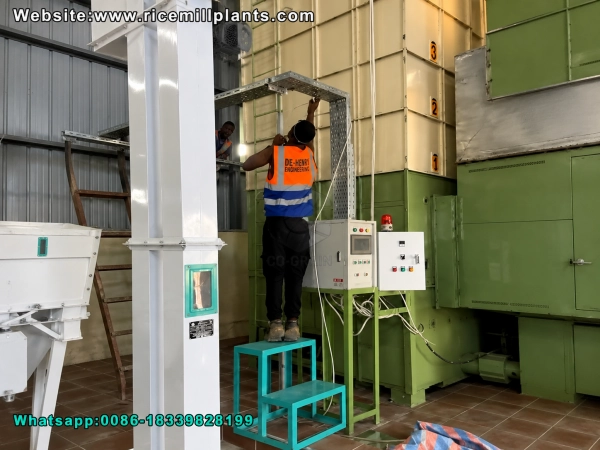
A centralized control system may monitor or control:
- Grain receiving
- Conveyor status
- Bucket elevator status
- Buffer silo level
- Dryer operation
- Grain temperature
- Moisture information
- Silo selection
- Silo level
- Alarm conditions
The objective is not simply to automate individual machines.
It is to coordinate the material flow between machines.
How to Design a Grain Drying and Storage Plant
Before selecting equipment, confirm the following project data.
Raw Material
Paddy, corn, wheat or another grain?
Annual and Daily Intake
How much grain must the plant handle?
Peak Receiving Rate
How quickly do trucks need to unload?
Initial Moisture
What moisture range is expected at harvest?
Target Moisture
What is required before storage or processing?
Dryer Operating Hours
How many hours per day will the dryer operate?
Heat Source
What fuel or thermal energy is available locally?
Storage Capacity
How many tons need to be stored?
Grain Segregation
How many varieties or grades must be stored separately?
- Downstream Use
Will the grain go to:
- Rice mill
- Flour mill
- Feed mill
- Trading
- Port / shipment
Other processing?
These answers determine the system configuration.
Common Grain Drying & Storage System Design Mistakes
Mistake 1: Starting with the Dryer Model
The project should start with grain flow and moisture conditions, not a catalog model number.
Mistake 2: Ignoring Receiving Peaks
Harvest-season truck intake may be much higher than average dryer throughput.
Mistake 3: No Wet Grain Buffer
This can force receiving and drying to operate at the same rate.
Mistake 4: Undersized Pre-Cleaner
The cleaning section can become the bottleneck before the dryer.
Mistake 5: Undersized Conveying Equipment
Elevators and conveyors must support the required grain flow.
Mistake 6: Insufficient Dry Storage
The dryer may have to stop when there is nowhere to send dried grain.
Mistake 7: Ignoring Silo Aeration
Drying and storage management should be treated as connected processes.
Mistake 8: Ignoring Silo Discharge
A silo must not only be filled efficiently—it must also discharge reliably.
Mistake 9: Selecting the Heat Source Too Late
Heat-source requirements affect layout and operating cost.
Mistake 10: Designing Each Machine Independently
The best individual machines do not automatically create the best complete system.
Frequently Asked Questions
What equipment is needed for a complete grain drying system?
A commercial system may include receiving equipment, pre-cleaner, bucket elevators, wet grain buffer silo, grain dryer, conveyors, storage silos, aeration, monitoring and automation.
Why should grain be cleaned before drying?
Pre-cleaning removes straw, dust and other impurities that can interfere with grain flow and drying conditions.
Does a grain dryer need a wet grain buffer silo?
Not every project requires one, but it is particularly useful when grain receiving is irregular or faster than dryer throughput.
Can a grain dryer feed directly into a storage silo?
Yes. Dried grain is commonly transferred through conveyors and bucket elevators into a silo filling and distribution system.
What is the difference between a grain dryer and silo aeration?
A grain dryer removes substantial moisture using controlled drying conditions. Silo aeration is primarily used to manage grain temperature and storage conditions.
Can one bucket elevator fill multiple silos?
Yes. In many systems, one elevator feeds a silo-top conveyor that distributes grain to several silos.
What happens to grain remaining at the bottom of a flat-bottom silo?
After gravity discharge, a sweep auger can move remaining grain toward the central outlet for further discharge.
How do you choose grain silo capacity?
Silo capacity depends on harvest volume, dryer throughput, storage duration, grain segregation and downstream processing or shipment requirements.
Should receiving capacity equal dryer capacity?
No. Receiving capacity may be higher because truck arrivals are concentrated. Wet grain buffering can balance the difference.
Can a drying and storage system connect to a rice mill?
Yes. A typical paddy project can use Receiving → Cleaning → Drying → Storage → Rice Milling.
- Why an Integrated System Is Better Than Isolated Equipment
A grain project should not be viewed as:
- Cleaner + Dryer + Elevator + Silo
as four unrelated machines.
The more useful engineering view is:
How does grain move through the entire plant?
A well-coordinated system considers:
- Where grain arrives
- → How quickly it arrives
- → How impurities are removed
- → Where wet grain waits
- → How moisture is reduced
- → How dried grain is transferred
- → Where it is stored
- → How its condition is managed
- → How it leaves storage
That is the difference between supplying equipment and designing a grain drying and storage solution.
How Co-Grain Approaches Grain Drying & Storage Projects
Co-Grain develops integrated grain handling solutions around the customer’s raw material, capacity and operating conditions.
Depending on project requirements, the scope can include:
- Grain Receiving
- Pre-Cleaning
- Wet Grain Buffering
- Grain Drying
- Bucket Elevators
- Chain / Belt / Screw Conveyors
- Silo Filling & Distribution
- Grain Storage Silos
- Aeration & Temperature Monitoring
- Silo Discharge & Sweep Systems
- Automation
The system can then connect with downstream:
- Rice Milling
- Flour Milling
- Feed Processing
or other grain-processing operations.
The objective is to create a coordinated system from wet grain receiving to safe storage and further processing.