Grain dryer capacity should be selected from actual wet-grain flow, moisture reduction, operating schedule and the capacity of the surrounding plant. A dryer rated in tons per batch cannot be compared directly with one rated in tons per hour, and nominal loading alone does not determine daily throughput.
For a commercial project, the correct objective is not to buy the largest dryer. It is to create a balanced process:
Receiving > Pre-Cleaning > Wet-Grain Buffering > Drying > Cooling > Dry-Grain Storage > Processing or Dispatch
Define the wet grain, initial and target moisture, peak and daily intake, effective dryer hours and downstream capacity. Then calculate the required batch cycles or hourly wet-grain flow using the same moisture basis as the supplier’s rating.
Why Correct Dryer Capacity Matters
An undersized dryer can allow wet grain to accumulate during harvest, delay truck unloading and increase the time high-moisture grain waits before processing. It may also force the plant to operate beyond the intended schedule.
An unnecessarily large dryer can increase:
- Equipment and heat-source investment
- Electrical connected load
- Size of elevators, conveyors and buffers
- Civil, structural and installation requirements
- Fuel demand at full load
- Cost of underutilized capacity
Correct sizing balances harvest risk, operating flexibility, investment and future demand without treating excessive nameplate capacity as the only safety margin.
What Does Grain Dryer Capacity Mean?
Grain dryer capacity describes how much wet grain a dryer can handle under stated conditions. The rating is meaningful only when its technical basis is clear.
Important conditions include:
- Grain type and bulk characteristics
- Initial and target moisture
- Ambient design conditions
- Drying-air temperature and airflow
- Cooling included or excluded
- Heat-source output
- Operating mode and allowable quality requirements
The same dryer can deliver different effective throughput when the grain or moisture reduction changes.
T/Batch vs. T/H vs. T/Day
| Capacity Term | Meaning | Main Use | Additional Information Required |
| T/Batch | Wet-grain quantity handled in one batch | Batch dryer loading | Complete cycle time, grain and moisture basis |
| T/H | Wet-grain throughput per hour | Continuous-flow dryer | Moisture reduction, ambient conditions and cooling basis |
| T/Day | Required or planned daily plant throughput | Overall project planning | Effective operating hours, downtime, buffers and storage |
These three terms cannot be exchanged without calculation.
Tons per Batch
A nominal 15 T/Batch rating describes one batch loading under the manufacturer’s stated design basis. It does not mean 15 tons per hour and does not guarantee a specific daily output.
A complete batch cycle may include:
Loading + Drying + Tempering or Cooling + Discharge + Preparation for the Next Batch
Tons per Hour
Continuous dryers are commonly rated by hourly wet-grain flow under specified grain and moisture conditions. A 10 T/H rating at one moisture reduction should not be assumed to remain 10 T/H when substantially more water must be removed.
Tons per Day
Daily tonnage describes the project requirement, not necessarily the dryer rating. The same 100 T/Day requirement spread across a long operating window is very different from 100 tons that must be processed during one short shift.
Start with Wet-Grain Mass, Not Dry-Grain Output
Drying removes water, so the mass leaving the dryer is lower than the wet-grain mass entering it. Confirm whether the project capacity refers to wet intake, dried grain, storage turnover or downstream processing.
For wet-basis moisture expressed as decimals:
Dry matter = Wet grain mass x (1 – Initial moisture)
Final grain mass = Dry matter / (1 – Final moisture)
Water removed = Wet grain mass – Final grain mass
The equivalent direct calculation is:
Water removed = Wet grain mass x (Initial moisture – Final moisture) / (1 – Final moisture)
This mass balance estimates water removal. It does not calculate drying time or required heat by itself, because dryer design, airflow, climate, grain quality and heat losses also matter.
The Main Factors That Determine Actual Capacity
1. Grain Type and End Use
Paddy, corn, wheat, soybeans and seeds have different physical properties, airflow resistance and quality requirements. A nominal capacity should not be assumed identical for every material.
The end use also matters. Grain for long-term storage, rice milling, feed processing or seed requires different operating priorities.
2. Initial Moisture
The dryer must be sized for the expected moisture range, not only an average value. Harvest peaks or wet weather may create a higher design condition than normal intake.
3. Target Moisture and Grain Temperature
The target depends on grain type, storage duration, local climate, silo management and downstream specifications. Cooling requirements should also be stated because hot grain should not automatically be treated as storage-ready.
4. Required Water Removal
More moisture reduction means a greater drying load. Compare supplier capacities only when grain, initial moisture, target moisture and operating conditions are equivalent.
5. Effective Operating Hours
Do not divide daily tonnage by the full calendar day unless the plant can actually dry for that entire period. Effective dryer hours should allow for start-up, loading, discharge, cleaning, planned inspection, fuel handling, operator breaks and other expected interruptions.
6. Local Climate and Altitude
Ambient temperature, humidity, rainfall season and altitude where relevant can influence airflow, heat demand and actual dryer performance. Provide the country and project location during selection.
7. Heat Source and Heat Delivery
The furnace, burner, heat exchanger or steam system must supply the heat and control response required by the dryer. A large dryer with inadequate heat supply cannot achieve its intended duty.
8. Quality and Automation Requirements
Gentler drying, tempering, seed viability, batch records, automatic moisture control or strict discharge conditions may affect capacity and operating strategy.
Step-by-Step Grain Dryer Capacity Method
Step 1: Define the Design Grain
State the grain, variety where relevant, bulk density basis, end use and expected impurity condition after pre-cleaning.
Step 2: Define Daily and Peak Wet Intake
Record average daily intake, peak harvest intake, truck arrival pattern and the maximum quantity that must be processed before unacceptable wet-grain accumulation occurs.
Step 3: Confirm Initial and Target Moisture
Use an expected range and a selected design condition. Record whether moisture values are wet basis and how they will be measured and sampled.
Step 4: Calculate Approximate Water Removal
Use the moisture mass balance to understand the drying duty. This makes supplier comparisons more meaningful than wet tonnage alone.
Step 5: Define Effective Operating Time
Confirm the actual hours available for drying, not just the shift length. For batch equipment, define the entire cycle. For continuous equipment, include expected start-up, stabilization and planned downtime.
Step 6: Select Batch or Continuous Operation
Batch dryers suit flexible lots, variable intake and separate cycle management. Continuous dryers suit stable, sustained material flow. Multiple batch dryers may provide another project-specific option.
Step 7: Add a Project-Specific Operating Margin
Allow for harvest variability, moisture fluctuation, maintenance and future demand. The margin should be justified by operating risk rather than applied as an arbitrary universal percentage.
Step 8: Balance the Complete Plant
Verify receiving, cleaner, wet buffer, heat source, dryer feeding, dry-grain conveying, silo filling, storage and downstream processing capacities.
How to Estimate Batch Dryer Daily Capacity
For a batch dryer:
Complete cycle time = Loading + Drying + Tempering or Cooling + Discharge + Inter-Cycle Allowance
Workable batches per day = Effective operating time / Complete cycle time
Approximate wet-grain throughput = Nominal batch loading x Workable completed batches
Use the supplier-confirmed cycle at the required moisture conditions. Do not round an incomplete cycle up to a full batch.
Illustrative Batch Relationship
A 15 T/Batch dryer completing four full cycles would have a planning relationship of:
15 T/Batch x 4 Completed Batches = 60 T of Wet-Grain Batch Throughput
This is not a performance guarantee. The project must confirm loading, drying, cooling, discharge, heat supply, climate, downtime and grain-quality conditions before assuming four cycles are workable.
How to Estimate Continuous Dryer Capacity
For initial planning:
Required average wet-grain flow = Daily wet-grain intake / Effective dryer operating hours
Then check:
- Supplier throughput at the same initial and target moisture
- Expected moisture variation
- Start-up and planned downtime
- Wet-buffer discharge capability
- Heat-source capacity
- Cleaner and conveying capacity
- Dry-storage availability
- Project-specific operating margin
If 240 tons must be dried during 24 effective operating hours, the simple average is 10 T/H. If only 20 effective hours are available, the average becomes 12 T/H before any project-specific margin. This illustrates why daily tonnage alone is incomplete.
Average Intake vs. Peak Receiving Rate
Truck receiving often operates much faster than the dryer. This is not automatically a design problem because the two sections perform different functions.
Peak Truck Receiving Rate > Average Dryer Throughput
A wet-grain buffer can absorb the difference:
Truck Receiving > Pre-Cleaning > Wet-Grain Buffer > Controlled Dryer Feeding
The receiving pit should be sized for unloading objectives, while the dryer should be sized for moisture-removal duty and operating schedule.
How to Size the Wet-Grain Buffer
Wet-buffer capacity should be based on the maximum expected cumulative difference between incoming and outgoing grain over the selected operating period.
Key inputs include:
- Peak receiving rate and duration
- Truck arrival pattern
- Cleaner and conveyor capacity
- Dryer loading or hourly feed rate
- Number and timing of batch dryers
- Planned dryer operating hours
- Maximum acceptable wet-grain holding time
- Minimum operating reserve and discharge geometry
In concept:
Required process buffer = Cumulative grain received – Cumulative grain sent to the dryer, evaluated over the critical period
Wet grain is not stable storage. Its allowable holding time depends on moisture, temperature and cleanliness, so operating rules must accompany buffer sizing.
Match Dryer Capacity with Dry Storage
After drying and cooling, grain must move to storage or downstream processing:
Grain Dryer > Conveyor > Bucket Elevator > Silo Filling and Distribution > Storage Silos
Dry-storage capacity should consider dryer output, grain segregation, mill consumption, shipment schedule, harvest duration and desired operating independence.
If storage is full or the silo-filling route is unavailable, the dryer may have to stop even when the dryer itself is correctly sized.
Match Conveying Capacity with Peak Flow
Conveyors should not always be sized from average daily dryer throughput.
For a batch dryer, loading and discharge may occur over short periods, creating an instantaneous conveying rate much higher than average tons per day. The elevator and discharge conveyor must handle the selected loading and unloading schedule.
For a continuous dryer, feed and discharge conveyors should support the stable hourly flow plus the confirmed control and operating margin.
Check:
- Receiving and cleaner discharge rates
- Wet-buffer filling and discharge rates
- Dryer loading time for batch systems
- Continuous dryer feed rate
- Batch discharge time and peak outlet flow
- Silo-filling and route-selection capacity
Match Paddy Dryer Capacity with Rice Mill Capacity
Drying and milling do not need to operate at the same instantaneous rate when dried-paddy storage separates the processes.
Paddy Receiving > Drying > Paddy Storage > Rice Milling
The dryer can follow its batch or continuous schedule while the mill draws previously dried paddy from storage. Capacity planning should use the mill’s actual wet-paddy demand, operating hours, storage strategy and required reserve.
Ghana Project Example
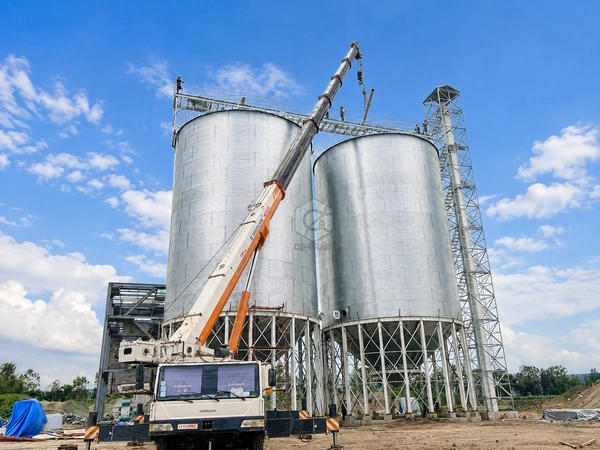
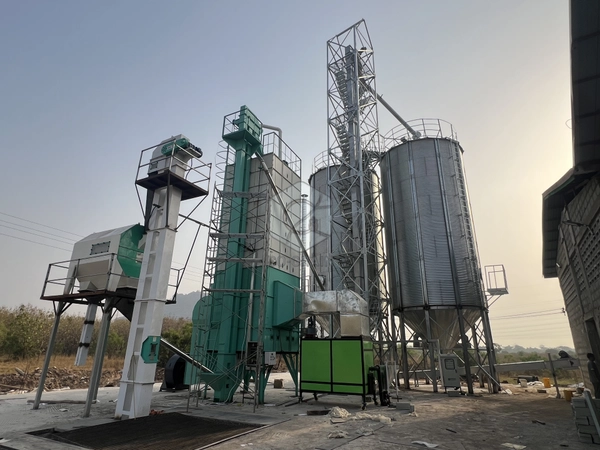
A documented Co-Grain project in Ghana combines:
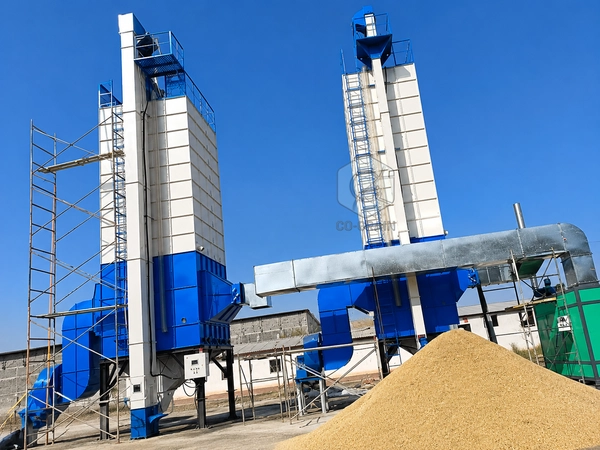
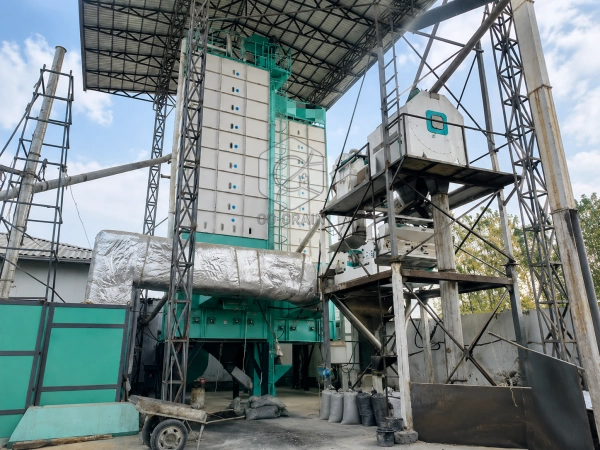
- 15 T/Batch paddy dryer
- 2 x 100 T grain silos
- 60 T/Day rice mill plant
The silos provide nominal buffer storage between drying and milling. This is a confirmed project configuration, not a universal formula for every 60 T/Day rice mill. Dryer suitability still depends on the actual moisture reduction and complete batch cycle.
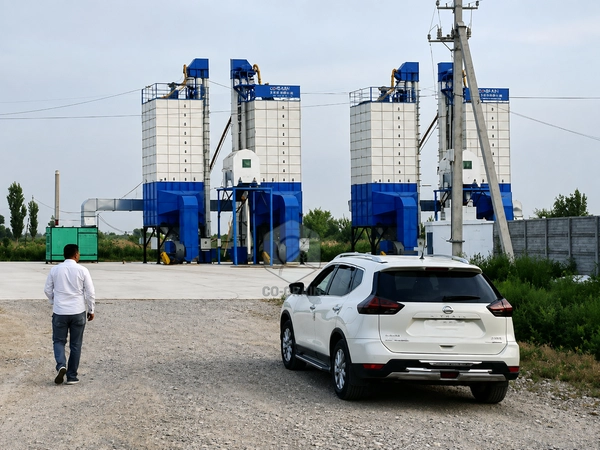
One Large Dryer or Multiple Smaller Dryers?
One large dryer may simplify the equipment arrangement and centralize operation, but it can concentrate production dependence in one unit.
Multiple dryers may provide:
- Flexible capacity during low and high intake periods
- Separate treatment of grain lots or moisture conditions
- Staged loading and discharge
- Partial drying availability during planned maintenance
- A modular expansion path
Multiple units also add conveyors, distributors, valves, controls, foundations and maintenance points. Compare the complete system rather than nominal dryer totals alone.
Batch or Continuous Dryer?
| Project Condition | Direction to Evaluate | Capacity Implication |
| Variable daily intake and separate lots | Batch dryer | Size by complete cycles and workable batches |
| Moderate seasonal paddy intake | Batch or multiple batch dryers | Coordinate cycles with buffer and rice mill demand |
| High, stable intake for long operating periods | Continuous dryer | Size by wet T/H at the required moisture reduction |
| Large receiving and storage center | Continuous or parallel drying lines | Balance peak receiving, wet buffers and silo filling |
| Need for lot separation and partial operation | Multiple batch units | Include distribution and control interfaces |
There is no universal capacity threshold at which every project must change from batch to continuous drying.
Grain-Specific Capacity Considerations
Corn or Maize
Corn may arrive with high and variable harvest moisture. Capacity planning should consider water-removal duty, heat supply, long harvest-season operation, cooling and direct silo integration.
Paddy Rice
Paddy capacity should balance throughput with drying uniformity, kernel stress, tempering, cooling and rice-mill quality requirements. Fast drying is not the only objective.
Wheat
Wheat drying demand depends on harvest moisture and storage plans. Dust control, pre-cleaning, cooling and the intended storage or milling application should be included.
Seeds and Other Materials
Seed viability or special quality requirements may require gentler temperature, airflow and handling, which can affect throughput. Confirm the crop and end use with the supplier.
Complete Plant Capacity Balance
A coordinated plant considers:
Peak Receiving > Pre-Cleaning > Wet Buffer > Dryer Feed > Drying > Cooling > Dry Conveying > Silo Filling > Storage > Processing or Dispatch
The capacities do not need to be identical. They need to match the operating sequence.
| Plant Section | Capacity Basis to Confirm |
| Receiving | Peak truck unloading rate and arrival duration |
| Pre-cleaning | Peak or scheduled wet-grain flow and impurity load |
| Wet buffer | Cumulative intake-flow difference and allowable holding time |
| Dryer | Grain, moisture reduction, operating time and quality basis |
| Heat source | Required thermal duty, control response and fuel supply |
| Wet conveying | Batch loading peak or continuous feed rate |
| Dry conveying | Batch discharge peak or continuous outlet rate |
| Storage | Dryer output, segregation, turnover and downstream demand |
| Processing | Actual grain consumption rate and operating schedule |
Common Capacity Selection Mistakes
Selecting Only by T/Day
Daily tonnage without effective operating time and moisture conditions is incomplete.
Treating T/Batch as T/H
They describe different operating modes and cannot be compared directly.
Assuming a Fixed Number of Batches
Actual cycle count depends on loading, moisture reduction, cooling, discharge and downtime.
Using Only Average Initial Moisture
The design should consider the expected range and selected peak condition.
Ignoring Wet-Grain Waiting Time
A dryer that meets annual averages may still be too small for a short, concentrated harvest window.
Ignoring Batch Loading and Discharge Peaks
Undersized elevators or conveyors can extend cycle time and reduce daily output.
Ignoring Heat-Source Capacity
Dryer nameplate capacity is not achievable when heat delivery is inadequate or unstable.
Ignoring Dry Storage
The dryer cannot continue when there is nowhere to send dried grain.
Comparing Supplier Ratings on Different Bases
Always normalize grain, initial moisture, target moisture, cooling, ambient conditions and operating hours.
Oversizing Without an Operating Plan
Excess capacity can add cost without reducing the real bottleneck. Use a justified project margin and confirm how reserve capacity will be used.
Frequently Asked Questions
How do I calculate the grain dryer capacity I need?
Start with daily and peak wet-grain intake, initial and target moisture, water-removal requirement and effective operating hours. Then calculate batch cycles or continuous hourly flow and balance the supporting plant.
What does 15 T/Batch mean?
It describes nominal wet-grain loading for one batch under the stated design basis. It does not mean 15 T/H or guarantee daily output.
How many tons can a 15 T/Batch dryer process per day?
Multiply nominal batch loading by the number of complete cycles that can actually be achieved. Cycle count depends on moisture reduction, loading, cooling, discharge, heat supply and downtime.
Does higher initial moisture reduce throughput?
Greater required moisture removal increases drying duty and may reduce achievable throughput under the same dryer and operating conditions.
Should dryer capacity equal receiving capacity?
Not necessarily. Receiving can have a higher peak rate, while a wet-grain buffer balances the difference and supplies the dryer at a controlled rate.
Should dryer capacity equal rice mill capacity?
Not necessarily on an hourly basis. Dried-paddy storage can separate dryer operation from mill consumption.
Is a larger grain dryer always better?
No. Oversizing can increase investment and reduce utilization. The selected capacity should match harvest risk, operating hours, storage and future demand.
Can multiple dryers replace one large dryer?
Yes, in some projects. Compare total capacity, cycle scheduling, heat distribution, conveyors, controls, maintenance and layout.
How much spare capacity should be included?
There is no universal percentage. The margin should reflect moisture variation, downtime, harvest concentration, future expansion and the cost of wet-grain delay.
What must be included in a supplier capacity quotation?
The quotation should state grain, initial and target moisture, throughput basis, cooling condition, heat source, ambient design conditions and relevant operating assumptions.
Information Needed for a Capacity Recommendation
| Project Data | Information to Provide |
| Grain and end use | Paddy, corn, wheat, seed or other material; storage or processing use |
| Daily wet intake | Average and peak T/Day |
| Peak receiving | T/H and duration of peak deliveries |
| Initial moisture | Expected range and selected design value |
| Target condition | Final moisture and cooling requirement |
| Operating schedule | Effective dryer hours per day and harvest duration |
| Dryer preference | Batch, continuous or recommendation required |
| Heat source | Biomass, gas, liquid fuel, steam or other source |
| Wet buffer | Existing or required capacity and allowable holding time |
| Dry storage | Existing or required silo capacity and segregation needs |
| Downstream process | Rice mill, flour mill, feed plant, storage or dispatch rate |
| Site | Country, region, climate, layout and power conditions |
How Co-Grain Selects Grain Dryer Capacity
Co-Grain begins with raw material, moisture conditions, wet-grain intake and operating schedule. The dryer configuration is then balanced with receiving, pre-cleaning, wet buffering, heat supply, conveying, cooling, storage and downstream processing.
For rice projects, the calculation also considers the relationship between paddy drying, paddy storage and rice-mill capacity. The objective is a coordinated material flow rather than an isolated machine rating.