Grain conveyor capacity should be selected according to more than a simple tons-per-hour requirement. The final design depends on grain type, bulk density, moisture, required throughput, distance, elevation, inclination, speed, inlet and outlet arrangement, and the capacity of connected equipment.
Capacity Must Match the Complete Plant
A commercial grain plant should balance every process zone instead of selecting each conveyor independently:
Receiving may need a higher peak rate than dryer feeding, while silo discharge may be governed by the downstream mill or truck-loading system. The narrowest transfer point determines the effective continuous flow.
What Does Grain Conveyor Capacity Mean?
Capacity describes how much material a conveyor can move in a specified period. Grain plants commonly use T/H (tons per hour), while equipment geometry is also related to m³/h (cubic metres per hour).
A quotation should identify the grain, expected bulk density, moisture and target throughput. Comparing offers only by casing width or motor size can produce an inaccurate result.
Why T/H Alone Is Not Enough
Capacity by Grain Type
Paddy
Check bulk volume, husk characteristics, moisture, dust, transfer impact and grain damage. A conveyor rated for wheat may not deliver the same mass throughput with paddy.
Corn / Maize
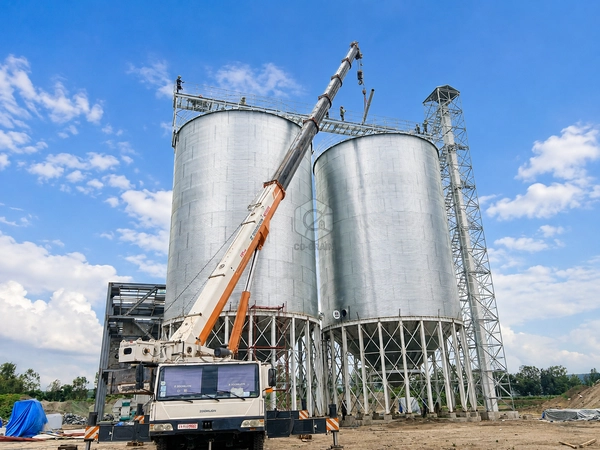
Commercial receiving and drying plants often require high harvest-season intake, continuous dryer feed, large silo filling capacity and high-capacity discharge.
Wheat and Barley
Storage systems need stable conveying. Long silo galleries may use Belt or Air Cushion Belt Conveyors, while compact routes may use Drag Chain Conveyors.
Soybeans and Seed
Flowability and damage sensitivity should be checked together with capacity. Speed and transfer impact can be more important than simply increasing the motor size.
How Route Conditions Change Capacity
| Condition | Typical options | Capacity considerations |
|---|---|---|
| Short, compact route | Screw Conveyor, Drag Chain Conveyor | Simple feeding and discharge; check loading and motor load. |
| Medium horizontal route | Drag Chain Conveyor, Belt Conveyor | Compare enclosure, transfer points, grain handling and maintenance. |
| Long horizontal route | Belt, Enclosed Belt or Air Cushion Belt Conveyor | Distance affects power, support, dust control and project economics. |
| Major vertical lift | Bucket Elevator | Use bucket volume, speed, grain condition and head / boot design. |
| Moderate incline | Inclined Chain or suitable Belt Conveyor | Material rollback, filling and power can change with the angle. |
As distance increases, a Screw Conveyor may become less attractive because of friction, power demand and maintenance. For major elevation change, a Bucket Elevator is normally the first solution to evaluate.
Speed, Inclination and Grain Quality
Higher speed can increase throughput, but higher speed is not always better. Excessive speed can increase impact, dust, wear, belt-tracking problems, chain wear, transfer loading and grain breakage.
- Screw Conveyor capacity can decrease significantly as inclination increases.
- Belt Conveyor design must consider rollback, belt loading and grain stability.
- Drag Chain Conveyor inclination is possible within suitable design limits.
- Bucket Elevators are normally preferred for major vertical lifting.
- Paddy and seed require special attention to speed and transfer-point impact.
Capacity by Conveyor Type
Belt Conveyor
Capacity depends on belt width, trough angle, speed, loading, bulk density, inclination and feeding condition. A larger belt does not mean it should run at maximum speed.
Drag Chain Conveyor
Check chain speed, flight loading, casing size, route length, number of inlets and outlets, and the maximum number of simultaneous silo discharges.
Bucket Elevator
Check bucket volume, spacing, belt or chain speed, grain fill, boot inlet and head discharge. Vertical capacity must match the horizontal conveyors feeding it.
Screw Conveyor
Short feeding routes are usually suitable. Capacity changes with screw diameter, rotation speed, fill level, material condition and inclination.
Air Cushion Belt
For selected long and high-capacity silo-gallery routes, compare belt width, speed, distance, support system and project economics with a conventional belt.
Inclined Chain
Combined horizontal and inclined transfer can save space, but the design must account for the elevation change and stable grain movement.
Capacity Zones in a Grain Plant
One project can legitimately use different capacities for different zones:
| Plant zone | Capacity basis |
|---|---|
| Truck receiving | Peak unloading rate and truck arrival pattern |
| Pre-cleaning | Receiving flow and buffer strategy |
| Wet grain buffer | Peak upstream transfer and hopper discharge |
| Dryer feeding | Stable, controlled dryer feed rate |
| Dryer discharge | Dryer output and downstream storage route |
| Silo filling | Receiving or dryer transfer rate and distribution route |
| Silo discharge | Mill, processing or truck-loading demand |
Typical Project Examples
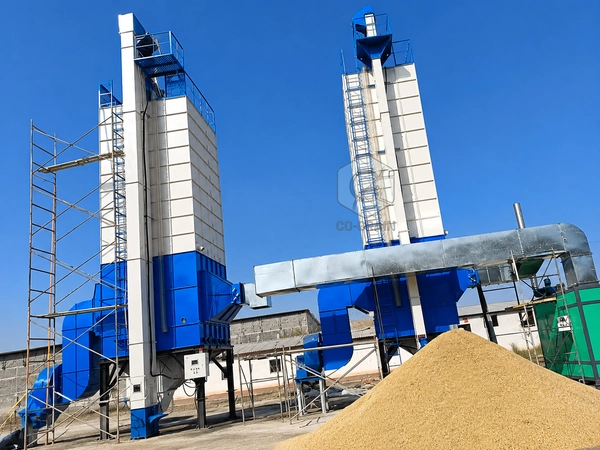
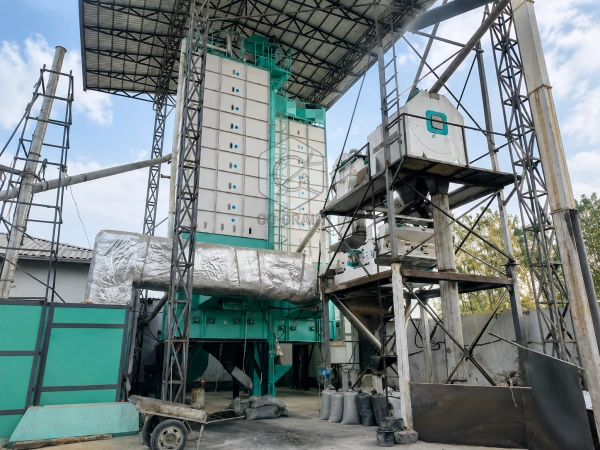
Truck Receiving → Pre-Cleaner → Wet Paddy Buffer → Paddy Dryer → Dry Paddy Silo.
Receiving may be designed above dryer-feed capacity because trucks unload intermittently.
Truck Receiving → High-Capacity Cleaner → Wet Corn Buffer → Continuous Dryer → Large Storage Silos.
High harvest peaks may require large elevators and long Belt or Air Cushion Belt Conveyors.
Silo 1 / 2 / 3 / 4 → Drag Chain Conveyor → Bucket Elevator.
Check the number of simultaneous outlets, gate discharge rate and downstream elevator capacity.
Hourly paddy demand depends on operating hours. T/D alone is not enough to size the conveyor; required T/H rises when the same daily volume is processed in a shorter shift.
Motor Power Does Not Define Capacity
Motor power is only one design parameter. Two conveyors with similar motors can have different capacities because of size, speed, distance, inclination, grain, friction and loading condition. Do not select a grain conveyor by motor kW alone.
Common Capacity Selection Mistakes
- Asking only for T/H without specifying the grain and route
- Ignoring bulk density and moisture
- Using dry-grain data for wet grain
- Ignoring inclination and transfer chutes
- Increasing speed to solve every capacity problem
- Making every conveyor in the plant the same capacity
- Ignoring peak flow and simultaneous silo outlets
- Oversizing equipment without a defined future requirement
- Selecting capacity before confirming the complete process flow
Frequently Asked Questions
How do I calculate grain conveyor capacity?
Start with required T/H, grain type, bulk density, moisture, distance, inclination and conveyor type. Final sizing must follow the equipment geometry and actual operating conditions.
Is grain conveyor capacity normally measured in T/H?
Yes, T/H is common, but m³/h is also important because different grains have different bulk densities.
Does the same conveyor carry the same T/H of paddy and wheat?
Not necessarily. Their bulk densities and flow characteristics differ, so mass throughput can change.
Does wet grain reduce conveyor capacity?
Wet grain can reduce flowability and increase resistance or blockage risk. Check the conveyor under the expected wet-grain condition.
Should every conveyor in a grain plant have the same T/H?
No. Receiving, dryer feeding, silo filling and processing may require different flow rates.
Is a larger conveyor always better?
No. Oversizing increases cost and may reduce efficiency. Select a suitable reserve based on the process and future expansion plan.
Key Takeaway
The correct question is not simply “What T/H conveyor do I need?” Confirm the grain, bulk density, moisture, distance, elevation, conveyor type, peak flow and connected equipment first.
The objective is a balanced material-flow system that removes bottlenecks without unnecessary oversizing. Co-Grain coordinates Bucket Elevators, Drag Chain Conveyors, Belt Conveyors, Air Cushion Belt Conveyors, Screw Conveyors, Inclined Chain Conveyors, chutes, gates, silos and process equipment as one complete solution.
Discuss Your Project
Need a Complete Grain Drying & Storage Solution?
Co-Grain provides turnkey grain drying plants, grain storage silos, cleaning, conveying, and automation systems for modern grain handling facilities. Our equipment includes batch and continuous grain dryers, paddy dryers, grain cleaners, bucket elevators, chain conveyors, and belt conveyors.
From engineering design and equipment manufacturing to installation and commissioning, we deliver reliable, customized solutions for paddy rice, maize, wheat, barley, sorghum, and other grains.
Talk to Co-Grain
Planning a new project or upgrading an existing facility? Contact us for a customized solution and free quotation.
Henan Co-Grain Machinery Engineering Co., Ltd.
Email: info@ricemillplants.com
WhatsApp: 0086 18339828199