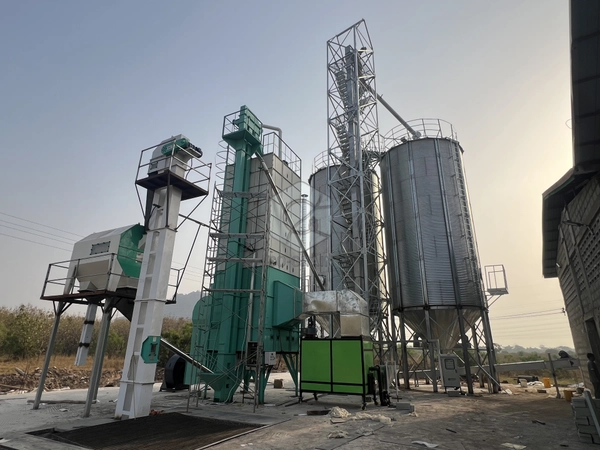
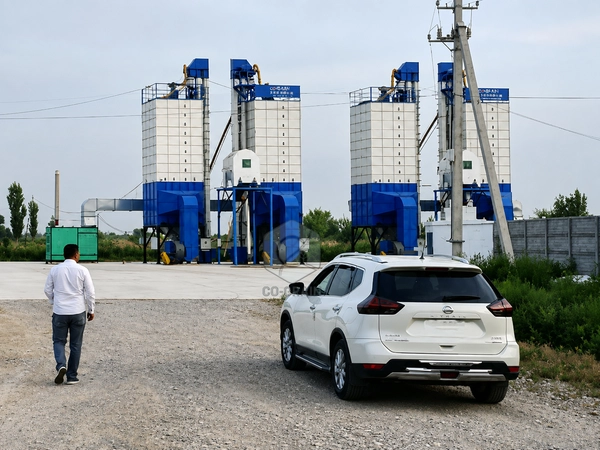
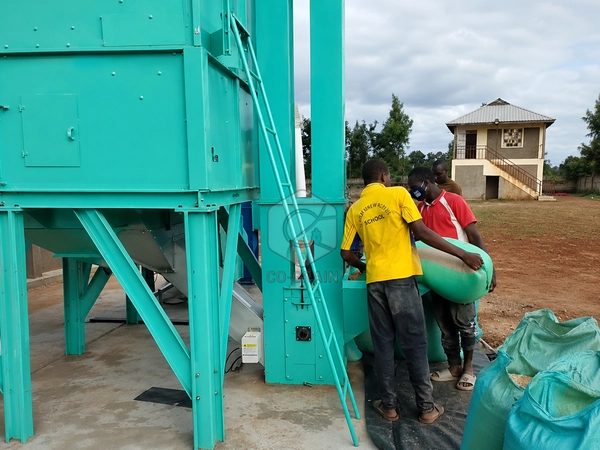
A silo filling and distribution system transfers grain from receiving, drying or processing equipment to one or multiple storage silos. The system coordinates vertical lifting, horizontal distribution, silo selection, level monitoring and route control.
Typical Silo Filling Route
For commercial grain storage plants, the goal is not simply to move grain to the silo roof. The system must deliver the correct grain to the correct silo at the required capacity without bottlenecks, unnecessary damage or routing errors.
What Is a Silo Filling and Distribution System?
It is the conveying network connecting grain receiving, pre-cleaning, drying or processing equipment with one or more storage silos.
The system combines vertical lift and horizontal distribution. The top route is selected according to capacity, distance, number of silos, discharge points, grain type and grain-damage requirements.
How the System Works
1. Grain Inlet
Grain arrives from receiving, a dryer, an existing storage system or a processing line.
2. Vertical Lift
A Bucket Elevator raises grain from ground level to above the silo roof.
3. Top Conveying
A Drag Chain, Belt, Enclosed Belt or Air Cushion Belt Conveyor carries grain across the silo group.
4. Route Selection
Gates, distributors, trippers or dedicated outlets select the required silo.
5. Safe Filling
Level sensors, interlocks and controlled chutes prevent overfilling and reduce dust or impact.
6. System Monitoring
PLC control coordinates conveyor motion, gate position, silo levels and alarm signals.
Why Use a Bucket Elevator?
Large steel silos can be tall, so grain must be lifted from ground level to above the silo roof. A Bucket Elevator is well suited because it provides:
- Large vertical lift
- Compact footprint
- Continuous grain handling
- High-capacity operation
- Direct connection with top conveyors
Without an elevator, a long inclined conveyor may be required to reach the same elevation and may occupy more space.
Choosing the Silo-Top Conveyor
Drag Chain Conveyor
Common for compact and medium silo rows with several fixed discharge points.
- Enclosed structure
- Multiple outlets
- Compact layout
- Good silo-roof integration
Belt Conveyor
Worth considering for longer, relatively straight routes where gentle handling is important.
- Longer horizontal distance
- Relatively gentle transfer
- Tripper or plough discharge
- High continuous throughput
Enclosed Belt Conveyor
Adds weather and dust protection to a belt route installed outdoors or in a silo gallery.
- Rain protection
- Dust containment
- Cleaner operating area
Air Cushion Belt Conveyor
For selected long, high-capacity silo galleries and large storage projects.
- Long route
- Large silo group
- High continuous capacity
- Relatively gentle handling
Screw Conveyor
Normally used for short local feeding or selected silo-bottom discharge, rather than long roof routes.
- Short distance
- Compact connection
- Controlled local feed
Which Conveyor Is Best for Multiple Silos?
| Project condition | Equipment to evaluate | Reason |
|---|---|---|
| Compact 2–6 silo group | Drag Chain Conveyor | Several fixed outlets can be arranged along an enclosed route. |
| Long silo row | Belt Conveyor | Suitable for longer, relatively straight and gentle transfer. |
| Long high-capacity gallery | Air Cushion Belt Conveyor | Worth comparing for large storage projects and continuous operation. |
| Major vertical lift | Bucket Elevator | Efficient lift to the roof level with a compact footprint. |
| Very short local feed | Screw Conveyor | Compact connection between a hopper, silo outlet and nearby equipment. |
A Belt Conveyor can distribute grain to several silos with suitable tripper, plough, movable discharge or project-specific chute arrangements. For many compact multi-silo systems, a Drag Chain Conveyor may provide a simpler route.
Can One Bucket Elevator Fill Multiple Silos?
Yes. One elevator can feed a top conveyor serving several silos:
The elevator provides vertical lift while the top conveyor performs distribution. The number of silos depends on elevator capacity, conveyor length, storage strategy, grain varieties, required filling rate, route control and future expansion.
One Elevator or Multiple Elevators?
One Elevator
Can reduce equipment count and simplify a common filling route.
- Lower initial equipment count
- Shared maintenance point
- Suitable for coordinated silo filling
- Requires adequate top-conveyor capacity
Multiple Elevators
Can provide independent routes for different grains, process zones or operating schedules.
- Separate grain routes
- Operational flexibility
- Potential redundancy
- Higher equipment and structural cost
Important Design Factors
Dust, Airflow and Grain Safety
Dust can be generated at both major transfer points:
- Use sealed chutes and enclosed conveyor sections where appropriate.
- Provide aspiration points and dust collection at transfer locations.
- Reduce unnecessary drop height to limit impact and dust.
- Design silo vents for displaced air during filling.
- Use level sensors and interlocks to prevent overfilling.
As grain enters the silo, it displaces air. The sequence Grain Inflow → Air Displacement → Venting should be considered together with dust control.
Monitoring and Automation
Elevator protection
Speed monitoring, belt misalignment, bearing temperature, motor overload and blockage detection.
Top conveyor protection
Chain or belt motion monitoring, motor overload, outlet status and route confirmation.
Silo monitoring
High-level sensor, continuous level measurement, gate position and filling status.
These signals can be integrated into a central PLC so the selected outlet opens only when the route is ready and the receiving silo has available capacity.
Common Silo Filling Problems
| Problem | Possible causes | Design response |
|---|---|---|
| Wrong silo filling | Incorrect route, gate error or control logic issue | Route confirmation, gate feedback and PLC interlocks |
| Conveyor blockage | Closed outlet, overfeeding or wet grain buildup | Flow monitoring, suitable capacity and blockage protection |
| Silo overfilling | Level sensor failure or delayed stop command | High-level protection and independent stop logic |
| Grain leakage | Poor chute sealing, worn gate or damaged casing | Sealed transfer points and inspection access |
| Grain damage | Large drop height, high speed or poor chute design | Gentle transfer and controlled speed |
| Dust leakage | Poor sealing, no aspiration or excessive free fall | Enclosures, dust collection and reduced drop height |
Common Design Mistakes
- Selecting the elevator before confirming the silo layout
- Undersizing the top conveyor and creating a filling bottleneck
- Providing no expansion space for additional silos
- Using too many transfer points
- Failing to confirm the selected silo route
- Providing no high-level protection
- Ignoring maintenance walkways and structural loads
- Using one conveyor type for every silo arrangement
How to Choose a Silo Filling Conveyor
Confirm the following project information before equipment selection:
- Grain type: paddy, corn, wheat or other grain
- Required capacity in T/H
- Number, diameter and height of silos
- Length of the silo row
- Number of discharge points
- Indoor or outdoor installation
- Grain-damage requirements
- Future expansion plan
Frequently Asked Questions
What is a Silo Filling and Distribution System?
It is a conveying system that lifts grain to silo-roof level and distributes it to one or multiple storage silos.
Can one Bucket Elevator fill multiple silos?
Yes. One elevator can feed a top conveyor that distributes grain to several silos.
Which conveyor is best for silo filling?
Drag Chain Conveyors are commonly suitable for compact multi-silo systems. Belt or Air Cushion Belt Conveyors are often worth considering for longer routes.
Can a Belt Conveyor fill several silos?
Yes, with suitable tripper, plough, movable discharge or project-specific chute arrangements.
How do I prevent filling the wrong silo?
Use route selection, gate-position feedback, silo-level monitoring and PLC interlocks.
How do I prevent silo overfilling?
High-level sensors and control interlocks should stop or redirect grain before the silo exceeds its permitted filling condition.
Can paddy use the same silo filling system?
Yes, but drop height, conveying speed and transfer impact should receive additional attention.
Should a conveyor be supported directly by the silo roof?
Only according to the approved structural design. Conveyor loads must be included in the silo or independent gallery design.
Key Takeaway
A complete silo filling system is more than a Bucket Elevator and a conveyor. It combines vertical lift, horizontal distribution, silo selection, level monitoring, dust control and safe transfer.
Compact + multiple outlets → Drag Chain Conveyor
Long + gentle route → Belt Conveyor
Long + high capacity → Air Cushion Belt Conveyor
Co-Grain designs the route around grain type, capacity, silo dimensions, conveyor distance, grain damage, structural support, automation and future expansion.
Discuss Your Project
Need a Complete Grain Drying & Storage Solution?
Co-Grain provides turnkey grain drying plants, grain storage silos, cleaning, conveying, and automation systems for modern grain handling facilities. Our equipment includes batch and continuous grain dryers, paddy dryers, grain cleaners, bucket elevators, chain conveyors, and belt conveyors.
From engineering design and equipment manufacturing to installation and commissioning, we deliver reliable, customized solutions for paddy rice, maize, wheat, barley, sorghum, and other grains.
Talk to Co-Grain
Planning a new project or upgrading an existing facility? Contact us for a customized solution and free quotation.
Henan Co-Grain Machinery Engineering Co., Ltd.
Email: info@ricemillplants.com
WhatsApp: 0086 18339828199