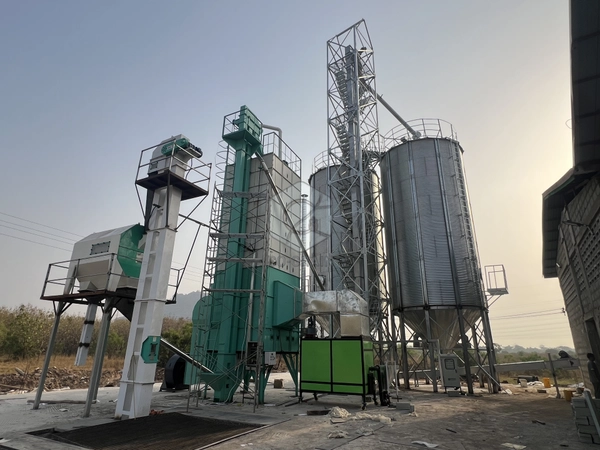
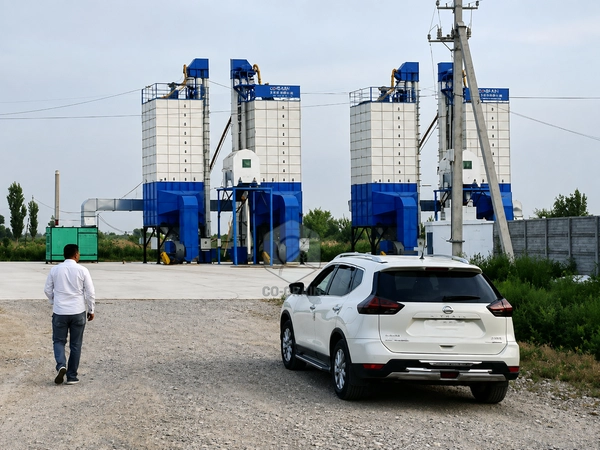
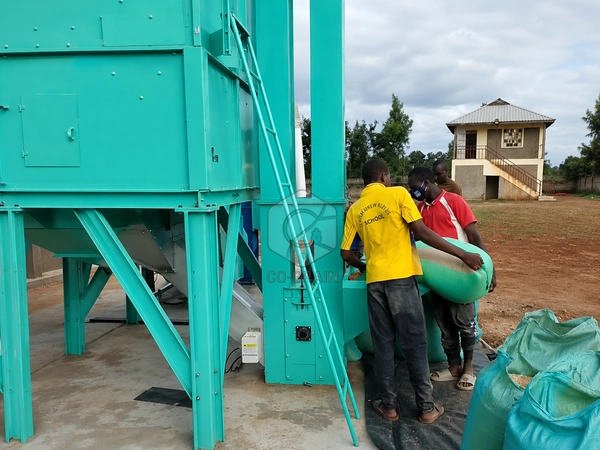
A grain dryer depends on a properly designed conveying system both before and after drying.
Before the dryer, wet grain must move from receiving and pre-cleaning through a buffer system and into the dryer at a controlled rate.
After drying, the grain must be removed reliably and transferred to storage or downstream processing.
A typical system is:
Truck Receiving → Pre-Cleaning → Wet Grain Buffer → Conveyor / Bucket Elevator → Grain Dryer → Discharge Conveyor → Bucket Elevator → Silo Filling → Storage
Depending on layout, the conveying system may use:
- Bucket Elevator
- Drag Chain Conveyor
- Belt Conveyor
- Screw Conveyor
- Inclined Chain Conveyor
- Air Cushion Belt Conveyor
The correct design should balance receiving capacity, dryer feed rate, dryer discharge rate and storage capacity.
Why Does a Grain Dryer Need a Conveying System?
A grain dryer cannot operate effectively as an isolated machine.
Wet grain must first reach the dryer.
After drying, the grain must leave the dryer and move to another destination.
Therefore, every dryer has two important material-flow interfaces:
- Before Drying
- Wet Grain Feeding
- After Drying
- Dry Grain Discharge
The overall route becomes:
- Wet Grain Source
- Dryer Feeding System
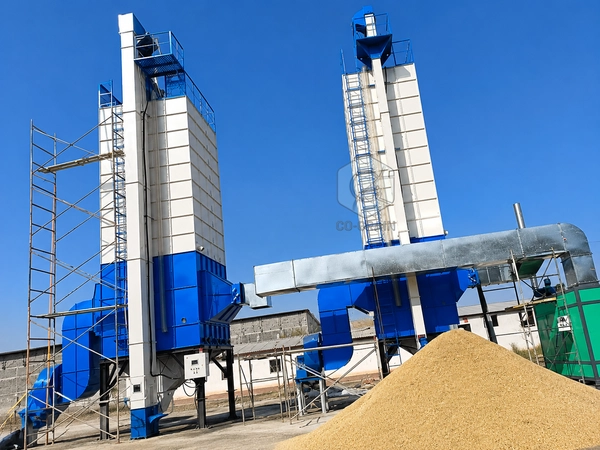
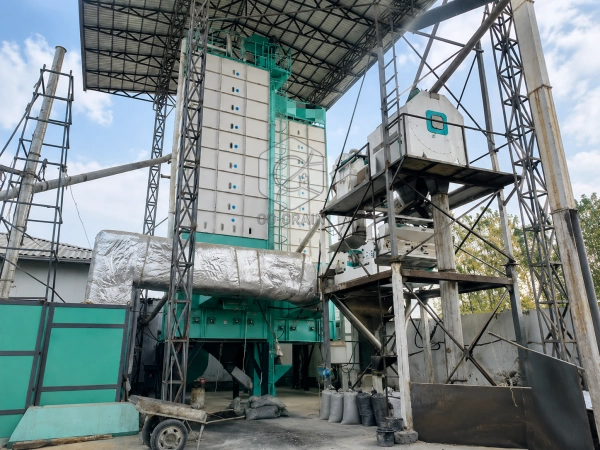
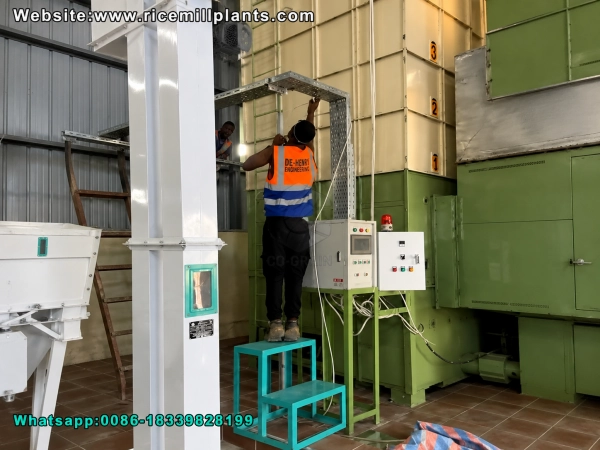
- Grain Dryer
- Dry Grain Discharge System
Storage / Processing
If either side is poorly designed, the dryer can become underfed, overloaded or forced to stop.
What Is a Grain Dryer Feeding System?
A grain dryer feeding system transfers wet grain from receiving, cleaning or buffer storage to the dryer inlet.
A typical process is:
- Truck Receiving
- Receiving Pit
- Pre-Cleaner
- Wet Grain Buffer Silo
- Controlled Conveyor
- Bucket Elevator
- Grain Dryer
The system should provide the dryer with a stable and controllable grain supply.
Why Should Wet Grain Pass Through a Buffer Before the Dryer?
Because:
- Truck Receiving Rate ≠ Dryer Feeding Rate
Trucks arrive irregularly.
The grain dryer normally requires a more controlled material flow.
A Wet Grain Buffer Silo separates these two operating conditions.
Without a buffer:
Truck → Dryer
must be closely synchronized.
With a buffer:
Truck → Receiving → Buffer
Buffer → Dryer
can operate more independently.
This is one of the most important principles in dryer feeding system design.
Typical Grain Flow Before Drying
A commercial drying plant may use:
- Truck
- Receiving Pit
- Drag Chain Conveyor
- Bucket Elevator
- Pre-Cleaner
- Wet Grain Buffer Silo
- Controlled Discharge
- Bucket Elevator
- Grain Dryer
This combines horizontal and vertical conveying equipment according to the plant layout.
Why Is Pre-Cleaning Important Before Dryer Feeding?
Fresh grain may contain:
- Straw
- Leaves
- Chaff
- Dust
- Large impurities
- Small foreign material
These impurities can create problems in:
- Buffer silos
- Conveyors
- Bucket elevators
- Grain dryers
Possible effects include:
- Blockage
- Uneven flow
- Poor air distribution
- Higher dust load
- Reduced dryer performance
For this reason, the preferred process is generally:
Receiving → Pre-Cleaning → Buffer → Dryer
rather than:
Receiving → Dryer Directly
for commercial systems.
What Conveyor Is Used from Receiving Pit to Cleaner?
A common arrangement is:
- Receiving Pit
- Drag Chain Conveyor
- Bucket Elevator
- Pre-Cleaner
The Drag Chain Conveyor moves grain horizontally out of the receiving pit.
The Bucket Elevator then provides vertical lift.
For longer yard routes, Belt Conveyor may also be considered.
What Conveyor Is Used from Cleaner to Wet Grain Buffer?
Depending on elevation and distance, the system may use:
- Bucket Elevator
- Drag Chain Conveyor
- Belt Conveyor
- Gravity chute where appropriate
A common layout is:
- Pre-Cleaner
- Bucket Elevator / Conveyor
Wet Grain Buffer Silo
The objective is to fill the buffer reliably without creating unnecessary transfer points.
What Conveyor Is Used from Wet Grain Buffer to Dryer?
This is one of the most important selection points.
Possible options include:
- Screw Conveyor
Suitable when:
- Distance is short
- Layout is compact
- Controlled feeding is required
- Drag Chain Conveyor
Suitable when:
- Route is longer
- Capacity is higher
- Several buffer bins share one route
- Enclosed conveying is preferred
- Belt Conveyor
Suitable when:
- Gentle wet grain handling is important
- Route is longer
- Bucket Elevator
Required when grain must be lifted to the dryer inlet.
A common combination is:
Wet Grain Buffer
- Screw / Drag Chain Conveyor
- Bucket Elevator
- Grain Dryer
Why Is Bucket Elevator Commonly Used to Feed Grain Dryers?
Many grain dryers are fed from the top.
The dryer inlet may be several meters or tens of meters above ground level.
A Bucket Elevator is therefore a practical way to lift wet grain vertically.
Typical system:
Wet Grain Buffer
- Horizontal Conveyor
- Bucket Elevator
- Dryer Top Inlet
This arrangement is compact and widely used.
Why Does Dryer Feed Rate Matter?
A dryer is designed around a specific grain flow.
If the dryer receives too little grain:
Capacity may drop
- Continuous operation may become unstable
- Energy utilization may decrease
If too much grain enters:
- Overloading can occur
- Residence time can change
- Grain flow may become unstable
- Blockage risk can increase
Therefore:
Stable Feed Rate → Stable Dryer Operation
The conveyor system should support controlled rather than uncontrolled loading.
Batch Dryer Feeding System
A Batch Grain Dryer operates in cycles.
Typical process:
- Load Batch
- Dry
- Cool / Condition
- Discharge
- Load Next Batch
The feeding system therefore needs to deliver the required batch quantity efficiently during the loading stage.
Typical equipment:
Wet Buffer → Conveyor → Bucket Elevator → Batch Dryer
Once the batch is full, feeding stops until the next cycle.
Continuous Dryer Feeding System
A Continuous Grain Dryer requires a more stable grain supply.
Typical process:
Wet Grain Buffer
- Controlled Continuous Feed
- Bucket Elevator
- Continuous Dryer
The Wet Grain Buffer becomes especially important because it helps maintain stable supply even when truck arrivals vary.
For a continuous dryer:
Stable feeding is one of the foundations of stable throughput.
- Batch vs Continuous Dryer Feeding
- Factor Batch Dryer Continuous Dryer
- Feeding method Intermittent Continuous
- Buffer silo Useful Particularly important
- Feed control Batch quantity Stable flow rate
Conveyor operation Start/stop cycles Longer continuous operation
Typical system Buffer → Elevator → Dryer Buffer → Controlled Conveyor → Elevator → Dryer
The conveying strategy should match the dryer type.
How Wet Grain Affects Conveyor Selection
Wet grain may behave differently from dried grain.
Possible characteristics include:
- Reduced flowability
- Greater adhesion
- More bridging
- Higher impurity content
- Increased resistance
Therefore, the conveyor before the dryer should be selected for wet-grain conditions.
A conveyor rated for dry wheat should not automatically be assumed to perform identically with high-moisture paddy or corn.
- Wet Paddy Conveying Before Drying
For paddy, the main priorities include:
- Stable flow
- Reduced grain damage
- Low drop height
- Limited unnecessary handling
- Reliable cleanout
Typical process:
- Paddy Receiving
- → Pre-Cleaning
- → Wet Paddy Buffer
- → Bucket Elevator
- → Paddy Dryer
Belt conveying may be considered for longer gentle routes.
Screw or Chain Conveyors can be used for short or enclosed routes.
Wet Corn Conveying Before Drying
Large corn drying plants often require higher harvest-season capacities.
Typical system:
- Truck Receiving
- → High-Capacity Drag Chain Conveyor
- → Bucket Elevator
- → Cleaner
- → Wet Corn Buffer
- → Continuous Dryer
For these plants, stable high-capacity conveying is critical.
What Happens After Grain Leaves the Dryer?
Once grain has reached the required drying condition, it must be removed from the dryer.
Typical process:
- Grain Dryer
- Discharge Device
- Horizontal Conveyor
- Bucket Elevator
- Storage / Processing
The discharge conveyor must be able to handle the dryer’s output without creating backup.
What Is a Grain Dryer Discharge Conveyor?
A dryer discharge conveyor collects dried grain leaving the dryer and transfers it toward:
- Bucket Elevator
- Storage silo
- Cooling equipment
- Processing plant
- Truck loading
Possible equipment includes:
- Drag Chain Conveyor
- Belt Conveyor
- Screw Conveyor
Selection depends mainly on:
Capacity + Distance + Grain Quality + Layout
- Screw Conveyor After the Dryer
A Screw Conveyor can be suitable when:
- Dryer discharge is close to the elevator
- Route is short
- Installation space is limited
- Controlled feeding is useful
Typical process:
- Dryer
- Screw Conveyor
- Bucket Elevator
For paddy, the screw route should remain appropriately short to limit unnecessary grain friction.
- Drag Chain Conveyor After the Dryer
A Drag Chain Conveyor is suitable when:
- Distance is longer
- Enclosed transfer is preferred
Capacity is commercial-scale
- Several dryer outlets feed one route
Typical process:
- Dryer
- Drag Chain Conveyor
- Bucket Elevator
This is one of the most common dryer-to-silo connections.
- Belt Conveyor After the Dryer
Belt Conveyor can be attractive when:
- Horizontal distance is longer
- Grain damage should be minimized
- Paddy or seed is being handled
- Outdoor transfer is required
Typical process:
- Dryer
- Belt Conveyor
- Bucket Elevator / Storage
For longer large-scale routes, Air Cushion Belt Conveyor can also be evaluated.
Why Should Dried Grain Be Handled Gently?
After drying, some grains can become more vulnerable to mechanical damage.
For paddy in particular, drying quality is connected to downstream milling performance.
Excessive impact during conveying can contribute to grain damage.
Therefore, after the dryer, attention should be given to:
- Conveyor speed
- Drop height
- Transfer-point geometry
- Number of transfers
- Belt vs chain vs screw selection
The dryer may preserve grain quality, but poor conveying afterward can still damage the grain.
How Does the Dryer Connect to Storage Silos?
A typical system is:
- Grain Dryer
- Discharge Conveyor
- Bucket Elevator
- Silo-Top Conveyor
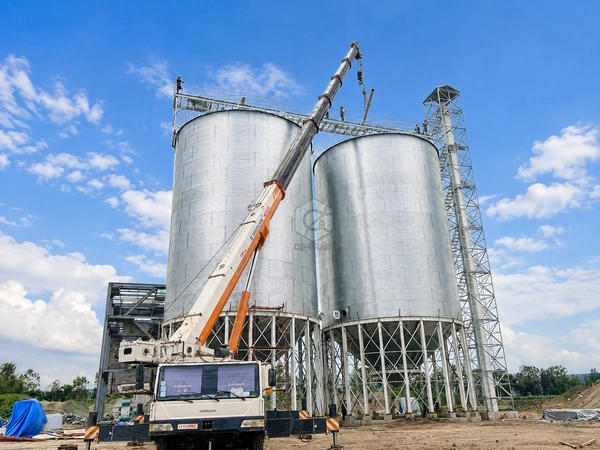
- Storage Silo
This route connects the drying section with the silo storage system.
The silo-top conveyor can use:
- Drag Chain Conveyor
- Belt Conveyor
- Air Cushion Belt Conveyor
depending on the project.
- Grain Dryer to One Storage Silo
For a simple project:
- Grain Dryer
- Conveyor
- Bucket Elevator
- One Grain Silo
The route can be relatively straightforward.
A distributor may not be required if only one destination exists.
- Grain Dryer to Multiple Silos
For several silos:
- Grain Dryer
- Bucket Elevator
- Silo-Top Conveyor
- → Silo 1
- → Silo 2
- → Silo 3
- → Silo 4
The filling system must select the correct silo.
This adds:
- Route selection
- Gates
- Level monitoring
- Automation
Why Use Storage After the Dryer?
Storage performs an important production-buffer function.
For example:
- Paddy Dryer
- Dry Paddy Silos
- Rice Mill
The dryer can operate according to its batch or continuous drying schedule.
The rice mill can operate according to its own processing schedule.
The storage system separates:
- Drying
from:
- Processing
This improves operational flexibility.
Wet Buffer Before Dryer vs Dry Storage After Dryer
These two storage stages solve different problems.
- Storage Stage Main Purpose
Wet Grain Buffer Balance receiving and drying
Dry Grain Storage Balance drying and downstream processing
The complete process is:
- Receiving
- Wet Buffer
- Dryer
- Dry Storage
- Processing
This structure is particularly useful in commercial rice mills and grain storage plants.
How to Match Dryer Conveyor Capacity
The conveying route should be matched with the dryer.
For example:
- Dryer Output: 20 T/H
but:
- Discharge Conveyor: 12 T/H
This creates a bottleneck.
The dryer may eventually need to stop because grain cannot leave quickly enough.
Therefore:
- Dryer Capacity ≤ Effective Discharge Route Capacity
under the approved operating basis.
The exact conveyor design margin should be confirmed by the supplier.
- Feeding Capacity vs Discharge Capacity
Before the dryer:
- Feed Route Capacity
must provide sufficient wet grain.
After the dryer:
- Discharge Route Capacity
must remove dried grain.
Both sides matter.
A correctly sized dryer with an undersized discharge conveyor is still an incorrectly designed plant.
- Example Capacity Relationship
Consider a continuous dryer:
- Dryer Throughput: 20 T/H
Possible system:
Wet Grain Buffer
- → Feed Conveyor: suitable for dryer requirement
- → Bucket Elevator
- → Dryer: 20 T/H
→ Discharge Conveyor: suitable for ≥ operating discharge requirement
- → Bucket Elevator
- → Silos
The complete route must be checked together.
Why Receiving Capacity May Be Higher Than Dryer Capacity
A grain plant may receive trucks much faster than the dryer can process them.
For example:
- Receiving: 50 T/H
- Dryer: 15 T/H
This can still be a good design if a Wet Grain Buffer is installed.
The process becomes:
- 50 T/H Peak Receiving
Wet Grain Buffer
15 T/H Controlled Drying
This is why dryer-feed conveying should not automatically be sized equal to truck-receiving capacity in every section.
Capacity Zones Around a Dryer
A drying plant can be divided into:
- Zone 1 — Receiving
High short-term throughput.
Zone 2 — Buffer Filling
Handles receiving peaks.
Zone 3 — Dryer Feeding
Controlled flow.
Zone 4 — Dryer
Stable process rate.
Zone 5 — Dryer Discharge
Matches dryer output.
Zone 6 — Silo Filling
Transfers dry grain to storage.
Different conveyors can therefore have different capacities.
- Grain Dryer Feeding for a 15 T/Batch Paddy Dryer
Consider a Batch Dryer:
- 15 T/Batch
The feed system does not necessarily need to operate continuously.
Instead, it must fill the dryer within an appropriate loading period.
Typical route:
- Wet Paddy Buffer
- Screw / Drag Conveyor
- Bucket Elevator
- 15 T/Batch Paddy Dryer
After filling, the feeding system stops or changes route.
This is different from a continuous dryer.
Example: 15 T/Batch Dryer + 2 × 100 T Silos
A practical rice project can use:
- 15 T/Batch Paddy Dryer
- Discharge Conveyor
- Bucket Elevator
- Silo-Top Conveyor
- → 100 T Silo 1
- → 100 T Silo 2
The two silos allow dried paddy to be stored before the 60 T/D rice mill consumes it.
This creates:
Drying → Storage → Milling
instead of:
Drying → Immediate Milling
Conveyor System for a Continuous Corn Dryer
A larger commercial corn drying plant may use:
- Truck Receiving
- → Drag Chain Conveyor
- → Bucket Elevator
- → Pre-Cleaner
- → Wet Corn Buffer Silos
- → Controlled Chain Conveyor
- → Bucket Elevator
- → Continuous Grain Dryer
then:
- Dryer
- → Drag Chain / Belt Conveyor
- → Bucket Elevator
- → Large Storage Silos
This is a complete continuous grain-flow system.
- How to Reduce Grain Damage Around the Dryer
Consider:
- Before Dryer
Wet grain may be more resilient in some respects, but excessive mechanical handling should still be avoided.
After Dryer
Dried grain may be more sensitive to impact.
Good design includes:
- Minimize free-fall height
- Reduce unnecessary transfer points
- Use appropriate conveyor speed
- Design smooth chutes
- Use Belt Conveyor where gentle handling provides value
Avoid excessively long Screw Conveyor routes for sensitive grain
For paddy, this can support downstream milling quality.
Transfer Point Design
The transition between:
Conveyor → Bucket Elevator
Dryer → Conveyor
can be as important as the conveyor itself.
A poor transfer point may cause:
- Grain leakage
- Blockage
- Dust
- Uneven loading
- Grain damage
The chute should be designed for:
- Grain flow direction
- Required capacity
- Drop height
- Access
- Wear
Dust Control Before the Dryer
Wet grain receiving can generate dust from:
- Dry impurities
- Straw
- Soil
- Chaff
Dust-control points may include:
- Receiving pit
- Pre-cleaner
- Conveyor transfer
- Bucket Elevator head
Pre-cleaning and aspiration can help reduce dust before grain enters the dryer.
Dust Control After the Dryer
Dried grain may generate significant dust during transfer.
Typical dust points include:
- Dryer Discharge
- Bucket Elevator
- Silo-Top Conveyor
Silo Filling Point
Possible control measures include:
- Enclosed conveyors
- Sealed chutes
- Aspiration
- Dust collectors
- Controlled drop height
Dust management should be designed as part of the route.
- Conveyor Automation Around the Dryer
Automation can coordinate:
Wet Grain Buffer level
- Feed conveyor
- Bucket Elevator
- Grain Dryer
- Discharge conveyor
- Silo filling route
- Silo level
A simple continuous system may operate according to:
- Dryer Ready
- Feed Elevator Running
- Feed Conveyor Starts
- Dryer Operates
- Discharge Conveyor Runs
- Storage Route Available
This helps prevent feeding into stopped equipment.
Start-Up Sequence
A simplified principle is:
- Start Downstream First
For example:
- Silo Route Ready
- Silo-Top Conveyor Starts
Dry Grain Bucket Elevator Starts
- Dryer Discharge Conveyor Starts
- Dryer Starts / Releases Grain
Wet Grain Feed System Starts
This allows downstream equipment to receive grain before upstream flow begins.
Exact logic depends on dryer design.
Shutdown Sequence
Generally:
- Stop Wet Grain Feed
Allow Dryer and Conveyors to Clear according to operating procedure
- Stop Upstream Equipment
- Stop Downstream Equipment after clearing
The precise sequence must follow manufacturer instructions and plant-control logic.
What Happens If a Conveyor Stops?
If a downstream conveyor stops unexpectedly while grain continues flowing, material can accumulate.
For example:
- Dryer Continues Discharging
- Discharge Conveyor Stops
- Grain Accumulates
- Blockage / Overflow
Therefore, conveyor status should be interlocked with dryer operation.
The dryer may need to:
- Stop feed
- Stop discharge
- Enter safe condition
depending on the system design.
- Useful Monitoring Devices
Possible monitoring around the dryer includes:
- Bucket Elevator
- Speed
- Belt misalignment
- Bearing temperature
- Drag Chain Conveyor
- Chain motion
- Speed
- Blockage
- Belt Conveyor
- Belt misalignment
- Speed
- Emergency pull cord
- Screw Conveyor
- Rotation
- Motor overload
- Bearing condition
- Silo
- High-level
- Continuous level
These signals support coordinated plant control.
How to Choose the Right Conveyor Before the Dryer
Use this basic logic.
- Very Short Buffer-to-Elevator Route
- → Screw Conveyor
- Enclosed Medium Route / Multiple Buffer Bins
- → Drag Chain Conveyor
- Long / Gentle Transfer
- → Belt Conveyor
- Major Vertical Lift
- → Bucket Elevator
- Horizontal + Moderate Elevation Change
- → Inclined Chain Conveyor
- How to Choose the Right Conveyor After the Dryer
- Short Dryer-to-Elevator Route
- → Screw or Drag Chain Conveyor
- Medium Enclosed Route
- → Drag Chain Conveyor
- Longer Gentle Route
- → Belt Conveyor
- Large Long-Distance Silo Route
- → Air Cushion Belt Conveyor
- Vertical Lift to Silo Roof
- → Bucket Elevator
The final decision depends on actual project geometry.
Batch Dryer vs Continuous Dryer Conveyor Design
- Design Factor Batch Dryer Continuous Dryer
- Wet grain feed Intermittent Continuous
- Buffer value High Very high
- Feed conveyor duty Cyclic Continuous
- Discharge Batch Continuous
- Storage buffer Recommended Recommended
- Automation Batch sequencing Continuous interlocking
This difference should be recognized early in project design.
Common Dryer Conveying System Mistakes
Mistake 1: Selecting the Dryer Before Planning the Conveying Route
The dryer position affects every elevator and conveyor around it.
Mistake 2: No Wet Grain Buffer
Receiving and dryer feeding become directly dependent on each other.
Mistake 3: Undersized Feed Elevator
The dryer cannot be loaded at the required rate.
Mistake 4: Undersized Discharge Conveyor
Dried grain backs up at the dryer.
Mistake 5: Using Screw Conveyor for an Excessively Long Route
This may increase energy, wear and grain damage.
Mistake 6: Too Many Transfer Points
More transfer means more dust and potential grain damage.
Mistake 7: Ignoring Wet Grain Flowability
Wet corn or paddy can behave differently from dry grain.
Mistake 8: Poor Chute Design
Even properly sized conveyors can block at transitions.
Mistake 9: No Equipment Interlocks
One stopped conveyor can cause a chain reaction of blockage.
Mistake 10: No Storage Route Confirmed Before Discharge
The dryer should not discharge grain into an unavailable silo route.
Frequently Asked Questions
What conveyor is used to feed a grain dryer?
Depending on layout, Screw Conveyor, Drag Chain Conveyor or Belt Conveyor may transfer grain horizontally, while Bucket Elevator is commonly used to lift grain to the dryer inlet.
Does a grain dryer need a Bucket Elevator?
Many commercial dryers do because grain enters from an elevated inlet. The exact configuration depends on dryer and plant layout.
Why does a dryer need a Wet Grain Buffer Silo?
The buffer separates irregular receiving from controlled dryer feeding and helps maintain stable grain supply.
Which conveyor is best after a grain dryer?
Drag Chain Conveyor is suitable for enclosed commercial transfer, Belt Conveyor for longer and gentler routes, and Screw Conveyor for selected short routes.
Can dried paddy use a Screw Conveyor?
Yes for suitable short transfer, but excessively long screw routes may increase mechanical grain handling and should be evaluated carefully.
How does grain move from a dryer to storage silos?
A typical system is Dryer → Horizontal Conveyor → Bucket Elevator → Silo-Top Conveyor → Storage Silo.
Should dryer-feed conveyor capacity equal dryer capacity?
The feed system should be capable of supporting the required dryer loading or continuous feed rate. Exact capacity should be based on dryer operation and loading strategy.
What happens if the discharge conveyor is smaller than the dryer capacity?
It can create a bottleneck and may eventually force the dryer to reduce throughput or stop.
Can one dryer feed multiple silos?
Yes. A Bucket Elevator and silo-top distribution conveyor can route dried grain to several silos.
Can the conveying system be automated with the dryer?
Yes. Conveyor status, dryer operation, silo levels and route selection can be integrated into a PLC control system.
Key Takeaway
A Grain Dryer needs two correctly designed conveying systems:
- Before the Dryer
Receiving → Cleaning → Wet Buffer → Controlled Feeding
- After the Dryer
Dryer Discharge → Conveyor → Elevator → Storage
The full relationship is:
- Truck Receiving
- Pre-Cleaning
Wet Grain Buffer
- Bucket Elevator
- GRAIN DRYER
- Discharge Conveyor
- Bucket Elevator
Silo Filling & Distribution
Storage Silos
The key is not simply selecting individual conveyors.
It is ensuring that:
- Receiving Capacity
- Dryer Feed Capacity
- Dryer Capacity
- Discharge Capacity
- Storage Route Capacity
work together as one coordinated system.
How Co-Grain Approaches Grain Dryer Conveying Systems
Co-Grain considers the conveying equipment around the dryer as part of the complete Grain Drying & Storage System.
Depending on the project, the scope can integrate:
- Grain Receiving
- → Pre-Cleaning
- → Wet Grain Buffer Silo
- → Dryer Feeding Conveyor
- → Bucket Elevator
- → Grain Dryer
- → Dryer Discharge Conveyor
- → Bucket Elevator
- → Silo Filling & Distribution
- → Grain Storage
The equipment may include:
- Bucket Elevators
- Drag Chain Conveyors
- Screw Conveyors
- Belt Conveyors
- Enclosed Belt Conveyors
- Air Cushion Belt Conveyors
- Inclined Chain Conveyors
- Gates and chutes
- Level sensors
- Conveyor safety monitoring
- PLC control
The objective is to maintain reliable grain flow before, through and after the dryer.