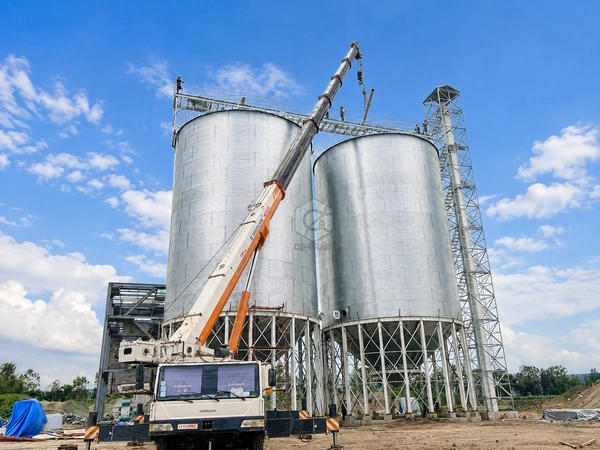
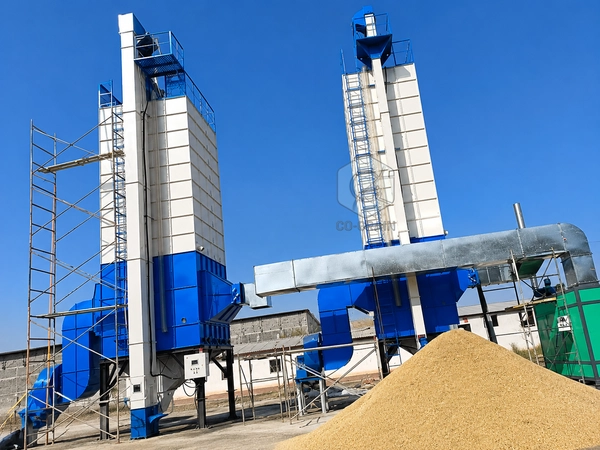
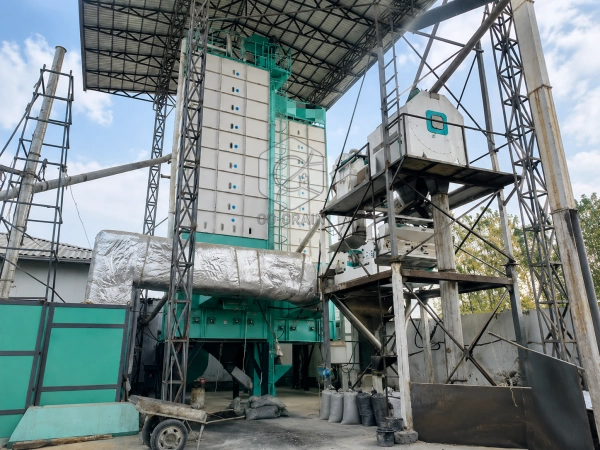
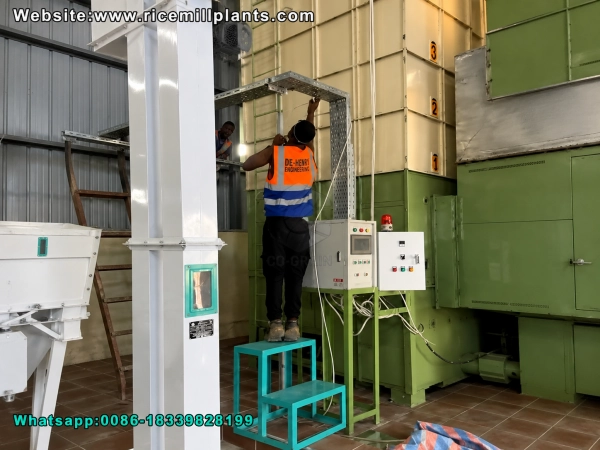
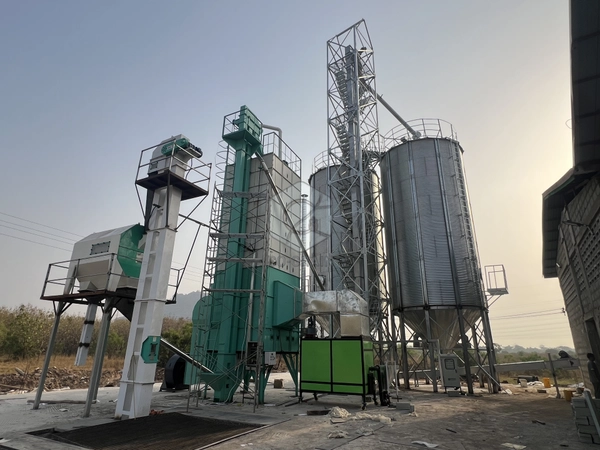
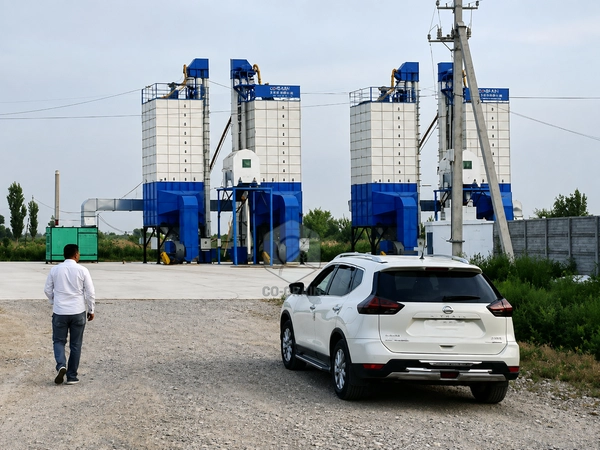
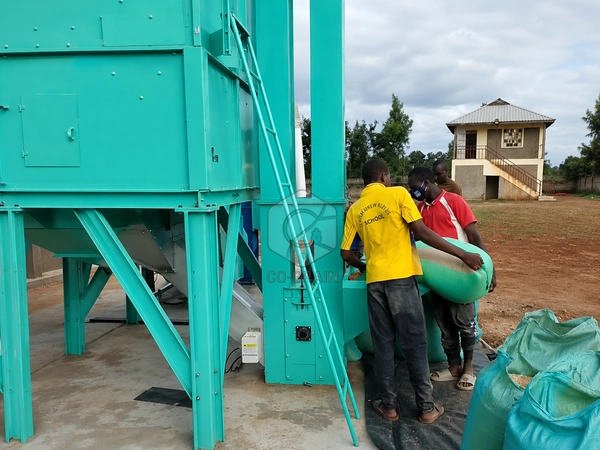
A wet grain buffer silo provides temporary storage between grain receiving and drying. Its main purpose is to separate irregular truck arrivals from the more stable operating rate of the grain dryer.
A typical process is:
Truck Receiving → Pre-Cleaning → Wet Grain Buffer Silo → Grain Dryer
The buffer helps prevent the dryer from depending directly on truck unloading, reduces receiving interruptions, supports controlled dryer feeding and improves overall plant continuity.
The required buffer capacity depends on peak receiving rate, dryer throughput, grain moisture, truck arrival pattern and acceptable wet-grain holding time.
What Is a Wet Grain Buffer Silo?
A wet grain buffer silo is a temporary grain holding bin positioned before the grain dryer.
It is designed to receive wet, pre-cleaned grain and hold it for a limited period before controlled feeding into the drying system.
Typical materials may include:
- Paddy
- Corn / maize
- Wheat
- Barley
- Sorghum
- Other technically confirmed grains
The buffer silo is not intended to replace proper drying or long-term dry-grain storage.
Its role is primarily:
Receive temporarily, hold briefly, and feed the dryer steadily.
Where Is the Wet Grain Buffer Silo Installed?
The typical position is:
- Truck Receiving
- Receiving Conveyor
- Pre-Cleaner
- Bucket Elevator
- Wet Grain Buffer Silo
- Controlled Discharge
- Grain Dryer
In some projects, the system may use more than one buffer silo or more than one dryer.
For example:
Receiving → Cleaner → 2 Wet Grain Buffer Silos → 2 Grain Dryers
The final layout depends on plant capacity and operating strategy.
Why Is a Buffer Silo Needed Before the Dryer?
Because grain receiving capacity and grain drying capacity are usually not the same.
Truck arrivals are irregular.
The dryer operates at a more controlled rate.
A buffer silo separates these two conditions.
Without a buffer:
Truck Arrival → Dryer Availability
must be closely synchronized.
With a buffer:
Truck Arrival → Buffer Storage
Buffer Storage → Dryer
can operate more independently.
That is the main engineering reason for using a wet grain buffer silo.
Receiving Rate and Dryer Rate Are Different
Consider a commercial grain drying plant during harvest season.
Several trucks may arrive within one hour.
The unloading system may be designed to receive grain quickly so that trucks do not wait for long periods.
But the grain dryer may require several hours to process the same quantity.
Therefore, it is common to have:
- Peak Receiving Capacity > Dryer Processing Capacity
This is not necessarily a design problem.
The buffer silo absorbs the difference.
Example of Capacity Imbalance
Suppose trucks deliver grain at a high short-term rate.
The receiving system can unload:
- 40 T/H
while the dryer can process approximately:
- 10 T/H
during stable operation.
Without buffering, the receiving system would soon need to stop.
With a wet grain buffer silo, the plant can:
Receive Faster → Store Temporarily → Dry More Slowly and Continuously
The buffer does not increase dryer capacity.
It helps the plant manage different capacities in different process sections.
How Does a Wet Grain Buffer Improve Dryer Operation?
1. More Stable Feeding
A grain dryer performs best when grain enters at a controlled rate.
The buffer silo provides a reserve of wet grain that can be discharged according to the dryer’s demand.
2. Fewer Receiving Interruptions
Truck unloading does not need to stop every time the dryer is temporarily full or unavailable.
3. Better Harvest-Season Management
Peak truck arrivals can be absorbed more effectively.
4. Reduced Dryer Starvation
If the dryer must wait for the next truck, throughput and operating continuity can decrease.
A buffer keeps grain available.
- 5. Better Process Coordination
The control system can coordinate:
Buffer Level → Dryer Readiness → Discharge Gate / Feeder → Dryer Feeding
This creates a more stable production process.
Why Is Pre-Cleaning Placed Before the Buffer Silo?
Wet grain arriving from the field may contain:
- Straw
- Leaves
- Chaff
- Stalks
- Dust
- Clods
- Other large impurities
If this material enters the buffer silo directly, it may create problems such as:
- Poor flowability
- Bridging
- Blockage
- Uneven discharge
- Dust accumulation
- More difficult cleanout
Therefore, the usual process is:
Receiving → Pre-Cleaning → Wet Grain Buffer
rather than:
Receiving → Wet Grain Buffer → Cleaning
Pre-cleaning also reduces unnecessary material entering the dryer.
Why Is Wet Grain More Difficult to Handle?
Wet grain generally behaves differently from dry grain.
Depending on moisture and impurities, it may have:
- Reduced flowability
- Higher tendency to bridge
- More surface adhesion
- More chaff and dust
- Greater risk of stagnant zones
- Higher biological activity during holding
This means a wet grain buffer silo should not simply be treated as a normal long-term storage silo.
Its shape, outlet and discharge system should support reliable turnover.
Why Is a Hopper-Bottom Silo Often Suitable?
A hopper-bottom silo can be useful for wet grain buffering because its sloped bottom supports gravity discharge.
Typical structure:
- Cylindrical Silo Body
- Conical Hopper
- Central Outlet
- Gate / Feeder / Conveyor
Potential advantages include:
- More complete gravity discharge
- Reduced residual grain
- Faster turnover
- Easier connection to dryer feed equipment
- Less dependence on manual cleanout
For this reason, hopper-bottom structures are often worth evaluating for wet grain buffer applications.
However, the actual silo design must still consider capacity, grain condition, structural loads and required discharge rate.
Can a Flat-Bottom Silo Be Used for Wet Grain Buffering?
Possibly, but it is not automatically the preferred solution.
A flat-bottom silo is generally more suitable for larger-capacity and longer-term storage applications.
For short-term wet grain buffering, the design should prioritize:
Fast Filling + Controlled Holding + Reliable Discharge + Frequent Turnover
A hopper-bottom structure often aligns better with these requirements.
The final decision should be based on the actual project.
How Long Can Wet Grain Stay in a Buffer Silo?
There is no universal safe holding time.
The acceptable holding period depends on:
- Grain type
- Grain moisture
- Grain temperature
- Ambient temperature
- Ambient humidity
- Impurity level
- Aeration availability
- Initial grain condition
The wetter and warmer the grain, the more carefully holding time should be managed.
A wet grain buffer silo should therefore be considered temporary process storage, not long-term storage.
Is Aeration Needed in a Wet Grain Buffer Silo?
It may be considered depending on the grain condition and required holding time.
However, aeration should not be treated as a substitute for drying.
If the grain contains excessive moisture, the primary objective should still be to move it into the dryer within the confirmed operating window.
Aeration may assist short-term condition management, but it does not convert a wet grain buffer into a long-term storage silo.
How Is Grain Discharged from the Buffer Silo?
Typical discharge equipment can include:
- Slide gate
- Screw feeder
- Chain conveyor
- Belt conveyor
- Other confirmed controlled-discharge equipment
The objective is to feed the dryer at the required rate.
Typical relationship:
- Buffer Silo
- Controlled Gate / Feeder
- Conveyor
- Bucket Elevator
- Grain Dryer
The discharge rate should be coordinated with dryer capacity.
Why Is Controlled Dryer Feeding Important?
If grain enters the dryer too quickly, the system may experience:
- Overloading
- Unstable residence time
- Uneven drying
- Higher motor load
- Blockage risk
If grain enters too slowly, the dryer may operate below its intended capacity.
Stable feeding therefore supports:
Stable Grain Flow → Stable Drying Time → More Consistent Drying
This is one of the main functions of the wet grain buffer system.
How to Select Wet Grain Buffer Capacity
Buffer capacity should not be chosen only by a standard catalog size.
The following factors should be evaluated.
Peak Receiving Rate
How quickly can grain arrive at the plant?
Dryer Throughput
How quickly can the dryer process wet grain?
Truck Arrival Pattern
Are deliveries distributed throughout the day or concentrated in short periods?
Number of Dryers
One buffer may supply one or several dryers depending on layout.
Grain Moisture
Higher-moisture grain may require more careful holding-time control.
Daily Operating Hours
Does receiving continue while the dryer is stopped?
Maximum Holding Time
How long can wet grain safely remain in the buffer under actual project conditions?
A Simple Buffer Sizing Concept
For initial planning, the buffer must absorb the difference between:
- Incoming Grain
- Grain Sent to Dryer
over a defined period.
Conceptually:
Buffer Requirement ≈ Receiving Peak – Dryer Consumption During the Same Period
This is only a planning concept.
Final capacity should include:
- Operating reserve
- Minimum and maximum level
- Silo geometry
- Grain bulk density
- Real truck schedules
- Control strategy
- Required emergency margin
Example: Truck Receiving Faster Than Drying
Consider:
- Receiving Rate: High during harvest peaks
- Dryer Rate: Stable and lower
- Receiving Window: Several hours of concentrated deliveries
The system can use:
- Receiving Pit
- → Pre-Cleaner
- → Wet Grain Buffer Silo
- → Grain Dryer
During peak intake:
- Buffer Level Rises
During steady dryer operation:
- Buffer Level Falls
The buffer therefore functions as a process equalizer.
Can One Buffer Silo Feed Several Grain Dryers?
Yes, it may be possible.
A typical arrangement can be:
Wet Grain Buffer Silo
- Distributor / Conveying System
- → Dryer 1
- → Dryer 2
However, the design must confirm:
- Total dryer capacity
- Discharge capacity
- Number of outlets
- Route selection
- Grain segregation
- Level control
- Conveyor capacity
- Automation logic
In larger plants, several buffer bins may provide more operating flexibility than one very large bin.
One Large Buffer Silo or Several Smaller Silos?
Both arrangements can be valid.
- One Larger Silo
Potential advantages:
- Simpler layout
- Fewer vessels
- Centralized feeding
Potential limitations:
- Less batch separation
- Greater dependence on one bin
- Multiple Smaller Silos
Potential advantages:
- Separate grain batches
- Different varieties
- Better routing flexibility
- Ability to isolate one silo
- Easier multi-dryer scheduling
The best arrangement depends on how the plant receives and processes grain.
Wet Grain Buffer for Paddy Drying
For a commercial rice mill, a typical process is:
- Paddy Receiving
- → Paddy Pre-Cleaning
- → Wet Paddy Buffer Silo
- → Paddy Dryer
- → Paddy Storage
- → Rice Mill
The wet paddy buffer helps manage irregular farm deliveries before drying.
This is particularly valuable during harvest season when multiple paddy trucks arrive within a short period.
For paddy, excessive holding of wet grain should be avoided.
Wet Grain Buffer for Corn Drying
A large corn drying plant may use:
Truck Receiving → Pre-Cleaning → Multiple Wet Corn Buffer Silos → Continuous Grain Dryer
Corn projects can involve large seasonal volumes, making buffer capacity an important part of receiving design.
In this case, the system is often designed so that:
- Receiving System Handles Peaks
while:
Continuous Dryer Handles Stable Flow
Wet Grain Buffer for Wheat
For wheat, the need for buffering depends on harvest moisture, receiving pattern and dryer demand.
A commercial grain depot may use buffer silos when:
- Trucks arrive in peaks
- Cleaning operates faster than drying
- Several grades must remain separate
- Dryer operation is continuous
How Does the Buffer Silo Connect to the Dryer?
A common configuration is:
- Pre-Cleaner
- Bucket Elevator
Wet Grain Buffer Silo
- Slide Gate / Feeder
- Conveyor
- Bucket Elevator
- Grain Dryer
In more compact layouts, some equipment may be combined or omitted according to elevation and plant geometry.
The important point is that grain flow must remain controlled.
What Sensors Are Useful on a Wet Grain Buffer Silo?
A buffer silo can be equipped with project-specific monitoring such as:
- High-level sensor
- Low-level sensor
- Continuous-level measurement
- Temperature monitoring where appropriate
- Gate position feedback
- Conveyor status
- Dryer readiness signal
These signals can support automatic coordination between receiving and drying.
For example:
High-Level Alarm → Reduce / Stop Receiving
Low-Level Signal → Warn Dryer Supply Is Running Low
- Automation Logic
A basic automated sequence can consider:
Is the dryer ready?
Is downstream conveying available?
Is the buffer silo above low level?
Is the discharge gate in the correct position?
Is the feed conveyor running?
Can grain be released safely?
This creates:
- Buffer Level + Dryer Status + Conveyor Status
- → Controlled Dryer Feeding
Automation should support the physical design, not compensate for poor equipment sizing.
Example: 60 T/D Rice Mill with Paddy Dryer
Consider the Ghana project:
- Rice Mill: 60 T/D
- Paddy Dryer: 15 T/Batch
- Storage: 2 × 100 T Silos
For a project like this, the complete upstream process can be planned as:
- Paddy Receiving
- → Pre-Cleaning
- → Wet Paddy Buffer
- → 15 T/Batch Paddy Dryer
- → Dry Paddy Storage
- → 60 T/D Rice Mill
The wet buffer helps separate truck receiving from batch dryer cycles.
The dry storage then separates dryer output from rice mill consumption.
The complete plant therefore uses two different buffer concepts:
- Wet Buffer Before Dryer
- Dry Storage After Dryer
Each solves a different process problem.
Wet Grain Buffer vs Dry Grain Storage Silo
These two systems should not be confused.
- Item Wet Grain Buffer Silo Dry Grain Storage Silo
- Position Before dryer After dryer
- Grain condition Wet / freshly received Dried
Main purpose Process buffering Storage
Holding time Short Longer, project-specific
Typical structure Hopper bottom often useful Flat bottom / hopper bottom
- Turnover Frequent Depends on storage strategy
Main concern Flow + short holding Safe storage condition
This distinction is important when planning the silo system.
Wet Grain Buffer vs Tempering Silo
These two also have different functions.
Wet Grain Buffer Silo
Purpose:
- Balance receiving and dryer feeding
Position:
- Before drying
- Tempering Silo
Purpose:
- Allow moisture redistribution between drying stages
Position:
- During or between drying stages
So:
- Buffering ≠ Tempering
Even though both involve temporary grain holding.
Common Wet Grain Buffer Design Mistakes
Mistake 1: No Pre-Cleaning
Straw and impurities can create poor flow inside the silo.
Mistake 2: Using Long-Term Storage Logic
Wet grain should not simply remain in the buffer because capacity is available.
Mistake 3: Undersized Outlet
A large silo with a small discharge system can still starve the dryer.
Mistake 4: Ignoring Bridging
Wet grain can have poorer flowability than dry grain.
Mistake 5: Ignoring Peak Receiving
Buffer capacity based only on average daily tonnage may be insufficient.
Mistake 6: Ignoring Maximum Holding Time
Wet grain cannot always be held safely for long periods.
Mistake 7: No Level Monitoring
The plant loses important control information.
Mistake 8: Poor Connection to Dryer
The silo and dryer must be designed as one material-flow route.
Does Every Grain Dryer Need a Buffer Silo?
No.
A buffer silo may not be necessary when:
- Grain arrives slowly and steadily
- Receiving capacity is close to dryer capacity
- The dryer is fed directly from an existing storage system
- Plant scale is small
- Operating schedule is simple
However, it becomes increasingly useful when:
- Truck arrivals are irregular
- Receiving rate is high
- Dryer operation is continuous
- Several dryers are used
- Harvest peaks are significant
- The plant needs better automation
The decision should be based on operating conditions rather than simply whether other plants use one.
Frequently Asked Questions
What is a wet grain buffer silo?
It is a temporary silo or bin installed before a grain dryer to hold wet, pre-cleaned grain and provide controlled feeding to the dryer.
Why not feed grain directly from the truck to the dryer?
Direct feeding can work in small or simple projects, but irregular truck arrivals may cause the dryer to stop or the receiving system to wait. A buffer separates these two processes.
How big should a wet grain buffer silo be?
Capacity depends on peak receiving rate, dryer throughput, truck arrival pattern, grain moisture and acceptable wet-grain holding time.
Is a hopper-bottom silo better for wet grain?
It is often worth considering because the sloped hopper supports gravity discharge and frequent turnover. Final suitability depends on the grain and project design.
Can wet grain be stored overnight?
This depends on grain type, moisture, temperature and operating conditions. No universal holding time should be assumed.
Does a buffer silo dry the grain?
No. It only holds and feeds grain. Aeration may assist short-term grain management but does not replace the dryer.
Can one buffer silo supply two dryers?
Yes, if outlet capacity, conveying routes, control logic and total dryer demand are properly designed.
Should grain be cleaned before entering the buffer?
Pre-cleaning is generally recommended to remove large impurities and improve flow through the buffer and dryer.
What sensors should be installed?
High-level and low-level sensors are commonly useful. Continuous level, temperature and automation signals may also be considered according to the project.
What is the difference between a wet buffer silo and a storage silo?
A wet buffer is for short-term process balancing before drying. A dry storage silo is intended to hold grain after drying under controlled storage conditions.
Key Takeaway
A Wet Grain Buffer Silo does not make the dryer dry faster.
Its value is that it makes the whole drying plant operate more smoothly.
Without buffering:
Truck Arrival → Dryer
must work almost as one process.
With buffering:
Truck Receiving → Buffer
Buffer → Dryer
can operate at different rates.
This creates:
Faster Receiving + Stable Dryer Feeding + Better Process Continuity
For commercial drying projects, that can be more valuable than simply increasing the nominal dryer size.
How Co-Grain Approaches Wet Grain Buffer Design
Co-Grain considers the buffer silo as part of the complete grain drying process.
Depending on project requirements, the system may include:
- Truck Receiving
- → Pre-Cleaning
- → Bucket Elevator
- → Wet Grain Buffer Silo
- → Controlled Discharge
- → Grain Dryer
The design is coordinated around:
- Grain type
- Moisture
- Peak receiving capacity
- Dryer throughput
- Buffer holding time
- Silo geometry
- Discharge system
- Conveying route
- Number of dryers
- Automation requirements
The objective is to create a stable transition between Receiving and Drying.