Paddy dryer capacity should not be selected from rice mill capacity alone.
A 60 T/D rice mill does not automatically require a 60 T/D paddy dryer, because the dryer handles wet paddy in batches or continuous flow, while the rice mill processes prepared paddy according to its own production schedule.
The correct dryer size depends on:
Wet Paddy Intake + Initial Moisture + Target Moisture + Drying Cycle + Operating Hours + Wet Grain Buffer + Dry Paddy Storage + Rice Mill Capacity
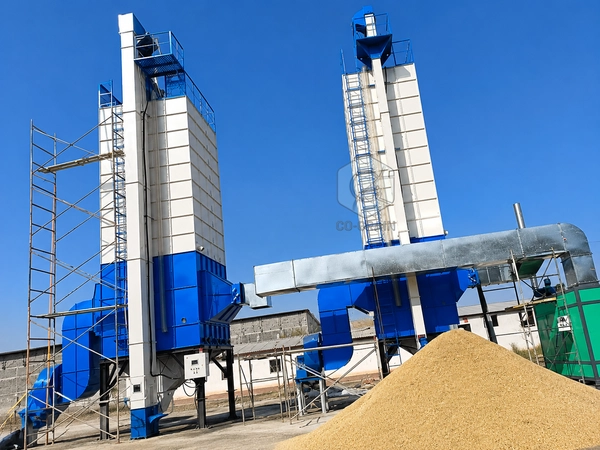
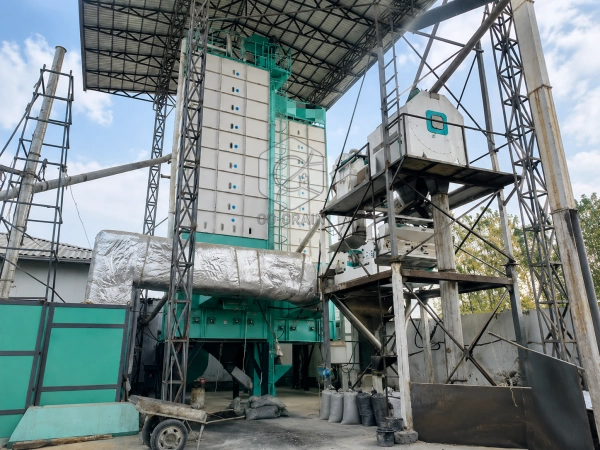
For some 60 T/D rice mill projects, for example, a 15 T/batch paddy dryer can be a practical solution when sufficient drying cycles can be completed and adequate dry paddy storage is available.
The correct approach is therefore to match the entire system:
Paddy Receiving → Pre-Cleaning → Wet Buffer → Paddy Drying → Dry Paddy Storage → Rice Milling
Why Should Paddy Dryer Capacity Match Rice Mill Capacity?
A paddy dryer and rice mill are two connected production sections.
If the dryer is too small, the plant may not prepare enough dry paddy to support the milling schedule.
Possible consequences include:
- Rice mill waiting for raw material
- Wet paddy accumulation
- Longer wet-grain holding time
- Reduced harvest-season processing capacity
- More complicated production scheduling
If the drying system is unnecessarily oversized, the project may require:
- Higher equipment investment
- Larger heat source
- Higher electrical capacity
- Larger conveying equipment
- More civil construction
- Lower equipment utilization
The objective is therefore not:
Install the largest possible paddy dryer.
The objective is:
Provide enough properly dried paddy to support the rice mill under actual operating conditions.
Does a 60 T/D Rice Mill Need a 60 T/D Paddy Dryer?
Not necessarily.
Rice Mill Capacity and Paddy Dryer Capacity describe different processes.
A rice mill may be rated according to daily processing capacity, such as:
- 60 T/D
while a batch paddy dryer may be rated:
- 15 T/Batch
The dryer can complete several batches before the rice mill consumes all the dried paddy.
A dry paddy storage system between the two sections allows them to operate more independently.
For example:
- 15 T/Batch Paddy Dryer
- Dry Paddy Storage Silos
- 60 T/D Rice Mill
If the dryer can complete enough batches under the actual moisture conditions, it may support the downstream milling requirement.
However, this must be verified from the actual drying cycle rather than from nominal tonnage alone.
Rice Mill Capacity ≠ Paddy Dryer Capacity
This is the most important concept in this article.
Consider:
- Rice Mill
The rice mill consumes paddy according to its hourly or daily processing schedule.
- Paddy Dryer
The dryer processes wet paddy according to:
- Initial moisture
- Target moisture
- Drying temperature
- Airflow
- Batch size
- Drying time
- Cooling time
- Loading and discharge time
Therefore, the two capacities cannot simply be compared as:
- 60 T/D Rice Mill = 60 T/D Dryer
Instead, the engineering question is:
Can the drying section prepare enough suitable paddy over the required operating period to maintain the rice mill’s production schedule?
Understand T/Batch, T/H and T/Day First
Before matching capacities, it is important to understand how equipment capacity is expressed.
Capacity Meaning Typical Equipment
- T/Batch Tons processed in one batch Batch paddy dryer
- T/H Tons processed per hour Continuous dryer / rice mill
- T/Day Tons processed per day Overall plant capacity
These numbers should not be compared directly without considering operating time.
What Does 15 T/Batch Mean?
A 15 T/batch paddy dryer handles approximately the specified quantity during one drying batch under its design basis.
A complete cycle may include:
Loading → Drying → Cooling / Conditioning → Discharge
If the plant completes four full batches, the simple nominal relationship is:
- 15 T/Batch × 4 Batches = 60 T
However, this does not automatically guarantee 60 T/day of drying capacity.
The actual number of batches depends on:
- Initial paddy moisture
- Target moisture
- Drying time
- Loading time
- Cooling time
- Discharge time
- Heat source
- Ambient conditions
- Equipment downtime
This distinction is critical when matching a dryer to a rice mill.
What Information Is Needed Before Selecting Paddy Dryer Capacity?
At least eight parameters should be confirmed.
- 1. Rice Mill Capacity
For example:
- 30 T/D
- 60 T/D
- 100 T/D
- 150 T/D
- 200 T/D
- 300 T/D
- 500 T/D
This establishes the downstream paddy demand.
2. Daily Wet Paddy Intake
The amount of paddy received during harvest may be different from the rice mill’s daily processing capacity.
For example, a 100 T/D rice mill may receive significantly more than 100 tons of wet paddy during a concentrated harvest period because the plant is also building inventory.
Therefore:
- Rice Mill Capacity ≠ Daily Receiving Capacity
- 3. Initial Paddy Moisture
Initial moisture directly affects drying duty.
Higher incoming moisture generally means more water must be removed.
Therefore, saying:
- “I need a dryer for 100 tons of paddy.”
is incomplete.
A better inquiry is:
“I need to process 100 tons/day of wet paddy from an expected initial moisture range to the required target moisture.”
- 4. Target Moisture
The required final moisture depends on:
- Storage duration
- Rice variety
- Local climate
- Milling schedule
- Downstream process requirements
The dryer should therefore be sized using both:
Initial Moisture → Target Moisture
rather than wet paddy tonnage alone.
5. Dryer Operating Hours
Consider two rice mills with identical daily capacity.
Plant A
Drying system operates for extended hours.
Plant B
Drying system operates for only one shift.
Plant B requires a much higher effective drying rate to prepare the same amount of paddy.
Therefore, daily capacity without operating hours is not sufficient for dryer selection.
6. Batch Cycle Time
For a batch paddy dryer, the number of possible batches per day is critical.
The complete cycle includes more than drying:
- Loading
- +
- Drying
- +
- Cooling / Conditioning
- +
- Discharge
If one batch requires substantially more time because incoming moisture is higher, daily dryer throughput changes accordingly.
- 7. Wet Paddy Buffer Capacity
The wet buffer is located before the dryer:
Receiving → Pre-Cleaning → Wet Paddy Buffer → Dryer
Its purpose is to separate:
- Irregular Paddy Receiving
from:
- Controlled Paddy Drying
This allows the receiving section to continue operating even when the dryer cannot immediately accept all incoming paddy.
- 8. Dry Paddy Storage Capacity
Dry storage is located after the dryer:
Dryer → Dry Paddy Storage → Rice Mill
Its purpose is different.
It separates:
- Dryer Production
from:
- Rice Mill Consumption
This is extremely important when matching dryer and rice mill capacities.
How to Calculate the Daily Paddy Requirement of a Rice Mill
Start with the rice mill’s actual raw-paddy processing requirement.
For example:
- Rice Mill Capacity: 60 T/D Paddy
If the mill operates according to this daily production schedule, the drying and storage system needs to provide sufficient prepared paddy over time.
But this does not necessarily mean the dryer must process exactly 60 tons every calendar day.
The plant may build inventory before milling.
For example:
- Day 1–3: Drying + Storage
followed by:
- Drying + Milling Simultaneously
The operating strategy matters.
- How to Estimate Batch Paddy Dryer Capacity
For preliminary planning:
Approximate Daily Batch Throughput = Batch Capacity × Actual Completed Batches
For example:
- 15 T/Batch × 4 Complete Batches = 60 T
But the word actual is important.
You must first verify whether four batches are realistically achievable under the project’s:
- Paddy moisture
- Target moisture
- Heat supply
- Ambient conditions
- Loading/discharge arrangement
- Operating schedule
Never select a dryer based only on an assumed number of cycles.
Example: 15 T/Batch Dryer + 60 T/D Rice Mill
Consider:
- Rice Mill: 60 T/D
- Paddy Dryer: 15 T/Batch
The basic capacity relationship appears to be:
- 15 × 4 = 60 T
Therefore, if four complete batches can reliably be processed within the required operating period, the nominal daily dryer throughput could align with the rice mill’s daily paddy requirement.
However, final selection must verify:
- Initial Moisture
- Required Moisture Reduction
- Actual Drying Time
- Complete Batch Cycle
- Number of Batches Available
- Actual Daily Dryer Throughput
This is a much more reliable approach than simply comparing 15 and 60.
- Why Dry Paddy Storage Changes the Capacity Relationship
Now add storage between the two systems:
- 15 T/Batch Dryer
- 2 × 100 T Paddy Silos
- 60 T/D Rice Mill
The two storage silos provide approximately 200 tons of nominal storage capacity, subject to actual silo design and grain bulk-density basis.
This creates an inventory buffer.
The dryer can operate according to its batch schedule while the rice mill draws dry paddy according to its own production schedule.
Therefore:
Dryer Output Does Not Need to Equal Rice Mill Consumption Every Hour
The important requirement is maintaining enough dry paddy inventory to support production.
Wet Buffer Before Dryer vs Dry Storage After Dryer
This distinction is very important.
- System Position Main Function
- Wet Paddy Buffer Before dryer Balance receiving and drying
- Dry Paddy Storage After dryer Balance drying and milling
The complete process is:
- Truck Receiving
- Pre-Cleaning
- WET PADDY BUFFER
- Balances Receiving ↔ Drying
- PADDY DRYER
- DRY PADDY STORAGE
- Balances Drying ↔ Milling
- RICE MILL
This is one of the most important principles when designing an integrated rice processing plant.
Initial Planning Guide for Different Rice Mill Capacities
The following table can be used for preliminary planning only.
It is not a fixed equipment-selection chart.
- Rice Mill Capacity Dryer Strategy to Evaluate
- 15–30 T/D Small / flexible batch drying
40–60 T/D 10–15 T/batch or appropriate multi-batch strategy
- 80–120 T/D Multiple batch dryers or continuous drying
- 150–200 T/D Multi-unit batch / continuous drying system
300–500 T/D High-capacity continuous or multi-unit integrated system
Final dryer capacity must be calculated from actual moisture and operating conditions.
Paddy Dryer for a 30 T/D Rice Mill
For a smaller rice mill, flexible batch drying is often worth evaluating.
The system may be relatively simple:
Paddy Receiving → Pre-Cleaning → Batch Paddy Dryer → Paddy Storage → 30 T/D Rice Mill
Important questions include:
How many tons of wet paddy arrive each day?
How many months per year does the dryer operate?
What is the harvest moisture?
Is paddy stored before milling?
Does the plant handle several rice varieties?
For a smaller plant, flexibility can be more important than maximum hourly dryer throughput.
Paddy Dryer for a 60 T/D Rice Mill
For a 60 T/D rice mill, a 15 T/batch dryer may be practical in some projects.
A possible system is:
- Receiving
- → Pre-Cleaning
- → Wet Paddy Buffer
- → 15 T/Batch Paddy Dryer
- → Paddy Storage
- → 60 T/D Rice Mill
The key question is whether the dryer can complete enough batches under the required moisture-removal conditions.
If not, possible options include:
- Larger batch dryer
- Additional batch dryer
- Longer dryer operating hours
- Different drying strategy
- Larger dry paddy inventory before milling
The final decision should be based on actual project conditions.
Paddy Dryer for a 100 T/D Rice Mill
As rice mill capacity increases, the drying strategy becomes more important.
For a 100 T/D plant, possible directions include:
- Multiple Batch Dryers
- Continuous Paddy Dryer
depending on:
- Harvest intake
- Moisture
- Operating hours
- Number of paddy varieties
- Storage
- Required automation
For example, two batch dryers may provide flexibility when different paddy batches need to remain separated.
A continuous system may become more attractive when wet paddy supply is stable and the plant operates for long periods.
Paddy Dryer for a 200 T/D Rice Mill
At higher processing capacities, the drying system increasingly needs to be considered as an independent production section.
A typical concept may become:
- High-Capacity Receiving
- → Pre-Cleaning
- → Multiple Wet Paddy Buffer Silos
- → Continuous / Multi-Unit Drying
- → Multiple Paddy Storage Silos
- → 200 T/D Rice Mill
The question is no longer simply:
What dryer model do I need?
It becomes:
How should the entire wet-paddy receiving, drying and storage section be designed?
Paddy Dryer for a 300–500 T/D Rice Mill
Large commercial rice mills may require a more integrated drying center.
A possible system concept is:
- Truck Receiving
- → High-Capacity Pre-Cleaning
- → Wet Paddy Buffering
- → Multiple / Continuous Dryers
- → Silo Filling & Distribution
- → Multiple Paddy Storage Silos
- → 300–500 T/D Rice Mill
At this scale, system design should consider:
- Peak harvest intake
- Multiple paddy varieties
- Dryer redundancy
- Silo segregation
- Automated routing
- Centralized control
- Maintenance strategy
- Future capacity expansion
Dryer selection becomes a system-engineering decision.
One Large Paddy Dryer or Multiple Smaller Dryers?
This is another important decision.
Suppose a project is evaluating:
- 1 × Larger Dryer
versus:
- 2 × Smaller Dryers
The total nominal capacity may appear similar, but the operating characteristics are different.
- One Larger Dryer
Potential advantages:
- Simpler equipment arrangement
- Fewer individual machines
- Potentially simpler conveying layout
- Centralized operation
Potential limitations:
- Greater dependence on one unit
- Less batch separation
- Less flexibility during low-volume periods
- Multiple Smaller Dryers
Potential advantages:
- Flexible operation
- Separate paddy batches
- Different moisture conditions
- Partial-capacity operation
- Operational redundancy
Potential limitations:
- More equipment
- More conveying routes
- More control points
- Potentially more complex layout
The correct solution depends on how the rice mill actually operates.
Example: 1 × 30 T/Batch vs 2 × 15 T/Batch
Consider two theoretical configurations:
- Option A
- 1 × 30 T/Batch
- Option B
- 2 × 15 T/Batch
Both provide the same nominal total batch capacity.
But Option B may allow:
Dryer 1 → Paddy Variety A
while:
Dryer 2 → Paddy Variety B
Dryer 1 → Operating
while:
Dryer 2 → Maintenance
This may be valuable for some commercial rice mills.
However, Option A may provide a simpler system.
There is no universal answer.
Batch or Continuous Paddy Dryer?
Consider Batch Drying When:
- Paddy intake varies
- Multiple varieties are handled
- Batch traceability is useful
- Production scale is moderate
- Flexible operating schedules are important
Consider Continuous Drying When:
- Paddy intake is high
- Wet paddy supply is stable
- Long operating hours are required
- Large storage capacity is available
- Centralized automation is required
Large rice mills can also use multiple batch dryers.
Capacity alone does not determine dryer type.
Should Dryer Capacity Be Larger Than Rice Mill Capacity?
Sometimes yes.
For example, the plant may need to dry a large amount of paddy during a short harvest season and store it for processing over several months.
In this situation:
- Harvest Drying Capacity > Average Rice Mill Consumption
may be desirable.
The plant can:
- Receive & Dry Quickly During Harvest
- Build Dry Paddy Inventory
- Mill Gradually Throughout the Season
This is common in projects where harvest intake is highly concentrated.
Can Dryer Capacity Be Smaller Than Rice Mill Capacity?
It may be possible when sufficient dry paddy inventory already exists.
For example:
- Dryer operates before and during the milling season
while:
- Storage provides prepared paddy to the rice mill
But if dryer capacity remains below long-term paddy consumption and no inventory is available, the rice mill will eventually run short of dry paddy.
Therefore, the analysis should consider the entire operating period, not one hour.
Harvest Season Is Often More Important Than Rice Mill Capacity
Consider a rice mill operating throughout much of the year.
The rice mill may process:
- 100 T/D
but harvest-season receiving may reach:
200–300 T/D or more during peak periods, depending on the project.
If all incoming paddy requires drying, the drying section may need to be designed around harvest intake rather than only the rice mill’s daily consumption.
This is why project engineers should ask:
How much wet paddy arrives during the peak harvest period?
not only:
What is your rice mill capacity?
How Much Wet Paddy Buffer Is Needed?
The wet buffer should absorb differences between:
- Peak Receiving Rate
- Dryer Consumption
For example:
- Truck Receiving: High and irregular
- Paddy Dryer: Lower and stable
The buffer allows:
Receiving → Continue
while:
Dryer → Operates at controlled capacity
Buffer sizing should consider:
- Peak receiving rate
- Dryer throughput
- Truck arrival pattern
- Wet grain holding time
- Number of dryers
- Paddy moisture
This is why the Wet Grain Buffer Silo discussed in the previous article is closely related to dryer capacity selection.
How Much Dry Paddy Storage Is Needed?
Dry storage capacity depends on a different set of factors:
- Rice mill daily consumption
- Dryer daily output
- Harvest season
- Required inventory
- Paddy varieties
- Storage duration
- Number of silos
- Procurement strategy
For example:
- 2 × 100 T Silos
may provide useful production buffering for a 60 T/D rice mill, but this does not mean that 200 T is universally correct for every 60 T/D project.
A plant that needs several weeks of inventory will require much more storage.
Why Use Multiple Paddy Silos?
Using several silos instead of one large silo can provide operational advantages.
Different silos can separate paddy by:
- Variety
- Supplier
- Harvest date
- Moisture
- Quality
- Processing requirement
For example:
Silo 1 → Variety A
Silo 2 → Variety B
This allows the rice mill to control raw-material selection more effectively.
Dryer → Silo → Rice Mill: Why This Layout Works
The storage section acts as an intermediate production buffer.
Instead of:
Dryer → Rice Mill Directly
the system becomes:
Dryer → Paddy Storage → Rice Mill
This provides several advantages:
- Dryer and rice mill can operate on different schedules
- Paddy varieties can be separated
- Milling does not need to wait for each drying batch
- Dryer maintenance does not immediately stop the rice mill
- Production scheduling becomes easier
This is why storage should be considered part of capacity matching.
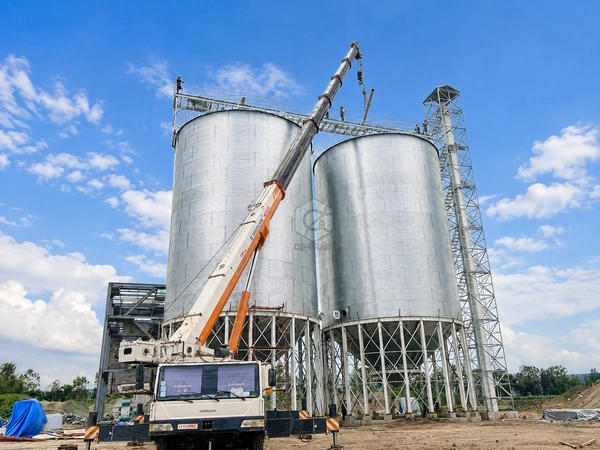
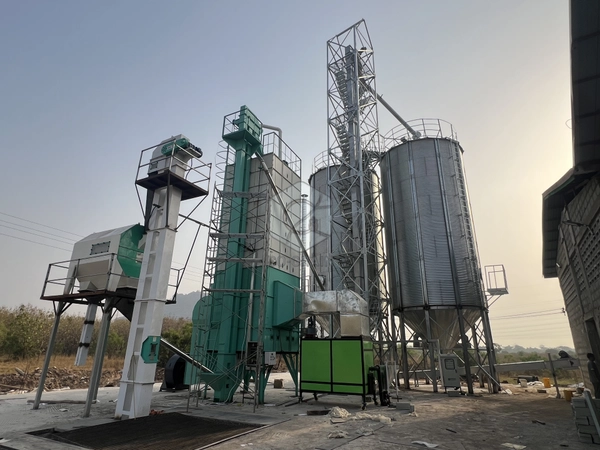
- Real Project Example: 60 T/D Rice Mill in Ghana
A practical Co-Grain project in Ghana uses:
Project Item Configuration
- Country Ghana
- Raw Material Paddy
- Paddy Dryer 15 T/Batch
- Paddy Storage 2 × 100 T Silos
- Rice Mill 60 T/D
The system is designed around the relationship between:
- Drying + Storage + Milling
rather than simply connecting a dryer directly to the rice mill.
The process is:
- Fresh Paddy
- Receiving & Pre-Cleaning
- 15 T/Batch Paddy Dryer
- Moisture Verification / Cooling
- 2 × 100 T Paddy Silos
- 60 T/D Rice Mill
Why Does This Configuration Work?
The 15 T/batch dryer processes paddy according to its drying cycles.
The 2 × 100 T silos provide intermediate dry-paddy storage.
The 60 T/D rice mill draws dried paddy from storage according to its production schedule.
Therefore:
- Dryer Cycle ≠ Rice Mill Cycle
The storage section connects them.
This allows the system to operate more flexibly than a direct:
Dryer → Rice Mill
configuration.
Actual daily dryer throughput still depends on the project’s moisture reduction and cycle time.
- Example of a Complete Paddy Flow
For a commercial rice mill, a more complete system may be:
- Truck Receiving
- Receiving Pit
- Bucket Elevator
- Paddy Pre-Cleaner
- Wet Paddy Buffer Silo
- Paddy Dryer
- Bucket Elevator
Silo Filling & Distribution
- Dry Paddy Storage Silos
- Silo Discharge
- Rice Mill
This is a complete Paddy Drying & Rice Milling System.
The dryer is one part of the raw-material preparation process.
How Conveying Capacity Affects the System
Do not forget the elevators and conveyors.
Suppose the selected dryer requires a certain feed rate.
The following equipment must be capable of supporting it:
- Receiving conveyor
- Pre-cleaner
- Wet buffer discharge
- Bucket elevator
- Dryer feed conveyor
- Dryer discharge conveyor
- Silo filling conveyor
- Silo discharge system
If one conveyor is undersized, it becomes the bottleneck.
Therefore:
Dryer Capacity + Conveyor Capacity + Silo Capacity + Rice Mill Capacity
must be coordinated.
- How Automation Helps Match Dryer and Rice Mill Operation
For medium and large plants, automation can coordinate:
- Wet buffer level
- Dryer status
- Dryer feed
- Dryer discharge
- Dry silo level
- Silo selection
- Rice mill raw-material demand
- Conveyor routing
For example:
- Dry Paddy Silo Low Level
- Production Requirement Detected
- Drying / Silo Filling Schedule Adjusted
The objective is not necessarily fully autonomous operation.
The objective is better coordination between process sections.
What If the Rice Mill Expands Later?
Future expansion should be considered during initial system design.
For example:
- Phase 1: 60 T/D Rice Mill
Future:
- Phase 2: 120 T/D
The initial project may consider:
- Space for another dryer
- Larger common bucket elevator
- Expandable silo-top conveyor
- Additional silo foundations
- Reserved electrical capacity
- Modular control system
This can reduce reconstruction when the rice mill expands.
Common Paddy Dryer Capacity Matching Mistakes
Mistake 1: Matching Only by T/Day
Rice mill daily capacity alone is insufficient.
Mistake 2: Assuming Fixed Batch Cycles
Drying time changes with moisture and operating conditions.
Mistake 3: Ignoring Harvest Peak
Wet paddy intake may be much higher than average rice mill consumption.
Mistake 4: No Wet Paddy Buffer
Receiving becomes directly dependent on dryer availability.
Mistake 5: No Dry Paddy Storage
The rice mill becomes directly dependent on dryer operation.
Mistake 6: Ignoring Paddy Variety
Different varieties may need separate storage or drying management.
Mistake 7: Ignoring Heat Source Capacity
A large dryer requires sufficient and stable thermal energy.
Mistake 8: Ignoring Conveying Capacity
Elevators and conveyors can become bottlenecks.
Mistake 9: No Redundancy
Large plants may need to consider what happens when one dryer is stopped.
Mistake 10: No Expansion Planning
Future rice mill expansion may require rebuilding the entire drying section.
Frequently Asked Questions
What size paddy dryer do I need for a 60 T/D rice mill?
A 15 T/batch dryer can be practical for some 60 T/D rice mill projects if the required number of drying cycles can be completed under the actual moisture conditions and sufficient dry-paddy storage is available. Final sizing should be based on initial moisture, target moisture, operating hours and batch-cycle time.
Is a 15 T/batch dryer enough for a 60 T/D rice mill?
Potentially, yes. Four nominal 15-ton batches equal 60 tons, but actual daily capacity depends on whether four complete cycles can reliably be achieved. It should not be assumed from nominal batch size alone.
What size dryer is needed for a 100 T/D rice mill?
There is no universal size. Multiple batch dryers or a continuous dryer may be evaluated depending on moisture, harvest intake, operating hours, paddy varieties and storage capacity.
Should paddy dryer capacity equal rice mill capacity?
Not necessarily. Storage can separate dryer output from rice mill consumption, and harvest-season drying demand may differ from milling demand.
Is one large dryer better than two smaller dryers?
Not always. Multiple smaller dryers can provide flexibility, batch separation and redundancy. One larger dryer may simplify layout and operation.
Can a batch dryer support a large rice mill?
Yes, depending on total batch capacity, number of units, cycle time and operating hours. Large projects may use multiple batch dryers.
When should I consider a continuous paddy dryer?
Continuous drying becomes attractive when paddy intake is high and stable, operating hours are long and the plant has sufficient buffering and storage.
How much wet paddy buffer do I need?
It depends primarily on the difference between peak receiving rate and dryer consumption, together with truck arrival patterns and acceptable wet-paddy holding time.
How much dry paddy storage should a rice mill have?
It depends on harvest volume, milling schedule, dryer output, inventory requirements, storage duration and the number of paddy varieties that need to be separated.
Can I expand the drying system later?
Yes, if the original plant layout, conveying equipment, electrical system and automation are designed with expansion in mind.
Key Takeaway
Do not select a paddy dryer by asking only:
- “My rice mill is 60 T/D. What size dryer do I need?”
A better calculation starts with:
- Rice Mill Capacity
- Peak Wet Paddy Intake
- Initial & Target Moisture
- Drying Cycle / Operating Hours
- Wet Paddy Buffer
- Dry Paddy Storage
The complete relationship is:
- Paddy Receiving
- → Wet Buffer
- → Paddy Dryer
- → Dry Storage
- → Rice Mill
The wet buffer balances receiving and drying.
The dry storage balances drying and milling.
Once these sections are designed together, the paddy dryer can be sized according to the real operating requirement rather than a simple nominal tonnage comparison.
How Co-Grain Matches Paddy Dryers with Rice Mills
Co-Grain approaches paddy drying as part of the complete rice-processing system.
Depending on project requirements, the scope can integrate:
- Paddy Receiving
- → Pre-Cleaning
- → Wet Paddy Buffering
- → Batch / Continuous Paddy Drying
- → Cooling & Moisture Control
- → Paddy Storage
- → Rice Milling
The drying section is configured according to:
- Rice mill capacity
- Wet paddy intake
- Initial moisture
- Target moisture
- Harvest period
- Required drying capacity
- Operating hours
- Heat source
- Storage requirement
- Paddy varieties
Project location
Future expansion
The objective is to create a balanced system from wet paddy receiving to finished rice processing.