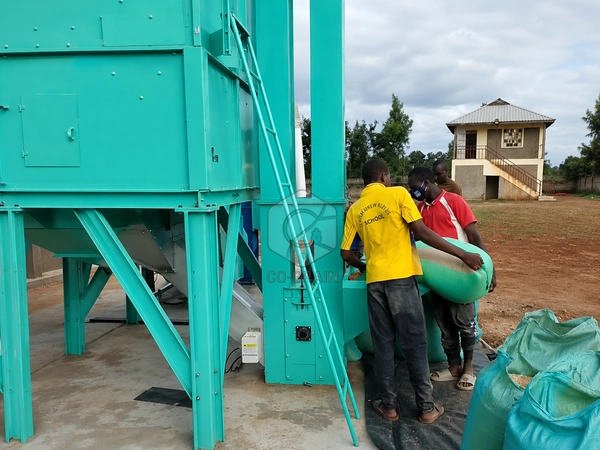
Paddy drying should reduce moisture without creating excessive thermal or moisture stress inside the grain kernel.
When paddy is dried too aggressively, moisture gradients can develop between the inner and outer parts of the kernel. This may increase the risk of fissuring or cracking, which can later contribute to broken rice during milling.
A good paddy drying strategy therefore focuses on:
Controlled Temperature + Proper Airflow + Reasonable Moisture Reduction + Sufficient Drying Time + Cooling / Tempering + Stable Final Moisture
The best settings depend on paddy variety, initial moisture, dryer type and downstream milling requirements.
Paddy quality can be affected by how quickly moisture is removed and how evenly the grain responds during drying.
Freshly harvested paddy may contain uneven moisture both:
- Between different kernels
- Within individual kernels
During drying, the outer layers of the kernel tend to lose moisture first.
If moisture is removed too quickly, the surface can become much drier than the interior.
This creates an internal moisture gradient.
As the kernel continues to dry and cool, internal stress may develop.
When the stress exceeds the grain’s structural tolerance, fissures or cracks can form.
Those fissures may not always be visible before milling, but they can weaken the kernel and increase the chance of breakage during:
- Husking
- Whitening
- Polishing
- Grading
This is why drying quality is closely related to rice milling performance.
Paddy cracking can occur when the grain experiences excessive moisture or temperature stress during drying and cooling.
Important contributing factors include:
- High drying temperature
- Rapid moisture removal
- Large moisture gradient inside the kernel
- Uneven drying
- Excessive rewetting
- Sudden cooling
- Repeated heating and cooling
- Poor moisture uniformity before drying
Drying temperature is important, but it is not the only factor.
The whole drying process must be considered.
During drying, moisture does not disappear uniformly from the entire kernel at the same time.
The general process is:
Internal Moisture → Kernel Surface → Drying Air
At the beginning of drying, moisture near the surface can be removed relatively quickly.
Moisture from the center of the grain then needs time to move outward.
If the outside dries much faster than the inside, a strong moisture gradient develops.
Conceptually:
- Wet Interior + Dry Surface = Higher Internal Stress
Allowing sufficient time for moisture redistribution can help reduce this imbalance.
This is one reason tempering or staged drying is used in some grain drying processes.
A moisture gradient is the difference in moisture content between different parts of the grain kernel.
For example:
- Outer Layer: Drier Inner Layer: Wetter
A large moisture gradient can increase internal stress.
The goal of controlled paddy drying is therefore not only to reach a final average moisture level, but also to improve moisture uniformity.
This distinction is important.
Two batches of paddy can have the same average final moisture but different internal moisture distributions.
The batch with more uniform moisture may behave better during storage and milling.
Higher drying temperature can accelerate moisture removal.
However, faster drying is not automatically better.
If the drying condition is too aggressive for the paddy variety and moisture condition, the grain may experience:
- Faster surface drying
- Larger internal moisture gradients
- Higher thermal stress
- Increased risk of fissuring
- Greater variation between kernels
Therefore, the best drying temperature should not be selected only to maximize throughput.
It should balance:
Drying Capacity + Grain Quality + Energy Use + Final Milling Requirement
No.
There is no single drying temperature that should automatically be used for every paddy drying project.
The appropriate temperature depends on:
- Paddy variety
- Initial moisture
- Target moisture
- Dryer type
- Airflow
- Residence time
- Batch or continuous operation
- Grain circulation
- Number of drying stages
- Final use
- Required milling quality
For this reason, a professional dryer should allow the operating parameters to be adjusted according to actual grain conditions.
Initial moisture is one of the most important parameters in paddy drying.
Paddy harvested under different conditions may enter the dryer at very different moisture levels.
Higher initial moisture generally means:
- More water must be removed
- More drying energy is required
- Longer drying time may be needed
- Moisture gradients may become more significant
- Process control becomes more important
This is why dryer capacity should always be quoted together with a moisture basis.
A capacity number without initial and target moisture is incomplete.
The dryer should not simply reduce moisture as much as possible.
The target moisture depends on what happens next.
Possible routes include:
Each route may require different moisture-management priorities.
The final target should therefore be determined according to:
- Storage duration
- Ambient climate
- Silo management
- Milling schedule
- Rice variety
- Final product requirement
Over-drying can create several disadvantages.
Removing more moisture than required increases fuel and energy use.
Excessive drying can increase physical stress in some paddy varieties.
Grain is traded and processed by weight.
Unnecessary moisture removal can reduce total product weight.
Very dry or unevenly dried paddy may behave differently during milling.
For commercial rice mills, the goal is therefore:
- Appropriate Moisture, Not Minimum Possible Moisture
If paddy remains too wet for the intended storage condition, risks may increase.
These can include:
- Heating
- Mold development
- Biological activity
- Quality deterioration
- Insect problems
- Storage instability
Drying should therefore reach the confirmed target before longer storage.
However, ventilation or aeration should not be treated as a substitute for proper drying where significant moisture reduction is required.
Uneven drying means some grains are drier than others.
This can happen due to:
- Uneven airflow
- Poor grain distribution
- Large variation in initial moisture
- Inconsistent residence time
- Poor circulation
- Unstable heat supply
- Incorrect dryer loading
When paddy moisture varies widely, downstream milling becomes harder to control.
Some kernels may be:
- Too Wet
while others are:
- Too Dry
A good drying system should therefore aim for uniform moisture distribution, not just a correct average.
Cracked kernels are weaker.
During milling, these weakened kernels are more likely to break.
The relationship can be summarized as:
Aggressive / Uneven Drying → Kernel Stress → Fissuring / Cracking → Weaker Kernels → More Breakage During Milling
This does not mean that every cracked grain is caused by the dryer.
Cracking can also be influenced by:
- Variety
- Harvesting method
- Field drying
- Handling damage
- Rewetting
- Storage conditions
- Milling settings
But drying is one important part of the total quality chain.
Do not use higher temperature simply to shorten drying time without considering grain quality.
The dryer should remove moisture according to the actual grain condition.
Uneven airflow can create wet and dry zones.
Circulation or controlled grain movement can help improve drying uniformity.
Tempering allows moisture inside the kernel time to redistribute.
This can reduce the difference between the outer and inner parts of the grain.
Cooling should be coordinated with the drying process rather than creating an abrupt temperature change.
Moisture should be checked during drying and after discharge.
Repeated wetting and drying cycles can increase stress.
Tempering is a controlled holding period between drying stages or before the next process step.
During tempering:
- Moisture Redistributes Within the Kernel
The wetter interior gradually transfers moisture toward the drier outer layer.
This helps reduce internal moisture differences before further drying.
A typical staged process may be:
First Drying Stage → Tempering → Second Drying Stage
Drying → Tempering → Cooling / Storage
Not every paddy drying project requires a separate tempering silo.
The process depends on dryer design and grain condition.
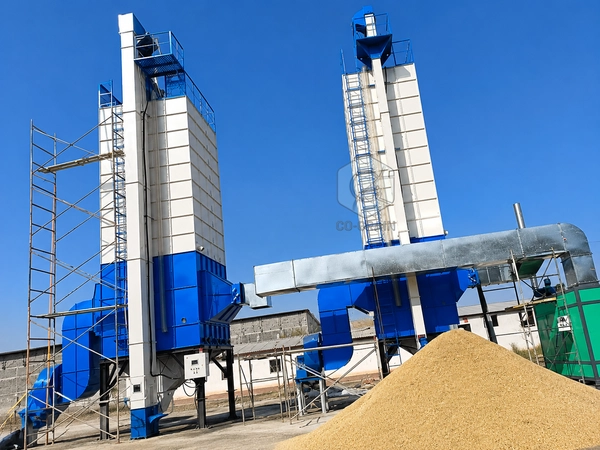
Batch dryers can provide useful flexibility for paddy because each batch can be managed separately.
Operators can adjust:
- Drying time
- Air temperature
- Cooling time
- Discharge timing
according to the actual moisture of the batch.
This can be valuable when:
- Paddy varieties change
- Harvest moisture varies
- Multiple farms supply the mill
- Batch identity matters
However, good results still depend on correct dryer operation.
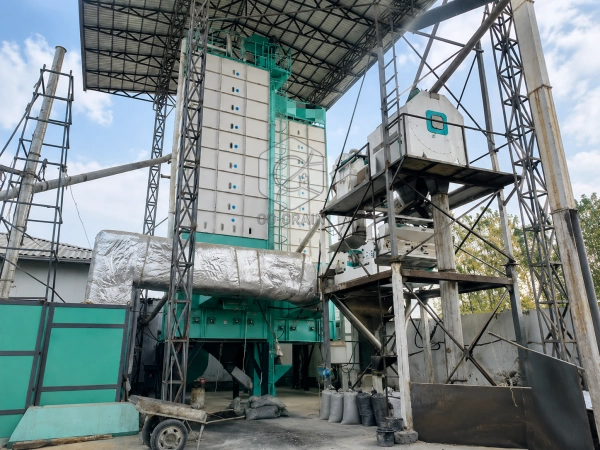
Continuous dryers can also produce high-quality dried paddy when grain flow and process control are well designed.
Important factors include:
- Stable wet grain supply
- Uniform feeding
- Controlled residence time
- Stable airflow
- Reliable temperature control
- Appropriate cooling
- Moisture monitoring
A wet grain buffer silo can be especially useful because it helps provide a stable feed to the dryer.
Fresh paddy may contain:
- Straw
- Leaves
- Chaff
- Dust
- Large impurities
- Small foreign material
These impurities can affect:
- Grain flow
- Airflow
- Dryer loading
- Heat distribution
A typical process therefore uses:
Receiving → Pre-Cleaning → Wet Grain Buffer → Dryer
Better pre-cleaning supports more stable drying conditions.
Truck receiving is often irregular.
Dryer feeding should be more stable.
A wet grain buffer silo helps separate these two operating patterns.
Typical relationship:
Truck Receiving → Cleaner → Wet Grain Buffer Silo → Paddy Dryer
The buffer helps the dryer receive grain at a controlled rate.
Stable feeding supports more consistent residence time and drying performance.
Grain leaving the dryer may still be warm.
For longer storage, grain temperature should be checked before it enters the silo.
Cooling can help:
- Reduce grain temperature
- Prepare paddy for storage
- Improve storage stability
- Support more controlled downstream handling
The required cooling method depends on dryer design and plant layout.
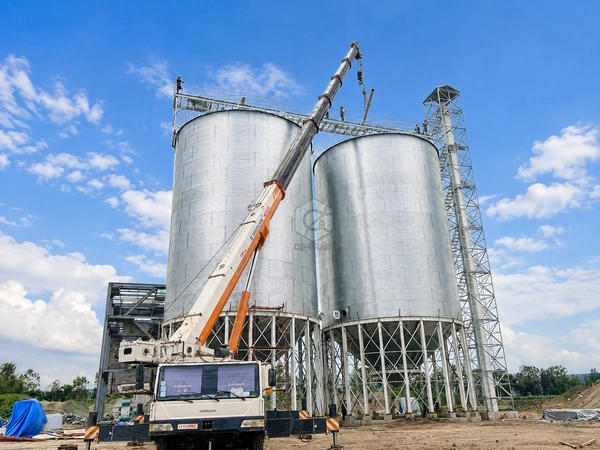
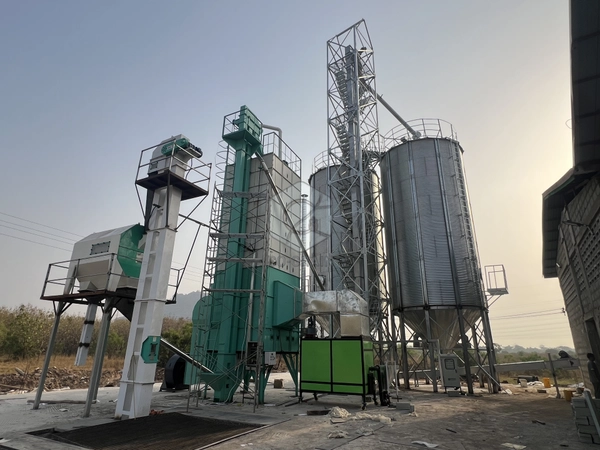
After drying and cooling, paddy may be transferred to steel silos.
A typical system is:
Paddy Dryer → Bucket Elevator → Silo-Top Conveyor → Paddy Storage Silo
The storage system may include:
- Aeration
- Temperature monitoring
- Level monitoring
- Roof ventilation
- Silo discharge equipment
Drying and storage should therefore be planned together.
Rice milling yield depends on many factors, including:
- Paddy variety
- Harvest quality
- Moisture
- Drying
- Storage
- Husking
- Whitening
- Polishing
- Machine adjustment
Drying is one of the upstream factors that influences kernel condition before milling.
A controlled drying process can help prepare more uniform paddy for the milling line.
The objective is to support:
Stable Paddy Condition → Stable Milling → Better Product Control
Consider a project using:
15 T/Batch Paddy Dryer 2 × 100 T Grain Silos 60 T/D Rice Mill
The process can be arranged as:
Fresh Paddy → Pre-cleaning → 15 T/Batch Drying → Cooling / Moisture Verification → 2 × 100 T Storage Silos → 60 T/D Rice Mill
In this arrangement, the storage silos separate dryer operation from rice mill operation.
This allows the plant to manage paddy batches more flexibly.
The dryer should be operated according to actual moisture and grain-quality requirements rather than only maximizing batch turnover.
In tropical and humid regions, paddy drying can become more challenging because:
- Harvest moisture may remain high
- Ambient humidity can be high
- Rain can interrupt natural drying
- Grain may need to be stored quickly after harvest
This makes mechanical drying particularly important for commercial rice mills.
Projects in regions such as:
- West Africa
- Southeast Asia
- South Asia
should consider the complete post-harvest system:
Receiving → Cleaning → Buffering → Drying → Storage
rather than dryer capacity alone.
Higher temperature does not automatically mean better drying.
Fast moisture removal can increase internal moisture gradients.
Different batches may need different drying conditions.
In some processes, moisture redistribution can be important.
Warm grain should not automatically be treated as ready for long-term storage.
Wide moisture variation between kernels can still create quality problems.
Impurities can affect airflow and grain movement.
Maximum throughput is not the only design objective.
There is no universal temperature for every paddy dryer. The correct setting depends on rice variety, initial moisture, airflow, residence time, dryer design and required milling quality.
Excessively aggressive drying can increase moisture and thermal stress inside the kernel, which may contribute to fissuring or cracking.
Cracking can occur when moisture inside the kernel redistributes unevenly or when the grain experiences rapid drying, cooling or rewetting.
Fissured kernels are generally weaker and may be more likely to break during subsequent rice milling.
Cooling is commonly required before longer-term storage, depending on dryer design and discharge condition.
Not automatically. Very low-temperature drying can require longer time and different airflow. The correct approach is to balance drying time, energy use and grain quality.
Even if average moisture is correct, large differences between individual grains can cause storage and milling problems.
Not every dryer requires one. The need depends on dryer design, moisture reduction, rice variety and drying strategy.
High-moisture paddy should only be held according to an approved wet-grain management plan. Long-term storage normally requires appropriate drying first.
The best paddy drying result does not come from using the highest possible temperature or the shortest possible drying time.
A good drying process balances:
- Temperature
- Airflow
- Moisture Reduction
- Residence Time
- Tempering / Conditioning
- Cooling
- Final Moisture Uniformity
For rice mills, the real objective is not simply to remove water.
It is to prepare paddy for:
- Safe Storage + Stable Milling + Controlled Rice Quality
Co-Grain evaluates paddy drying as part of the complete rice-processing system.
Depending on project requirements, the system can integrate:
Paddy Receiving → Pre-Cleaning → Wet Grain Buffering → Paddy Drying → Cooling / Moisture Verification → Paddy Storage → Rice Milling
Drying parameters and equipment configuration are selected according to:
- Paddy variety
- Initial moisture
- Target moisture
- Required capacity
- Rice mill capacity
- Heat source
- Storage requirement
- Project location
The objective is to balance drying capacity with grain quality and downstream production.