What Is a Grain Screw Conveyor?
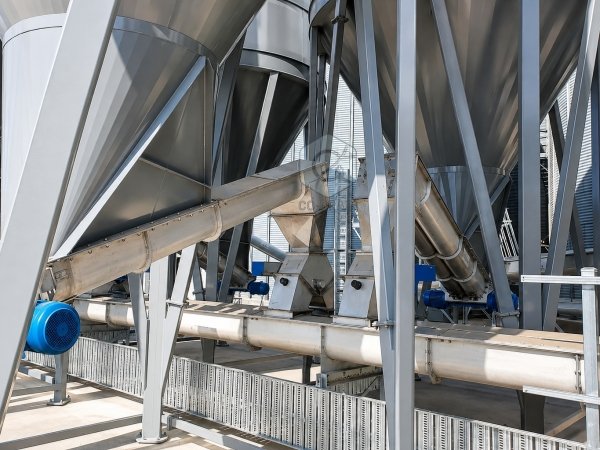
A screw conveyor moves grain through a trough or tube using a rotating helical flight fixed to a central shaft or another confirmed screw structure. It is mainly used for short-distance transfer, controlled feeding, collection and selected discharge duties where compact installation is important.
Screw conveyors are not the best choice for every grain route. Long distances, high inclines, fragile seed, strict residual-material limits and high capacities may favor a belt, chain conveyor or bucket elevator.
Typical Applications
- Short transfer between adjacent machines
- Controlled feeding into a cleaner, dryer or conveyor
- Hopper and bin discharge
- Selected silo-bottom collection or sweep interfaces
- Small receiving or loading equipment
- By-product and impurity transfer after technical confirmation
Typical flow:
Process Flow: Hopper / Bin / Machine Outlet > Screw Conveyor > Cleaner / Dryer / Conveyor / Collection Point
How It Works
The motor and gearbox rotate the screw flight inside the casing. Material entering through the inlet is pushed along the casing toward the discharge. The filling ratio, screw diameter, pitch, speed and inclination affect capacity, power, grain damage and residual material.
Uniform feeding is important. An overloaded screw can compact material, increase power demand and cause blockage. A starved screw reduces output and may produce unstable feeding.
Main Product Advantages
Compact Installation
The trough or tube can fit beneath hoppers, beside processing equipment or in limited service areas.
Combined Transfer and Feeding
The screw can transport grain while controlling discharge from a hopper or buffer when the drive and inlet are configured for the duty.
Enclosed Casing
The casing contains the material route and can be connected to sealed inlets and outlets.
Flexible Inlet and Outlet Arrangement
One or more inlets and selected discharge positions may be considered, subject to the screw structure and cleanout requirement.
Simple Mechanical Principle
The operating principle is straightforward, but correct selection is still required to control wear, blockage and grain damage.
Configuration Directions
- Trough-type or tubular casing
- Horizontal or technically confirmed inclined arrangement
- Fixed-pitch or selected variable-pitch screw
- Carbon-steel, galvanized or specified material/finish
- Selected flight thickness and wear protection
- Single or multiple inlets after review
- End discharge or selected intermediate outlet
- Fixed or variable-speed drive
- Inspection and cleanout covers
- Guards, overload protection and plant PLC integration
Selection Information Required
- Grain or material, particle size and bulk density
- Moisture, impurities and flowability
- Required capacity and feeding accuracy
- Conveying length and inclination
- Inlet and outlet positions
- Hopper pressure or material head above the screw
- Operating hours and start frequency
- Acceptable grain damage and residual material
- Cleanout and cross-contamination requirements
- Indoor/outdoor, corrosion and safety conditions
Safety and Maintenance
Guards must cover rotating shafts, couplings and drives. Overload, blockage and motor protection may be included in the control scope. Operators should inspect flight wear, hanger bearings where used, end bearings, seals, casing buildup and drive alignment. The conveyor must be isolated before covers are opened.
FAQ
Is a screw conveyor suitable for long-distance grain transfer?
It is normally more suitable for short routes. Power, wear, damage and maintenance become more important as length increases.
Can it convey wet grain?
Possibly, but moisture and impurities affect flowability, buildup and power. The actual wet-grain condition must be reviewed.
Is it suitable for seed grain?
Only after confirming acceptable mechanical damage, speed, filling ratio and distance. A belt or gentle elevator may be preferable.
Can it be used under a silo?
It can serve selected discharge or collection duties, but silo pressure, outlet arrangement, capacity and cleanout must be coordinated.
Can the screw control feeding rate?
Variable speed and appropriate inlet design can support controlled feeding, but accuracy depends on material behavior and the complete feeder arrangement.