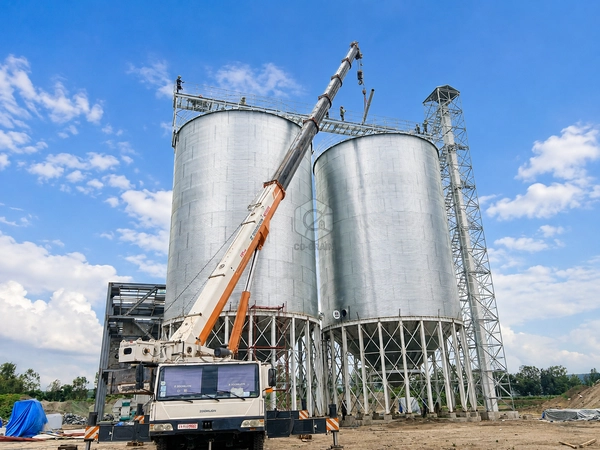
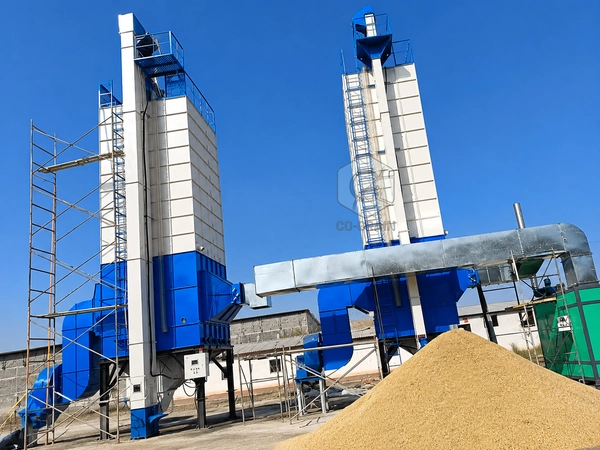
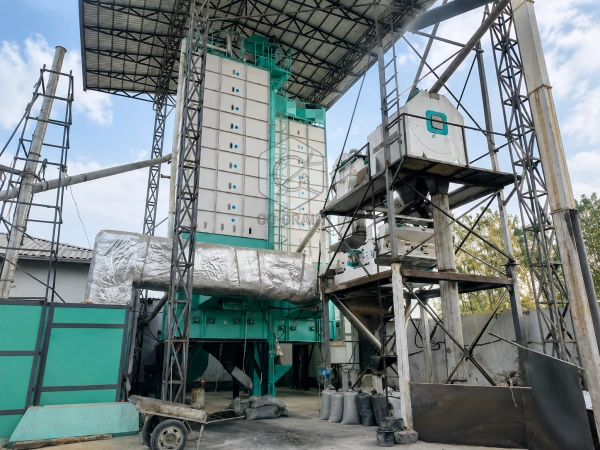
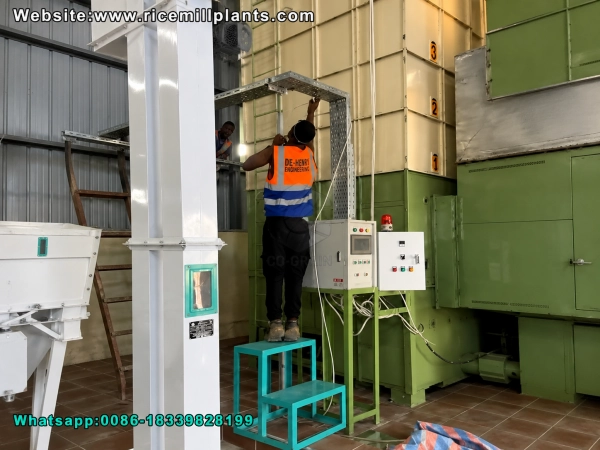
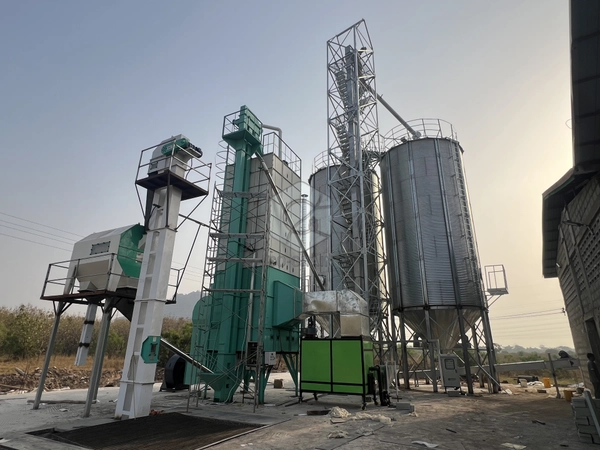
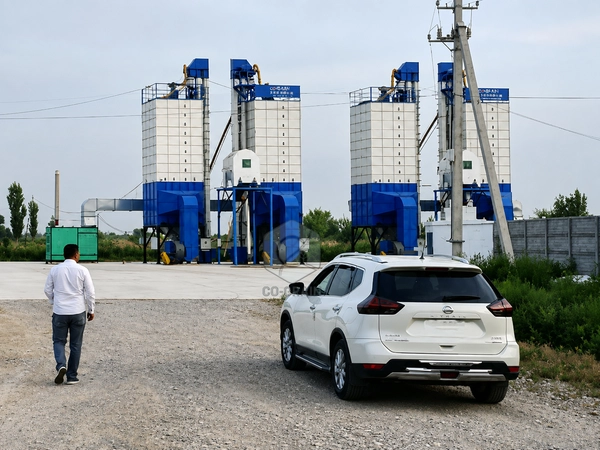
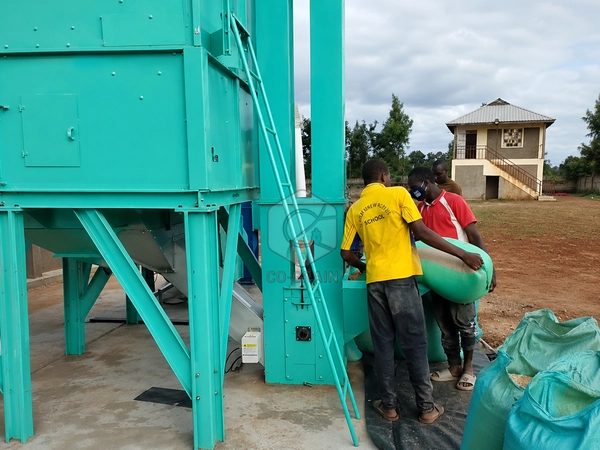
A grain dryer depends on a properly designed conveying system both before and after drying. Wet grain must move from receiving and pre-cleaning through a buffer system into the dryer at a controlled rate. After drying, grain must be discharged reliably to storage or downstream processing.
Complete Grain Dryer Conveying Route
Receiving
Cleaning
Buffer
Conveyor
Dryer
Conveyor
Filling
Depending on the plant layout, the system may use Bucket Elevators, Drag Chain Conveyors, Belt Conveyors, Screw Conveyors, Inclined Chain Conveyors and Air Cushion Belt Conveyors.
The design must balance receiving capacity, dryer feed rate, dryer discharge rate and storage capacity as one coordinated system.
Why Does a Grain Dryer Need Conveying Equipment?
A grain dryer cannot operate effectively as an isolated machine. It has two material-flow interfaces:
Before Drying
Wet grain feeding from receiving, pre-cleaning and buffer storage to the dryer inlet.
After Drying
Dry grain discharge from the dryer to a silo, processing line or loading system.
System Balance
If either side is poorly designed, the dryer may be underfed, overloaded or forced to stop.
What Is a Grain Dryer Feeding System?
The feeding system should provide the dryer with a stable and controllable grain supply. A buffer silo separates irregular truck arrivals from the dryer’s more consistent operating requirement.
Why Use a Wet Grain Buffer?
Truck receiving rate is usually different from dryer feeding rate. Trucks arrive intermittently, while the dryer needs a controlled flow.
| Without buffer | With wet grain buffer |
|---|---|
| Truck unloading must be synchronized closely with dryer feeding. | Receiving can fill the buffer while the buffer feeds the dryer independently. |
| A receiving delay can interrupt dryer operation. | The buffer helps maintain a stable supply during changes in truck arrival. |
This separation is one of the most important principles in commercial dryer-feeding system design.
Why Is Pre-Cleaning Important?
Fresh grain may contain straw, leaves, chaff, dust, large impurities and other foreign material. These can create problems in buffer silos, conveyors, elevators and dryers.
- Blockage and uneven flow
- Poor air distribution in the dryer
- Higher dust load
- Reduced dryer performance
- Additional wear and maintenance
For commercial systems, the preferred sequence is generally:
Conveyor Selection Before the Dryer
Receiving Pit to Cleaner
Drag Chain Conveyor commonly moves grain horizontally from the pit. A Bucket Elevator then provides vertical lift to the pre-cleaner.
Cleaner to Wet Buffer
Depending on distance and elevation, use a Bucket Elevator, Drag Chain Conveyor, Belt Conveyor or suitable gravity chute.
Buffer to Dryer
Screw, Drag Chain or Belt Conveyors can feed the dryer. A Bucket Elevator is used when the dryer inlet is elevated.
Screw Conveyor
Suitable for short, compact routes and controlled feeding from a hopper or buffer outlet.
Drag Chain Conveyor
Suitable for enclosed medium routes, higher capacity and multiple buffer bins sharing one route.
Belt Conveyor
Worth considering for longer, relatively gentle wet-grain transfer where the layout is more open.
Why Is a Bucket Elevator Commonly Used?
Many grain dryers are fed from the top, with the inlet several metres above ground level. A Bucket Elevator provides a compact, continuous vertical route:
This arrangement is widely used because it separates horizontal transfer from major vertical lifting.
Why Does Dryer Feed Rate Matter?
A dryer is designed around a specific grain flow. If it receives too little grain, capacity and energy utilization may decrease. If too much grain enters, overloading, unstable residence time and blockage risk may occur.
The conveying system should support controlled loading rather than uncontrolled flow.
Batch Dryer and Continuous Dryer Feeding
| Design factor | Batch dryer | Continuous dryer |
|---|---|---|
| Wet grain feed | Intermittent loading | Continuous controlled feed |
| Buffer value | High | Very high |
| Feed conveyor duty | Cyclic | Continuous |
| Discharge | Batch discharge | Continuous discharge |
| Automation | Batch sequencing | Continuous interlocking |
A batch dryer needs efficient filling during the loading stage. A continuous dryer needs a more stable supply from the wet buffer and coordinated discharge downstream.
Conveying After the Dryer
Short dryer-to-elevator route
Screw or Drag Chain Conveyor can be suitable when the distance is short and enclosed transfer is preferred.
Medium enclosed route
Drag Chain Conveyor provides compact conveying and can integrate with multiple transfer points.
Longer gentle route
Belt Conveyor is often worth evaluating for longer horizontal transfer and reduced impact.
Large silo route
Air Cushion Belt Conveyor may be considered for selected long, high-capacity galleries.
Vertical lift to storage
Bucket Elevator commonly lifts dried grain to the silo roof or elevated distribution line.
Capacity and System Matching
Automation and Interlocking
Conveyor status should be interlocked with dryer operation. A simplified start-up sequence is:
- Storage route ready
- Silo-top conveyor starts
- Dry-grain Bucket Elevator starts
- Dryer discharge conveyor starts
- Dryer starts or releases grain
- Wet-grain feed system starts
Shutdown normally stops wet-grain feed first, allows the dryer and conveyors to clear according to operating procedure, then stops upstream and downstream equipment in the approved order.
What Happens If a Conveyor Stops?
If a downstream conveyor stops while grain continues flowing, material can accumulate:
The dryer may need to stop feed, stop discharge or enter a safe condition depending on the system design. Speed, belt misalignment, bearing temperature, chain motion, blockage, motor overload and silo level should be monitored where appropriate.
How to Choose the Right Conveyor
| Route condition | Before the dryer | After the dryer |
|---|---|---|
| Very short compact route | Screw Conveyor | Screw or Drag Chain Conveyor |
| Enclosed medium route | Drag Chain Conveyor | Drag Chain Conveyor |
| Long gentle route | Belt Conveyor | Belt Conveyor |
| Major vertical lift | Bucket Elevator | Bucket Elevator |
| Horizontal plus moderate elevation | Inclined Chain Conveyor | Inclined Chain Conveyor |
| Long high-capacity silo route | — | Air Cushion Belt Conveyor |
Common Dryer Conveying Mistakes
- Selecting the dryer before planning the conveying route
- Providing no wet grain buffer
- Undersizing the feed elevator
- Undersizing the discharge conveyor
- Using a Screw Conveyor for an excessively long route
- Adding too many transfer points
- Ignoring wet-grain flowability
- Using poor chute design
- Providing no equipment interlocks
- Failing to confirm the storage route before discharge
Frequently Asked Questions
What conveyor is used to feed a grain dryer?
Screw, Drag Chain or Belt Conveyors may transfer grain horizontally, while a Bucket Elevator is commonly used to lift grain to an elevated dryer inlet.
Does a grain dryer need a Bucket Elevator?
Many commercial dryers do because grain enters from an elevated inlet. The exact configuration depends on the dryer and plant layout.
Why does a dryer need a Wet Grain Buffer Silo?
The buffer separates irregular receiving from controlled dryer feeding and helps maintain a stable grain supply.
Which conveyor is best after a grain dryer?
Drag Chain suits enclosed commercial transfer, Belt suits longer gentler routes, and Screw suits selected short routes.
What happens if the discharge conveyor is smaller than the dryer capacity?
It can create a bottleneck and force the dryer to reduce throughput or stop.
Can one dryer feed multiple silos?
Yes. A Bucket Elevator and silo-top distribution conveyor can route dried grain to several silos.
Can the conveying system be automated with the dryer?
Yes. Conveyor status, dryer operation, silo levels and route selection can be integrated into a PLC control system.
Key Takeaway
A grain dryer needs two correctly designed conveying systems:
Co-Grain coordinates feeding, drying, discharge, silo filling, safety monitoring and PLC control so the receiving capacity, dryer capacity and storage route work together as one reliable system.
Discuss Your Project
Need a Complete Grain Drying & Storage Solution?
Co-Grain provides turnkey grain drying plants, grain storage silos, cleaning, conveying, and automation systems for modern grain handling facilities. Our equipment includes batch and continuous grain dryers, paddy dryers, grain cleaners, bucket elevators, chain conveyors, and belt conveyors.
From engineering design and equipment manufacturing to installation and commissioning, we deliver reliable, customized solutions for paddy rice, maize, wheat, barley, sorghum, and other grains.
Talk to Co-Grain
Planning a new project or upgrading an existing facility? Contact us for a customized solution and free quotation.
Henan Co-Grain Machinery Engineering Co., Ltd.
Email: info@ricemillplants.com
WhatsApp: 0086 18339828199