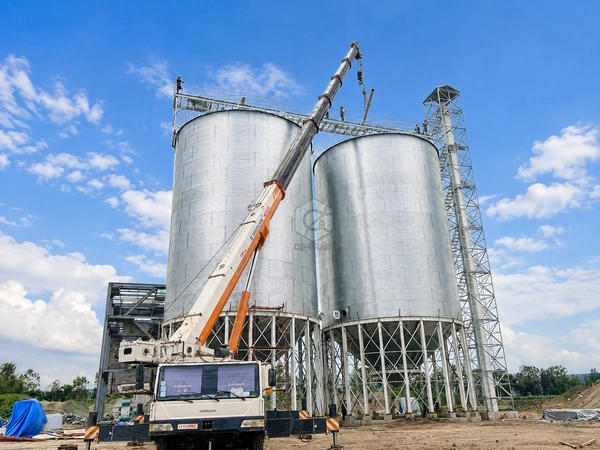
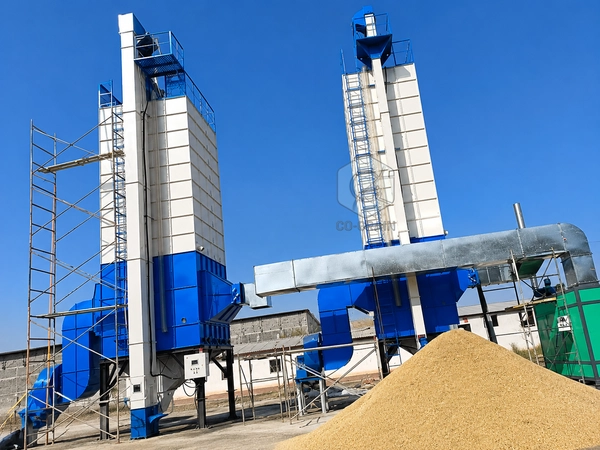
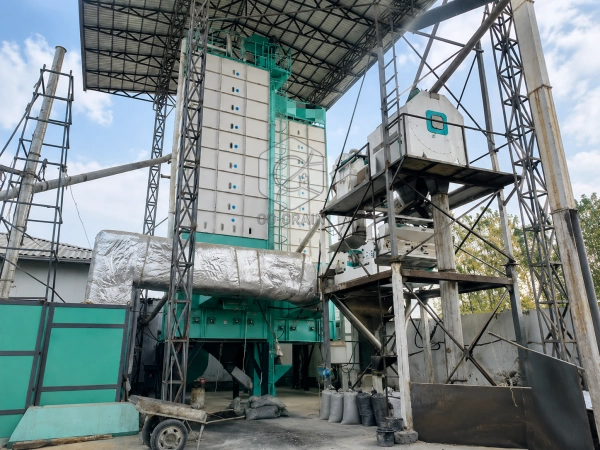
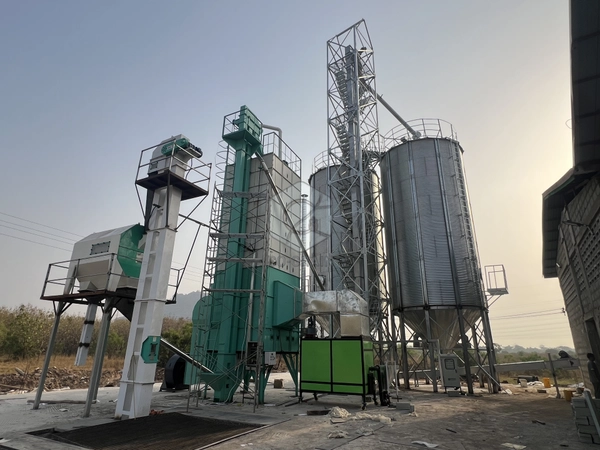
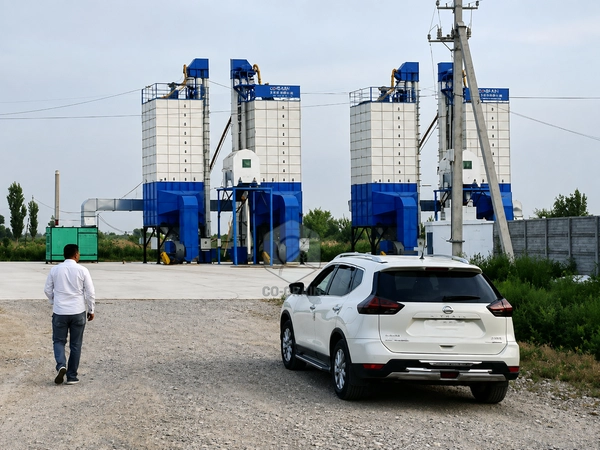
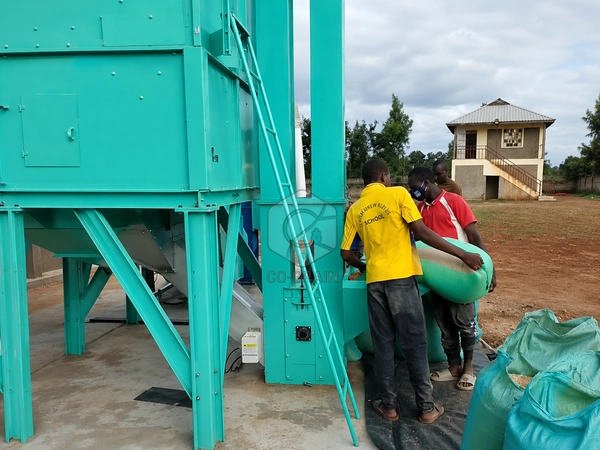
A Silo Filling and Distribution System transfers grain from receiving, drying or processing equipment to one or multiple storage silos.
A typical system uses:
Bucket Elevator → Silo-Top Conveyor → Distribution / Discharge Point → Selected Silo
Depending on capacity, distance and silo layout, the silo-top conveyor may use:
- Drag Chain Conveyor
- Belt Conveyor
- Enclosed Belt Conveyor
- Air Cushion Belt Conveyor
The system must coordinate vertical lifting, horizontal distribution, silo selection, level monitoring and route control.
For commercial grain storage plants, the goal is not simply to move grain to the silo roof. The system must deliver the correct grain to the correct silo at the required capacity without creating bottlenecks, unnecessary grain damage or routing errors.
What Is a Silo Filling and Distribution System?
A Silo Filling and Distribution System is the conveying network used to transfer grain into storage silos.
It normally connects upstream equipment such as:
- Grain receiving
- Pre-cleaning
- Grain dryer
- Existing grain storage
- Processing plant
with one or more storage silos.
The typical flow is:
- Grain Source
- Horizontal Conveyor
- Bucket Elevator
- Silo-Top Conveyor
- → Silo 1
- → Silo 2
- → Silo 3
- → Silo 4
The system provides both:
- Vertical Lift
- Horizontal Distribution
How Does a Silo Filling System Work?
Grain first reaches the base of a Bucket Elevator.
The elevator lifts the grain above the silo roof level.
At the top, the grain enters a horizontal conveyor.
The conveyor then carries grain across the silo group.
A selected outlet, distributor or discharge device directs the grain into the required silo.
The basic sequence is:
- Grain Inlet
- → Bucket Elevator
- → Silo-Top Conveyor
- → Selected Discharge Point
- → Storage Silo
For multiple silos, the route is controlled according to the storage plan.
Why Is a Bucket Elevator Used for Silo Filling?
Large steel grain silos can be very tall.
The grain therefore needs to be lifted from ground level to above the silo roof.
A Bucket Elevator is well suited to this duty because it provides:
- Large vertical lift
- Compact footprint
- Continuous grain handling
- High-capacity operation
- Easy connection with top conveyors
Typical system:
- Receiving / Dryer Conveyor
- → Bucket Elevator
- Silo Roof Level
Without the Bucket Elevator, a long inclined conveyor may be required to reach the same elevation.
What Happens After the Bucket Elevator?
At the Bucket Elevator head, grain is discharged into a top conveying system.
This horizontal conveyor travels over or alongside the silo group.
Possible equipment includes:
- Drag Chain Conveyor
- Belt Conveyor
- Enclosed Belt Conveyor
- Air Cushion Belt Conveyor
The right equipment depends on:
Number of Silos + Distance + Capacity + Grain Type + Number of Discharge Points + Grain Damage Requirements
Silo-Top Drag Chain Conveyor
A Drag Chain Conveyor is one of the most common choices for silo-top grain distribution.
Typical flow:
- Bucket Elevator
- Drag Chain Conveyor
- → Silo 1
- → Silo 2
- → Silo 3
- → Silo 4
Its main advantages include:
- Enclosed structure
- Multiple discharge points
- Compact layout
- Good integration with silo roofs
- Suitable commercial capacity
This makes it particularly useful for short-to-medium silo rows.
Why Is Drag Chain Conveyor Good for Multiple Silos?
Because several discharge points can be installed along one conveyor route.
For example:
- Conveyor Entry
→ Outlet 1 → Silo 1
→ Outlet 2 → Silo 2
→ Outlet 3 → Silo 3
→ Outlet 4 → Silo 4
The control system opens the required outlet while keeping the other routes closed.
This allows one Bucket Elevator and one horizontal conveyor to serve several silos.
Belt Conveyor for Silo Filling
A Belt Conveyor can also be used along the silo roof.
It is especially worth considering when:
- The silo row is long
- Grain damage should be minimized
- Higher conveying speed is appropriate
- The route is relatively straight
Possible layout:
- Bucket Elevator
- Belt Conveyor
- → Silo Group
For multi-point discharge, special devices may be required.
How Does a Belt Conveyor Distribute Grain to Multiple Silos?
Unlike a typical Drag Chain Conveyor with several fixed discharge gates, Belt Conveyors may use:
- Tripper conveyor
- Plough discharge
- Movable discharge
- Project-specific chute arrangement
The exact method depends on the conveyor and silo layout.
Therefore, for many compact multi-silo projects:
- Drag Chain Conveyor
may provide simpler distribution.
For long silo galleries:
- Belt Conveyor
may become more attractive.
Air Cushion Belt Conveyor for Silo Filling
For larger grain storage facilities, an Air Cushion Belt Conveyor can be considered.
Typical application:
- Large Bucket Elevator
- Long Air Cushion Belt Conveyor
- → Multiple Large Silos
This can be suitable when:
- Horizontal distance is long
- Required capacity is high
- The silo gallery is large
- Grain needs relatively gentle handling
- Continuous operation is important
The selection should compare lifecycle cost and route requirements with conventional Belt and Drag Chain Conveyors.
Which Conveyor Is Best for Silo Filling?
There is no universal answer.
A simple selection direction is:
- Drag Chain Conveyor
Best to evaluate when:
- Silo row is compact
- Several discharge points are needed
- Enclosed transfer is important
- Route is short to medium
- Belt Conveyor
Best to evaluate when:
- Route is longer
- Gentle handling is important
- Silo gallery is relatively straight
- Air Cushion Belt Conveyor
Best to evaluate when:
- Route is long
- Capacity is high
- Project scale is large
- Silo gallery is substantial
The best system depends on the actual plant layout.
Can One Bucket Elevator Fill Multiple Silos?
Yes.
This is one of the most common layouts in grain storage engineering.
Example:
- One Bucket Elevator
- One Silo-Top Conveyor
- → Silo 1
- → Silo 2
- → Silo 3
- → Silo 4
- → Silo 5
- → Silo 6
The top conveyor performs the distribution.
The elevator provides the vertical lift.
This can reduce the need to install one elevator for every silo.
How Many Silos Can One Elevator Serve?
There is no fixed maximum number.
It depends on:
- Elevator capacity
- Conveyor length
- Number of silo outlets
- Storage strategy
- Grain varieties
- Required filling rate
- Route control
- Future expansion
A large system may use one elevator for several silos, while another project may use multiple elevators to maintain independent routes.
One Elevator or Multiple Elevators?
- One Elevator
Potential advantages:
- Simpler layout
- Lower equipment count
- Centralized filling route
Potential limitations:
- One common bottleneck
- Less redundancy
- Scheduling conflicts between grain types
- Multiple Elevators
Potential advantages:
- Independent grain routes
- Higher combined capacity
- Better segregation
- Operational redundancy
Potential limitations:
- Higher investment
- More structural and control equipment
The correct choice depends on the plant’s operating strategy.
Silo Distribution Points
The distribution point is where grain leaves the top conveyor and enters the selected silo.
Possible devices include:
- Slide gate
- Discharge valve
- Diverter
- Chute
- Tripper
- Plough
- Distributor
The exact device depends on the conveyor type.
The outlet should provide:
- Reliable opening and closing
- Minimal leakage
- Controlled grain flow
- Correct silo routing
- Why Route Control Is Important
In a multi-silo system, sending grain to the wrong silo can create serious operational problems.
Different silos may contain:
- Different grain varieties
- Different moisture levels
- Different quality grades
- Different suppliers
- Different harvest batches
Therefore, silo selection should be controlled carefully.
A modern system may use:
Silo Selection → Gate Position Check → Conveyor Route Check → Start Transfer
This reduces wrong-silo filling risk.
Silo Filling Automation
Automation can coordinate:
- Bucket Elevator
- Silo-Top Conveyor
- Distributor
- Slide gate
- Silo level
- Upstream grain supply
A simplified logic may be:
- Operator Selects Silo 3
- System Confirms Silo 3 Available
- Silo 3 Route Opens
- Downstream Equipment Starts
- Bucket Elevator Starts
- Upstream Grain Feed Starts
This prevents grain from entering an unavailable route.
- Why Start-Up Sequence Matters
Consider:
Bucket Elevator → Silo-Top Conveyor → Silo
The downstream top conveyor should be available before the elevator begins delivering grain.
A simplified start sequence is:
- Open Correct Silo Route
- Start Silo-Top Conveyor
- Start Bucket Elevator
- Start Upstream Feed
This reduces the risk of grain accumulation at transfer points.
Shutdown Sequence
A simplified shutdown logic is:
- Stop Grain Feed
- Allow Bucket Elevator to Clear
- Allow Top Conveyor to Clear
- Stop Equipment
The actual timing should follow the approved control program.
Silo Level Monitoring
Silo level monitoring is important during filling.
Possible devices include:
- High-level sensor
- High-high level switch
- Continuous level transmitter
- Low-level sensor
The system should prevent overfilling.
For example:
- High-High Level Detected
- Stop Grain Feed / Change Route
The exact control response depends on project design.
- Why Silo Overfilling Must Be Prevented
Overfilling can cause:
- Grain blockage at roof inlet
- Grain entering ventilation components
- Conveyor backup
- Equipment overload
- Structural or operational risk
The filling system should therefore coordinate:
- Grain Flow + Silo Capacity + Level Monitoring
Silo Filling for Paddy
Paddy projects require attention to grain damage.
Typical system:
- Paddy Dryer
- Bucket Elevator
- Top Conveyor
- Paddy Storage Silo
For paddy:
- Drop heights should be controlled
- Chute design should minimize impact
- Conveyor speed should be appropriate
- Unnecessary transfer points should be reduced
Belt conveying may be useful on long paddy routes, while Drag Chain Conveyor remains practical for compact silo distribution.
Silo Filling for Corn
Commercial corn drying and storage systems frequently use:
- Continuous Grain Dryer
- → Bucket Elevator
- → Silo-Top Conveyor
- → Large Silos
Corn projects often involve:
- High seasonal intake
- High drying capacity
- Large storage volume
Therefore, conveyor capacity and silo filling speed become important.
Silo Filling for Wheat
Large wheat storage depots may use:
Receiving → Pre-Cleaning → Bucket Elevator → Silo Distribution
Dryer → Elevator → Storage Silos
Long silo rows may favor Belt or Air Cushion Belt Conveyors.
Compact silo groups may use Drag Chain Conveyors.
How to Choose Silo Filling Capacity
Silo filling capacity depends on the source of grain.
Possible sources include:
- Truck receiving
- Grain dryer
- Another silo
- Processing plant
The system should consider the maximum required transfer rate.
For example:
- Dryer Output: 20 T/H
If the silo filling system is dedicated only to the dryer, the conveying route should support the dryer discharge capacity.
But if the same route also receives grain directly from a 50 T/H receiving system, it may need higher capacity.
Capacity Must Be Balanced Across the Filling Route
Consider:
- Bucket Elevator: 50 T/H
- Top Conveyor: 30 T/H
- Silo Inlet: 40 T/H
The effective route capacity is limited by:
- 30 T/H Top Conveyor
Therefore, the filling system must be evaluated as:
- Elevator + Conveyor + Gate + Chute + Silo Inlet
not as separate machines.
Why Silo Inlet Design Matters
The inlet chute should deliver grain into the silo without:
- Excessive impact
- Grain leakage
- Blockage
- Structural interference
- Poor distribution
The design may include:
- Roof inlet chute
- Spouting
- Distributor
- Wear liner
For paddy or seed, impact reduction may be particularly important.
Can Grain Be Distributed Inside the Silo?
Some silo designs may use internal grain spreading or distribution equipment.
Its purpose may include improving how grain enters and accumulates inside the silo.
However, the exact need depends on:
- Silo diameter
- Grain
- Filling rate
- Storage strategy
This should be confirmed as part of the silo design.
Silo Filling & Grain Segregation
Multiple silos allow different grain lots to remain separate.
For example:
Silo 1 → Paddy Variety A
Silo 2 → Paddy Variety B
Silo 3 → Corn
Silo 4 → Wheat
The filling system must ensure that the selected route matches the intended grain.
This becomes increasingly important in multi-grain storage facilities.
- How to Prevent Cross-Contamination
Possible measures include:
- Correct route selection
- Clear gate-position feedback
- Conveyor cleanout
- Minimizing residual grain
- Batch change procedure
- Separate routes where necessary
The required approach depends on product quality requirements.
Silo Filling After Grain Drying
One of the most common applications is:
- Grain Dryer
- Discharge Conveyor
- Bucket Elevator
- Silo-Top Conveyor
- Storage Silo
This system connects drying and storage.
The conveyor should be coordinated with:
- Dryer discharge rate
- Grain temperature
- Grain moisture
- Storage silo availability
Example: Paddy Dryer + 2 Silos
Consider:
- 15 T/Batch Paddy Dryer
- 2 × 100 T Paddy Silos
A typical arrangement can be:
- Paddy Dryer
- Horizontal Conveyor
- Bucket Elevator
- Top Conveyor
- → Silo 1
- → Silo 2
The two silos allow different batches or varieties to be stored separately.
This is a practical application for a medium rice-processing project.
Example: 6-Silo Commercial Storage Plant
Consider:
- 6 × Large Grain Silos
A typical filling system can use:
- Large Bucket Elevator
- Silo-Top Drag Chain Conveyor
- → Silo 1
- → Silo 2
- → Silo 3
- → Silo 4
- → Silo 5
- → Silo 6
If the silo row is very long, a Belt or Air Cushion Belt Conveyor may also be evaluated.
Example: Large Grain Dryer + Silo Group
A large commercial drying plant may use:
- Truck Receiving
- → Pre-Cleaning
- → Wet Grain Buffer
- → Continuous Grain Dryer
- → Bucket Elevator
- → Long Top Conveyor
- → Multiple Large Silos
This is a complete:
- Drying + Filling + Storage
system.
Structural Support for Silo-Top Conveyors
The top conveyor requires structural support.
Possible support arrangements include:
- Silo roof support
- Independent steel gallery
- Bridge structure
- Towers and platforms
The conveyor and supporting loads must be included in structural design.
Important loads may include:
- Conveyor self-weight
- Grain load
- Maintenance load
- Wind
- Snow where applicable
- Dynamic load
The conveyor should not simply be added to the silo roof without engineering review.
Maintenance Access
A silo-top conveyor must be accessible.
Maintenance features may include:
- Walkway
- Handrails
- Platforms
- Access ladder
- Inspection covers
- Head and tail maintenance areas
This is particularly important because the equipment may be installed tens of meters above ground.
- Weather Protection
Outdoor silo-top conveyors are exposed to:
- Rain
- Wind
- Sun
- Dust
- Snow in some regions
Protection may include:
- Enclosed casing
- Conveyor cover
- Gallery
- Corrosion-resistant coating
Drag Chain Conveyors are already enclosed, while Belt Conveyors may require additional covering.
Dust Control During Silo Filling
Dust can be generated when grain transfers:
Elevator → Conveyor
Conveyor → Silo
Possible dust-control measures include:
- Sealed chutes
- Enclosed conveyor
- Aspiration points
- Dust collector
- Reduced drop height
Silo vents should also be designed for displaced air during filling.
Why Does Silo Filling Create Airflow?
As grain enters the silo, it displaces air.
That air must leave through designed ventilation or venting paths.
Otherwise, dust and pressure may increase around the filling point.
Therefore:
Grain Inflow → Air Displacement → Venting
should be considered in the silo system.
Safety Monitoring
A Silo Filling System can include:
- Bucket Elevator
- Speed monitoring
- Belt misalignment
- Bearing temperature
- Top Conveyor
- Chain / belt motion monitoring
- Motor overload
- Blockage detection
- Silo
- High-level sensor
- Continuous level
- Gate position
These signals can be integrated into a central PLC.
Common Silo Filling Problems
- 1. Wrong Silo Filling
Possible cause:
- Incorrect route
- Gate position error
- Control logic issue
- 2. Conveyor Blockage
Possible cause:
- Downstream outlet closed
- Overfeeding
- Wet grain buildup
- 3. Silo Overfilling
Possible cause:
- Level sensor failure
- Operator error
- Route not stopped in time
- 4. Grain Leakage
Possible cause:
- Poor chute sealing
- Worn gate
- Damaged casing
- 5. Excessive Grain Damage
Possible cause:
- Large drop height
- High speed
- Poor chute design
- 6. Dust Leakage
Possible cause:
- Poor sealing
- No aspiration
- Excessive free fall
Common Design Mistakes
Mistake 1: Selecting the Bucket Elevator Before the Silo Layout
The elevator position affects the entire top conveyor route.
Mistake 2: Undersizing the Top Conveyor
It becomes the filling bottleneck.
Mistake 3: No Future Expansion Provision
Adding new silos later becomes difficult.
Mistake 4: Too Many Transfer Points
More transfer means more dust and grain damage.
Mistake 5: No Silo Route Confirmation
Wrong-silo filling risk increases.
Mistake 6: No Maintenance Walkway
High-level equipment becomes difficult to service.
Mistake 7: Ignoring Structural Loads
Conveyor support must be part of engineering design.
Mistake 8: Ignoring Grain Damage
Especially for paddy and seed.
Mistake 9: No High-Level Protection
Creates overfilling risk.
Mistake 10: Selecting One Conveyor Type for Every Project
Long and compact silo groups may require different solutions.
- How to Choose a Silo Filling Conveyor
Before selecting equipment, confirm:
- Grain
- Paddy / Corn / Wheat / Other
- Capacity
- ___ T/H
- Number of Silos
How many storage silos?
Silo Diameter and Height
Determines layout and top elevation.
Distance
How long is the silo row?
Number of Discharge Points
One for each silo?
Grain Damage Requirement
Especially important for paddy and seed.
Indoor / Outdoor
Affects enclosure.
Future Expansion
Will more silos be added?
- Conveyor Selection Guide for Silo Filling
Project Condition Equipment Direction
- Compact 2–6 silo group Drag Chain Conveyor
- Multiple fixed outlets Drag Chain Conveyor
- Long silo row Belt Conveyor
- Long high-capacity gallery Air Cushion Belt Conveyor
- Major vertical lift Bucket Elevator
- Very short local feed Screw Conveyor
This is an initial guide rather than a fixed rule.
Frequently Asked Questions
What is a Silo Filling and Distribution System?
It is a conveying system that lifts grain to silo-roof level and distributes it to one or multiple storage silos.
Can one Bucket Elevator fill multiple silos?
Yes. One elevator can feed a top conveyor that distributes grain to several silos.
Which conveyor is best for silo filling?
Drag Chain Conveyor is commonly suitable for compact multi-silo systems. Belt or Air Cushion Belt Conveyors are often worth considering for longer routes.
Can Belt Conveyor fill several silos?
Yes, using suitable tripper, plough or discharge arrangements.
Can Air Cushion Belt Conveyor be used on silo roofs?
Yes. It is particularly relevant to selected long, high-capacity silo galleries.
How do I prevent filling the wrong silo?
Use controlled route selection, gate-position feedback, silo level monitoring and PLC interlocks.
How do I prevent silo overfilling?
High-level sensors and control interlocks should stop or redirect grain before the silo exceeds its permitted filling condition.
Should the top conveyor capacity equal Bucket Elevator capacity?
The route should be coordinated so the top conveyor does not become an unintended bottleneck.
Can paddy use the same silo filling system?
Yes, but grain damage, drop height and conveying speed should receive additional attention.
Should the conveyor be supported directly by the silo roof?
Only according to the approved structural design. Conveyor loads must be included in the silo or independent gallery design.
Key Takeaway
A complete Silo Filling System is not simply:
- Bucket Elevator + Conveyor
It is:
- Vertical Lift
- Horizontal Distribution
- Silo Selection
- Level Monitoring
- Safe Transfer
The typical flow is:
- Grain Source
- → Bucket Elevator
- → Silo-Top Conveyor
- → Selected Silo
The most suitable top conveyor depends on the project:
Compact + Multiple Outlets → Drag Chain
Long + Gentle → Belt
Long + High Capacity → Air Cushion Belt
The final goal is to fill the right silo, at the right capacity, with controlled grain handling.
How Co-Grain Approaches Silo Filling & Distribution Systems
Co-Grain designs the silo filling route as part of the complete grain handling system.
Depending on the project, the system can connect:
- Grain Receiving
- → Pre-Cleaning
- → Grain Dryer
- → Bucket Elevator
- → Silo Filling & Distribution
- → Grain Storage
The conveying equipment may include:
- Bucket Elevator
- Drag Chain Conveyor
- Belt Conveyor
- Enclosed Belt Conveyor
- Air Cushion Belt Conveyor
- Distributors
- Slide Gates
- Chutes
- Level Sensors
- PLC Control
The design considers:
- Grain type
- Capacity
- Number of silos
- Silo dimensions
- Conveyor distance
- Grain segregation
- Grain damage
- Structural support
- Automation
- Future expansion
The objective is to create a reliable connection between grain handling and storage.