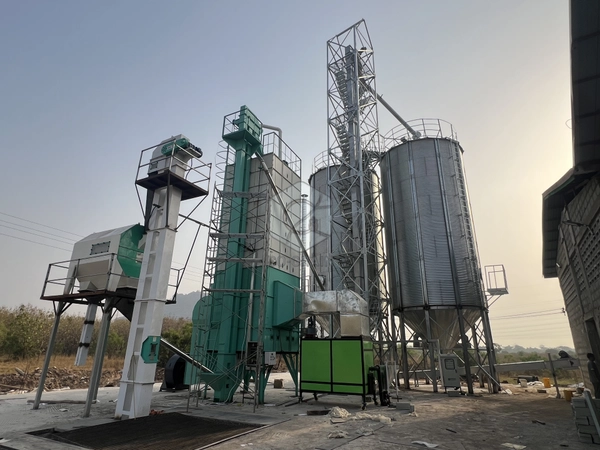
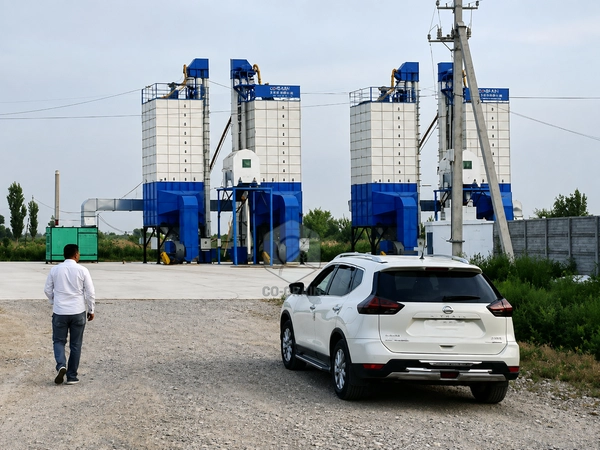
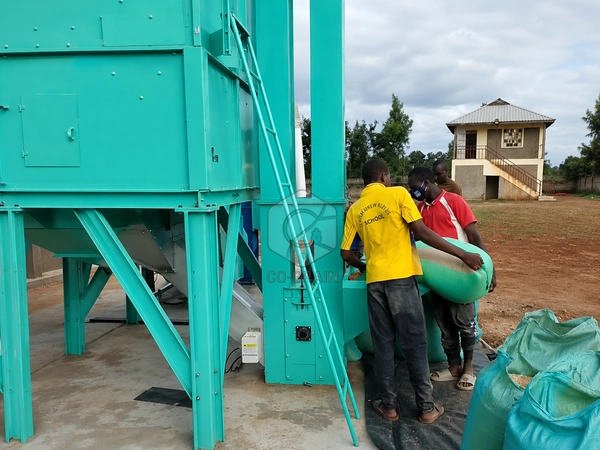
A grain bucket elevator is a vertical conveying machine used to lift paddy, corn, wheat and other bulk grains between different elevations in receiving, drying, storage and processing plants.
It uses a continuous belt or chain fitted with buckets inside an enclosed casing.
A typical grain route is:
Bottom Inlet → Bucket Filling → Vertical Lifting → Head Discharge
Bucket elevators are commonly used in:
Grain Receiving → Pre-Cleaning
Wet Grain Buffer → Grain Dryer
Grain Dryer → Silo-Top Conveyor
Silo Discharge → Processing Plant
They are especially important when grain must move vertically through a large height difference within a compact footprint.
What Is a Grain Bucket Elevator?
A grain bucket elevator is a continuous vertical conveying machine designed to move bulk grain upward.
The main components normally include:
- Boot section
- Inlet
- Buckets
- Belt or chain
- Elevator casing
- Head section
- Drive unit
- Discharge chute
- Tensioning system
- Inspection and monitoring components
Grain enters the bottom of the elevator, is collected by the moving buckets, lifted vertically and discharged from the head section.
This makes the equipment particularly suitable for commercial grain plants where processing machines, silos and dryers are installed at different elevations.
How Does a Grain Bucket Elevator Work?
A bucket elevator works by continuously circulating buckets inside a vertical casing.
The process is:
- Grain Enters the Boot
- Buckets Pick Up Grain
- Belt / Chain Lifts the Buckets
- Buckets Reach the Head
- Grain Leaves Through the Discharge Chute
- Empty Buckets Return to the Boot
The cycle then repeats continuously.
The elevator capacity should be coordinated with upstream and downstream equipment.
Main Components of a Grain Bucket Elevator
1. Boot Section
The boot is the lower section of the elevator.
It contains:
- Grain inlet
- Bottom pulley or sprocket
- Tensioning arrangement
- Inspection access
- Cleanout points depending on design
The upstream conveyor typically feeds grain into this section.
Typical connection:
Drag Chain Conveyor → Bucket Elevator Boot
2. Buckets
Buckets physically carry the grain upward.
Their:
- Size
- Shape
- Spacing
- Material
affect the elevator’s capacity and grain handling characteristics.
The bucket design should be matched with the selected grain and operating speed.
3. Belt or Chain
The buckets are attached to a continuous traction element.
Depending on elevator design, this may be:
- Belt
- Chain
The choice depends on:
- Capacity
- Elevator height
- Grain type
- Operating conditions
- Equipment design
For many grain applications, belt bucket elevators are widely used.
4. Elevator Casing
The casing encloses the moving buckets and grain route.
A tall industrial elevator may use multiple casing sections connected vertically.
The casing provides:
- Structural enclosure
- Dust containment
- Protection of moving parts
- Support for access and monitoring components
For outdoor grain facilities, corrosion and weather conditions should also be considered.
5. Head Section
The head is located at the top of the bucket elevator.
It normally includes:
- Head pulley / sprocket
- Drive
- Bearings
- Discharge section
- Inspection access
As the buckets pass over the head, grain is discharged into the downstream chute or conveyor.
Typical connection:
Bucket Elevator Head → Silo-Top Conveyor
6. Drive System
The drive supplies power to move the belt or chain.
Typical components may include:
- Electric motor
- Gear reducer
- Coupling
- Backstop where required
- Drive pulley / sprocket
Drive selection depends on elevator height, capacity and operating load.
7. Tensioning System
Proper belt or chain tension helps maintain stable bucket movement.
The system may be installed at the boot or another confirmed position according to design.
Incorrect tension can contribute to:
- Belt slip
- Misalignment
- Chain problems
- Unstable operation
Why Is a Bucket Elevator Used Instead of a Conveyor?
The main reason is vertical lift.
A horizontal conveyor is excellent for moving grain across distance, but it is inefficient for large vertical elevation changes.
For example:
Ground Level → 30 m Silo Roof
A Bucket Elevator can lift grain nearly vertically using a relatively compact footprint.
A Belt Conveyor would require a long inclined route to reach the same elevation.
Therefore, commercial grain facilities often combine:
Horizontal Conveyor → Bucket Elevator → Horizontal Conveyor
instead of trying to use one conveyor for the entire route.
Bucket Elevator vs Belt Conveyor
These two machines perform different duties.
- Item Bucket Elevator Belt Conveyor
Main direction Vertical Horizontal / inclined
Footprint Compact Longer
Typical duty Large elevation change Long horizontal transfer
Grain carrying method Buckets Belt
Silo filling Vertical lift to roof Horizontal roof distribution
Typical combination Elevator + top conveyor Conveyor + elevator
A typical silo system uses both:
Bucket Elevator ↑ → Belt / Chain Conveyor → Silos
Bucket Elevator vs Drag Chain Conveyor
A Drag Chain Conveyor is mainly used for enclosed horizontal transfer.
A Bucket Elevator is used for vertical lift.
Typical combination:
- Receiving Pit
- Drag Chain Conveyor
- Bucket Elevator
- Pre-Cleaner / Dryer / Silo Top
The two machines complement each other rather than compete directly.
Bucket Elevator vs Screw Conveyor
A Screw Conveyor is usually selected for short-distance transfer or feeding.
A Bucket Elevator is better suited to major vertical lifting.
For example:
- Hopper Bottom Silo
- Screw Conveyor
- Bucket Elevator
- Processing Equipment
Again, both machines may appear in the same system.
Where Is a Grain Bucket Elevator Used?
Bucket elevators are used throughout a complete grain plant.
Common applications include:
- Grain receiving
- Pre-cleaning
- Wet grain buffering
- Grain dryer feeding
- Dryer discharge
- Silo filling
- Silo discharge
- Rice milling
- Flour milling
- Feed processing
This is why they are among the most important conveying machines in grain engineering.
- Bucket Elevator in a Grain Receiving System
A typical receiving route is:
- Truck
- Receiving Pit
- Drag Chain / Belt Conveyor
- Bucket Elevator
- Pre-Cleaner
The elevator lifts grain from ground level to the elevation required by the cleaner.
This arrangement keeps the receiving section compact.
- Bucket Elevator in a Pre-Cleaning System
After receiving, grain may need to be lifted to:
- Rotary cleaner
- Vibrating cleaner
- Drum cleaner
- Aspiration system
Typical flow:
Receiving Conveyor → Bucket Elevator → Grain Cleaner
After cleaning, another conveyor or elevator may transfer grain to:
Wet Grain Buffer
- Grain Dryer
- Bucket Elevator in a Grain Dryer Feeding System
A dryer often requires grain to enter at a relatively high elevation.
Typical process:
Wet Grain Buffer Silo
- Controlled Discharge
- Conveyor
- Bucket Elevator
- Grain Dryer Inlet
The bucket elevator should provide enough capacity to maintain stable dryer feeding.
Why Is Stable Dryer Feeding Important?
A grain dryer operates according to a defined material-flow rate.
If the elevator is undersized, the dryer may experience:
- Underfeeding
- Reduced throughput
- Unstable operation
If the upstream system overloads the elevator, problems can include:
- Boot buildup
- Motor overload
- Belt slip
- Blockage
Therefore, the bucket elevator should be selected together with:
- Buffer Outlet + Conveyor + Dryer Feed Rate
- Bucket Elevator After the Grain Dryer
After drying, grain often needs to be lifted to the silo roof.
Typical process:
- Grain Dryer
- Horizontal Conveyor
- Bucket Elevator
- Silo-Top Conveyor
- Storage Silos
This is one of the most important applications in a complete grain drying and storage plant.
- Bucket Elevator in a Silo Filling System
A common multi-silo layout is:
- Bucket Elevator
- Silo-Top Conveyor
- → Silo 1
- → Silo 2
- → Silo 3
- → Silo 4
The elevator performs the vertical lift.
The top conveyor performs the horizontal distribution.
This allows one elevator to serve multiple silos in many project configurations.
Can One Bucket Elevator Fill Multiple Silos?
Yes.
The typical route is:
- Ground Conveyor
- Bucket Elevator
- Top Chain / Belt Conveyor
- Multiple Silo Inlets
However, the system should confirm:
- Elevator capacity
- Top conveyor capacity
- Number of silos
- Discharge arrangement
- Level sensors
- Route selection
- Structural support
- Automation logic
The elevator itself does not distribute grain to multiple silos; the silo-top conveyor and route-control system perform that function.
Bucket Elevator in a Silo Discharge System
When grain leaves storage, it may enter another bucket elevator.
Typical route:
- Storage Silo
- Outlet
- Bottom Drag Chain / Screw / Belt Conveyor
- Bucket Elevator
- Processing / Loading System
This elevator may transfer grain to:
- Rice mill
- Flour mill
- Feed mill
- Truck loading
- Another storage system
- Bucket Elevator in a Rice Mill
Bucket elevators are also widely used inside rice mills.
A typical rice process includes:
- Paddy Cleaner
- Destoner
- Husker
- Paddy Separator
- Rice Whitener
- Polisher
- Grader
Different machines may operate at different heights.
Bucket elevators transfer paddy and rice vertically between these process stages.
Bucket Elevator for Paddy
Paddy handling requires attention to grain damage.
The complete elevator system should consider:
- Bucket speed
- Bucket design
- Inlet loading
- Discharge geometry
- Transfer chute
- Drop height
- Number of conveying stages
A properly designed bucket elevator can be used effectively in paddy drying, storage and rice milling systems.
Bucket Elevator for Corn
Corn drying and storage plants frequently use large-capacity bucket elevators.
Typical route:
- Truck Receiving
- → Cleaner
- → Wet Corn Buffer
- → Dryer
- → Bucket Elevator
- → Large Grain Silos
For large commercial projects, the elevator height may reach the silo-top conveying gallery.
Bucket Elevator for Wheat
Wheat storage plants also commonly use bucket elevators for:
- Receiving
- Cleaning
- Dryer connection
- Silo filling
- Silo discharge
- Flour-mill feeding
Large grain depots may use several elevators serving different routes.
- How to Choose Bucket Elevator Capacity
Capacity is normally specified in:
- T/H — Tons per Hour
But T/H alone is not enough.
The design should consider:
- Grain type
- Bulk density
- Grain moisture
- Elevator height
- Bucket size
- Bucket spacing
- Belt or chain speed
- Inlet conditions
- Discharge conditions
A capacity quotation should therefore be linked to a confirmed grain basis.
Why Bulk Density Matters
Different grains have different bulk densities.
The same volumetric elevator capacity may represent different mass throughput for:
- Paddy
- Corn
- Wheat
Therefore:
- m³/h
- T/H
should not be treated as interchangeable without considering grain bulk density.
This is especially important when one elevator needs to handle several different grains.
- How to Match Bucket Elevator Capacity with a Grain Dryer
Suppose:
- Grain Dryer Capacity = 15 T/H
The dryer-feed elevator should be designed to support the required operating flow.
It is common to include a suitable design margin, but the exact margin should be confirmed by the equipment supplier rather than assumed universally.
The same principle applies after drying:
Dryer Discharge Capacity → Conveyor Capacity → Elevator Capacity
No section should create an unintended bottleneck.
How to Match Bucket Elevator Capacity with Grain Receiving
Receiving capacity is often much higher than average dryer capacity.
For example:
- Truck Receiving Peak
may be:
- 40 T/H
while:
- Dryer
runs at:
- 10 T/H
If the same elevator directly serves the high-capacity receiving route, it must be selected for the required receiving flow.
A wet grain buffer can then separate receiving from dryer feeding.
This is another example of why a plant may use several elevators with different capacities.
How Tall Can a Grain Bucket Elevator Be?
There is no single universal maximum height.
Elevator height depends on:
- Capacity
- Structural design
- Belt / chain design
- Casing
- Wind load
- Support system
- Head platform
- Site conditions
Large grain storage projects can use very tall elevators reaching above the roof line of large steel silos.
The elevator should be structurally designed for the project rather than selected only from conveying capacity.
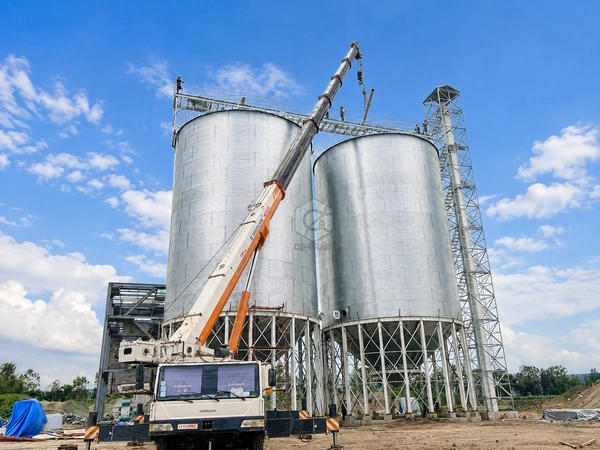
Large Bucket Elevators for Grain Silos
In large silo projects, the Bucket Elevator often becomes one of the tallest structures on site.
A typical configuration is:
- Large Enclosed Bucket Elevator
- Head Platform Above Silo Roof Level
- Horizontal Silo-Top Conveyor
- 4–8 Storage Silos
This is the type of layout commonly seen in large grain depots and storage terminals.
Belt or Chain Bucket Elevator?
Both configurations exist.
The correct choice depends on equipment design and operating duty.
Important considerations include:
- Grain type
- Capacity
- Elevator height
- Speed
- Temperature
- Duty
- Maintenance
For standard grain handling, belt bucket elevators are widely used because they can provide high-capacity continuous lifting with relatively smooth operation.
The final design should follow the confirmed manufacturer’s engineering basis.
How Does Grain Enter the Bucket Elevator?
The inlet geometry is important.
The upstream conveyor should feed grain into the boot in a controlled manner.
Poor feeding can lead to:
- Uneven bucket loading
- Grain buildup
- Excessive recirculation
- Blockage
- Grain damage
The interface should therefore be designed as:
- Upstream Conveyor + Inlet Chute + Boot
rather than treating the elevator inlet as an isolated opening.
How Does Grain Leave the Bucket Elevator?
At the head section, grain leaves the buckets and enters the discharge chute.
The downstream connection may be:
- Pre-cleaner
- Grain dryer
- Chain conveyor
- Belt conveyor
- Silo inlet
- Distributor
The discharge geometry should minimize:
- Grain rebound
- Blockage
- Excessive impact
- Dust leakage
This is especially important when handling paddy or seed.
Bucket Elevator Speed
Higher speed can increase conveying capacity, but faster is not automatically better.
Speed affects:
- Bucket filling
- Discharge behavior
- Grain impact
- Belt load
- Power
- Equipment wear
The correct speed should be determined by the elevator design.
This is another reason to avoid selecting equipment only from motor power or casing size.
Bucket Elevator Safety Monitoring
A commercial grain elevator may use monitoring devices such as:
- Speed-loss sensor
- Belt misalignment sensor
- Bearing temperature monitoring
- Motor overload protection
- Boot blockage monitoring
- Emergency stop
- Access-door safety provisions
These systems can be integrated into the plant PLC.
Why Is Belt Misalignment Monitoring Important?
A belt operating off-center can create:
- Belt wear
- Casing contact
- Bucket contact
- Heat generation
- Equipment damage
A misalignment sensor can provide an alarm or shutdown signal before the problem becomes more severe.
The exact sensor arrangement depends on elevator design.
Why Is Speed Monitoring Important?
If the belt or chain slows significantly or stops while the motor is operating, grain may continue entering the boot.
This can create:
Continued Feeding → Elevator Stops → Boot Blockage
Speed monitoring can help detect abnormal elevator motion and trigger appropriate control logic.
Bearing Temperature Monitoring
Bucket elevator bearings operate continuously under load.
Abnormal bearing temperature can indicate:
- Lubrication problem
- Bearing wear
- Misalignment
- Excessive load
Large commercial grain plants may integrate bearing temperature signals into the control system.
Dust Control Around Bucket Elevators
Bucket elevators can generate dust particularly at:
- Boot inlet
- Head discharge
- Transfer chutes
Possible dust-control measures include:
- Enclosed casing
- Sealed connections
- Aspiration points
- Dust collection
- Proper chute design
- Controlled feeding
An enclosed elevator should not automatically be assumed to eliminate all dust.
Bucket Elevator Installation
Installation quality affects long-term reliability.
Important issues include:
- Vertical alignment
- Casing connection
- Belt / chain installation
- Bucket installation
- Drive alignment
- Tensioning
- Structural support
- Head platform
- Access ladder
- Downstream chute alignment
Large elevators should be installed according to approved project drawings and procedures.
- Maintenance of a Grain Bucket Elevator
Routine maintenance should include inspection of:
- Buckets
- Belt / chain
- Fasteners
- Head pulley / sprocket
- Boot pulley / sprocket
- Bearings
- Drive
- Tensioning
- Casing
- Sensors
- Inlet and discharge chutes
Preventive inspection can help identify problems before they cause an unplanned shutdown.
Common Bucket Elevator Problems
- 1. Belt Misalignment
Possible causes:
- Incorrect tension
- Pulley alignment
- Uneven loading
- Installation problem
- 2. Boot Blockage
Possible causes:
- Excessive feeding
- Downstream stoppage
- Wet grain buildup
- Foreign material
- 3. Bucket Damage
Possible causes:
- Loose fasteners
- Casing contact
- Foreign object
- Incorrect alignment
- 4. Low Capacity
Possible causes:
- Insufficient feeding
- Poor bucket filling
- Belt slip
- Incorrect speed
- Blocked discharge
- 5. Bearing Overheating
Possible causes:
- Lubrication
- Misalignment
- Wear
- Overload
The actual root cause should be confirmed before making adjustments.
Bucket Elevator Start-Up Sequence
Because the elevator is part of a conveying route, start-up sequence matters.
Consider:
Receiving Conveyor → Bucket Elevator → Pre-Cleaner
A simplified concept is:
- Start Pre-Cleaner
- Start Bucket Elevator
- Start Receiving Conveyor / Grain Feed
This ensures downstream equipment is ready before grain enters the system.
The actual sequence should follow the project’s control logic.
Shutdown Sequence
Shutdown normally begins by stopping grain feeding.
Then the elevator and downstream equipment can be allowed to clear according to the approved operating sequence.
This helps reduce:
- Grain accumulation
- Boot blockage
- Restart load
The exact shutdown logic depends on system design.
- Example 1: Grain Receiving & Cleaning
Application:
- Truck Receiving
- Receiving Pit
- Drag Chain Conveyor
- Large Bucket Elevator
- Rotary Grain Cleaner
Why use a Bucket Elevator?
Because the cleaner is installed above ground level and requires vertical grain lifting.
- Example 2: Grain Dryer Feeding
Application:
Wet Grain Buffer Silo
- Controlled Conveyor
- Bucket Elevator
- Grain Dryer
The elevator supplies wet grain to the dryer’s top inlet.
This is a common configuration in commercial grain drying plants.
- Example 3: Silo Filling
Application:
- Grain Dryer
- Horizontal Conveyor
- Bucket Elevator
- Silo-Top Chain Conveyor
- Multiple Grain Silos
This is one of the most important large-scale applications for a grain Bucket Elevator.
- Example 4: Silo Discharge to Rice Mill
Application:
- Paddy Storage Silo
- Bottom Conveyor
- Bucket Elevator
- Rice Mill Pre-Cleaning Section
The elevator reconnects stored paddy with the downstream milling process.
- Example 5: 60 T/D Rice Mill + Dryer + Silos
Consider a system using:
- 15 T/Batch Paddy Dryer
- 2 × 100 T Paddy Silos
- 60 T/D Rice Mill
Bucket elevators may be positioned at several points:
Receiving → Pre-Cleaner
Wet Buffer → Paddy Dryer
Paddy Dryer → Silo Filling
Silo Discharge → Rice Mill
This demonstrates that the Bucket Elevator is not simply an accessory to one machine.
It is a core vertical-transfer component across the entire plant.
How Many Bucket Elevators Does a Grain Plant Need?
There is no universal number.
The quantity depends on:
- Plant layout
- Number of process routes
- Capacity
- Elevation
- Number of silos
- Grain segregation
- Dryer arrangement
- Processing plant configuration
A small plant may use only a few elevators.
A large storage and processing facility may use many elevators serving independent routes.
The objective should be to minimize unnecessary handling while maintaining operational flexibility.
Can One Elevator Serve Several Processes?
Sometimes.
For example, one large elevator may serve several silos through route valves and top conveyors.
However, sharing one elevator between unrelated process routes can create:
- Scheduling conflicts
- Cross-contamination risk
- Reduced redundancy
- Complex automation
The decision should be based on the plant’s actual operating requirements.
What Information Is Needed to Select a Bucket Elevator?
Before requesting a technical proposal, provide:
- Parameter Requirement
- Grain Type Paddy / Corn / Wheat / Other
- Capacity ___ T/H
- Bulk Density ___ / Grain type provided
- Grain Moisture ___%
- Vertical Lift ___ m
- Inlet Elevation ___
- Discharge Elevation ___
- Upstream Equipment ___
- Downstream Equipment ___
- Indoor / Outdoor ___
- Operating Hours ___ H/Day
Project Country ___
This information allows the elevator to be selected as part of the actual material route.
Common Bucket Elevator Selection Mistakes
Mistake 1: Selecting Only by T/H
Height and grain characteristics also matter.
Mistake 2: Ignoring Bulk Density
Different grains produce different mass throughput for the same volume.
Mistake 3: Undersizing the Elevator
The elevator can become the entire plant bottleneck.
Mistake 4: Oversizing Without Need
Unnecessary capacity can increase investment and operating requirements.
Mistake 5: Ignoring Wet Grain
Wet grain may feed differently from dry grain.
Mistake 6: Poor Inlet Design
This can cause poor bucket filling and boot buildup.
Mistake 7: Poor Discharge Design
This can create grain impact and blockage.
Mistake 8: No Monitoring
Large commercial elevators benefit from appropriate condition monitoring.
Mistake 9: No Maintenance Access
Head and boot areas must be accessible for inspection.
Mistake 10: Selecting the Elevator After the Silo Layout Is Fixed
Elevator location affects the entire conveyor and silo distribution layout.
Frequently Asked Questions
What is a grain bucket elevator?
A grain bucket elevator is a vertical conveying machine that uses buckets attached to a belt or chain to lift grain from a lower level to a higher discharge point.
What grains can a bucket elevator handle?
Depending on its design, it can handle paddy, corn, wheat, barley, sorghum and other bulk grains.
Can a bucket elevator fill a grain silo?
Yes. It commonly lifts grain to the silo roof, where a top conveyor distributes it to one or multiple silos.
Can one bucket elevator fill several silos?
Yes, when it feeds a suitable silo-top distribution conveyor and routing system.
Is a bucket elevator better than a belt conveyor?
They perform different duties. Bucket elevators are used mainly for vertical lifting, while Belt Conveyors are mainly used for horizontal or inclined transfer.
Can a bucket elevator feed a grain dryer?
Yes. It is widely used to lift wet grain from a buffer silo or conveyor to the dryer’s top inlet.
Can a bucket elevator handle wet grain?
Yes, when properly designed. Wet grain flowability, inlet design and cleanout should be considered.
How do I choose bucket elevator capacity?
Provide grain type, T/H, grain moisture, vertical lift, upstream and downstream equipment, and operating conditions.
What safety sensors can be used?
Depending on the project, speed monitoring, belt misalignment, bearing temperature, blockage and motor-overload protection may be included.
Is a large bucket elevator suitable for steel silos?
Yes. Large commercial grain silo facilities commonly use tall enclosed Bucket Elevators connected to silo-top conveying galleries.
Key Takeaway
The simplest way to understand a Grain Bucket Elevator is:
- Horizontal Conveyor
- BUCKET ELEVATOR ↑
- Horizontal Conveyor
It solves the vertical part of the grain-handling route.
Typical applications include:
Receiving → Cleaning
Buffer → Dryer
Dryer → Silo
Silo → Processing
For this reason, a bucket elevator is one of the core machines connecting a complete:
- Grain Receiving + Drying + Storage + Processing System
- How Co-Grain Approaches Bucket Elevator Selection
Co-Grain selects Bucket Elevators according to the complete grain-handling route rather than treating them as standalone vertical machines.
Depending on the project, the elevator can connect:
- Truck Receiving
- → Pre-Cleaning
Wet Grain Buffer
- → Grain Dryer
- Grain Dryer
- → Silo Filling & Distribution
- Silo Discharge
- → Rice / Flour / Feed Processing
The elevator is coordinated with:
- Grain capacity
- Grain type
- Moisture
- Lift height
- Upstream conveyor
- Downstream conveyor
- Silo layout
- Maintenance access
- Monitoring
- Automation
The objective is to provide reliable vertical grain transfer without creating a bottleneck in the complete system.