An Air Cushion Belt Conveyor, also called an Air-Supported Belt Conveyor, uses a thin layer of air to support the carrying belt instead of relying mainly on conventional carrying rollers along the loaded route.
A fan supplies air to a chamber beneath the belt, creating an air film that supports the belt and the grain load.
The basic structure is:
- Grain
- Conveyor Belt
- Air Film
- Perforated / Supported Pan
- Air Chamber
This design can be suitable for:
- Long-distance grain transfer
- Large grain storage facilities
- Silo-top conveying galleries
- Grain terminals
- Dryer-to-storage transfer
- High-capacity continuous grain handling
It is not automatically better than a conventional Belt Conveyor. The correct choice depends on capacity, distance, route, investment and operating requirements.
What Is an Air Cushion Belt Conveyor?
An Air Cushion Belt Conveyor is a belt conveying system that uses pressurized air to support the carrying side of the belt.
In a conventional Belt Conveyor, the loaded belt is normally supported by carrying rollers or idlers.
In an Air Cushion Belt Conveyor, the carrying belt runs over an air-support surface.
A fan supplies low-pressure air into the chamber below the belt.
The air passes through openings in the supporting pan and creates a thin air layer.
The belt then rides on this air film.
This can reduce direct mechanical contact between the loaded belt and conventional carrying rollers.
How Does an Air Cushion Belt Conveyor Work?
The working principle is:
- Fan
- → Air Chamber
- → Air Passes Through Supporting Surface
- → Air Film Forms Beneath Belt
- → Belt Carries Grain
The belt still moves continuously between the head and tail sections, but the loaded carrying side is supported by air.
A typical route is:
- Grain Inlet
- Air-Supported Belt
→ → → → →
Discharge
The return belt may use a different support arrangement depending on conveyor design.
Air Cushion Belt Conveyor vs Conventional Belt Conveyor
The most important difference is the carrying support method.
- Conventional Belt Conveyor
- Grain
- Belt
- Carrying Rollers / Idlers
- Air Cushion Belt Conveyor
- Grain
- Belt
- Air Film
- Air Chamber
Both systems use a continuous belt, but the way the loaded belt is supported is different.
Quick Comparison
Factor Conventional Belt Conveyor Air Cushion Belt Conveyor
- Carrying support Rollers / idlers Air film
Main conveying element Belt Belt
Typical route Short to long Medium to long / selected high-capacity routes
Grain handling Gentle Gentle
Carrying-side rollers Many Reduced / replaced by air support
- Air supply fan No Yes
- Silo gallery use Common Very suitable in selected projects
- Long-distance use Strong Strong
- High-capacity grain transfer Strong Strong
- Initial system complexity Lower Higher
- Maintenance focus Belt + rollers Belt + air system
Application decision General purpose Project-specific
Neither system is universally better.
Why Use Air Support Instead of Rollers?
Conventional belt conveyors use many rollers to support the loaded belt.
On a long conveyor, this can mean a large number of:
- Carrying rollers
- Bearings
- Supports
- Alignment points
An Air Cushion Belt Conveyor replaces much of this carrying-side mechanical support with an air layer.
Potential benefits may include:
- Reduced carrying-side rolling contact
- Smoother belt support
- Fewer carrying rollers
- Continuous support across the loaded belt
- Suitability for long enclosed routes
The actual benefit depends on conveyor design and operating conditions.
Main Components of an Air Cushion Belt Conveyor
A typical system may include:
- Head section
- Tail section
- Conveyor belt
- Air chamber
- Air-support pan
- Fan / blower
- Drive system
- Belt tensioning
- Grain inlet
- Grain discharge
- Enclosure
- Inspection access
Safety monitoring
The air supply system is the main feature that distinguishes it from a conventional belt conveyor.
1. Conveyor Belt
The belt carries the grain along the route.
Selection depends on:
- Capacity
- Belt width
- Grain type
- Conveyor length
- Speed
- Temperature
- Duty
The belt must be suitable for the confirmed grain handling application.
2. Air Chamber
The air chamber is installed beneath the carrying belt.
The fan supplies air into this chamber.
Air then passes through the supporting surface beneath the belt.
The chamber should provide relatively even pressure distribution along the route.
3. Air Support Pan
The supporting pan or plate is shaped to support the belt profile.
Small air openings allow air to form the supporting layer.
The belt rides on this air film rather than directly on a conventional row of carrying rollers.
4. Air Supply Fan
The fan provides the air required to maintain the supporting cushion.
Its performance should be coordinated with:
- Conveyor width
- Conveyor length
- Belt load
- Air chamber design
- Pressure requirement
A poorly designed air system can reduce conveyor performance.
5. Drive Section
Like a normal Belt Conveyor, an Air Cushion Belt Conveyor still requires a drive.
Typical components include:
- Motor
- Gear reducer
- Drive pulley
- Coupling
- Bearings
The drive moves the belt continuously.
The air cushion supports the loaded belt but does not replace the drive system.
6. Tail Section
The tail section receives or guides the returning belt and connects with the loading area.
It may also include:
- Tensioning components
- Inspection points
- Belt tracking arrangement
Proper belt tension remains important.
Where Is an Air Cushion Belt Conveyor Used?
This conveyor is particularly relevant to larger grain engineering projects.
Typical applications include:
- Grain silo filling
- Long silo galleries
- Grain terminals
- Dryer-to-storage transfer
- Commercial grain depots
- High-capacity horizontal transfer
- Port grain handling systems
- Large grain processing plants
It is less likely to be justified for very short local transfer routes.
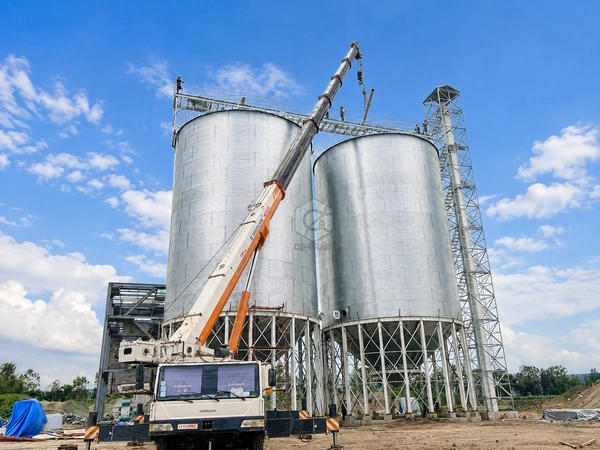
Air Cushion Belt Conveyor for Grain Silos
One of the most suitable applications is on top of a large silo group.
Typical system:
- Bucket Elevator
- Air Cushion Belt Conveyor
- → Silo 1
- → Silo 2
- → Silo 3
- → Silo 4
- → Silo 5
This allows one elevated conveyor route to distribute grain across multiple storage silos.
For long silo rows, the Air Cushion Belt Conveyor can be an attractive option.
Why Is It Suitable for Long Silo Galleries?
A long silo gallery may require a conveyor route of substantial length.
The conveyor must:
- Maintain capacity
- Protect grain
- Limit dust
- Remain accessible for maintenance
- Operate continuously
- Integrate with multiple silo discharge points
Air Cushion Belt Conveyors are worth evaluating in this type of application because they combine belt conveying with an enclosed air-support structure.
Air Cushion Belt Conveyor for Grain Dryer Systems
A grain dryer may be located some distance from the storage silos.
The route may be:
- Grain Dryer
- Bucket Elevator
- Air Cushion Belt Conveyor
- Storage Silos
This can be useful when the dryer and silo group are separated by a longer horizontal distance.
For short dryer-to-silo transfer, a Drag Chain Conveyor may be more economical.
- Air Cushion Belt Conveyor for Grain Terminals
Large grain terminals often require:
- High throughput
- Long conveying distance
- Continuous operation
- Enclosed or protected routes
Possible applications include:
- Ship / Truck Receiving
- → High-Capacity Conveyor
- → Storage Silos
- Storage Silos
- → Long Conveyor
- → Loading / Processing
Air Cushion Belt Conveyor can be evaluated for these types of large routes.
Which Grains Can It Handle?
Depending on design, it can convey:
- Paddy
- Corn
- Wheat
- Barley
- Sorghum
- Soybeans
- Other grains
Because it uses belt conveying, it can provide relatively gentle grain handling compared with more aggressive transfer methods.
This can be useful for:
- Paddy
- Seed
- High-value grain
where grain damage needs attention.
Is Air Cushion Belt Conveyor Good for Paddy?
Yes, it can be suitable.
Paddy is relatively sensitive to repeated impact and mechanical stress.
A Belt Conveyor carries grain rather than pushing it continuously through a casing.
Therefore, for longer paddy transfer routes, belt-based conveying can be attractive.
The complete system should still minimize:
- Drop height
- Transfer points
- Excessive belt speed
- Poor chute design
Is It Good for Corn?
Yes.
Large commercial corn storage facilities may use Air Cushion Belt Conveyors for long routes between:
- Dryer
- Silo
- Terminal
- Processing plant
However, Drag Chain Conveyors and conventional Belt Conveyors remain very common.
The choice depends mainly on project scale.
Is It Good for Wheat?
Yes.
Large wheat silos and grain depots can use this conveyor for:
- Silo-top distribution
- Long grain transfer
- Terminal handling
Wheat’s high-volume commercial storage applications make long belt routes particularly relevant.
How Long Does the Conveyor Need to Be Before Air Cushion Becomes Attractive?
There is no universal minimum length.
The decision depends on:
- Required capacity
- Conveyor length
- Belt width
Number of conventional rollers that would otherwise be required
- Maintenance strategy
- Air-system investment
- Energy use
Project scale
A short 10–20 m route may not justify the added air system.
A long commercial silo gallery may make the comparison more meaningful.
Final selection should be based on lifecycle cost, not one fixed distance rule.
Capacity Considerations
Air Cushion Belt Conveyor capacity depends on:
- Belt width
- Belt speed
- Grain loading
- Bulk density
- Route inclination
- Inlet design
- Discharge arrangement
Like any grain conveyor:
- Same Belt Width ≠ Same T/H for Every Grain
Paddy, corn and wheat have different bulk densities.
Capacity should therefore always be stated with the grain basis.
How Does Conveyor Speed Affect Performance?
Higher belt speed can increase capacity.
But excessive speed can also increase:
- Grain impact
- Dust
- Transfer-point loading
- Belt wear
For paddy and seed, grain quality should be considered.
The objective should be:
- Required Capacity + Controlled Speed
rather than maximum possible speed.
Air Cushion vs Drag Chain Conveyor
These two conveyors solve different problems.
- Air Cushion Belt Conveyor
Better suited to:
- Long horizontal transfer
- Gentle grain handling
- Long silo galleries
- High-capacity routes
- Drag Chain Conveyor
Better suited to:
- Compact enclosed routes
- Multiple inlets
- Multiple outlets
- Silo bottom collection
- Shorter silo-top distribution
A typical selection rule is:
Long Route → Air Cushion / Belt
Multi-Point Compact Route → Drag Chain
Air Cushion vs Screw Conveyor
The difference is even greater.
- Screw Conveyor
Best for:
- Short transfer
- Hopper discharge
- Compact feeding
- Air Cushion Belt Conveyor
Best for:
- Long-distance horizontal transport
- High-capacity grain routes
- Large silo or terminal projects
They normally do not compete for the same application.
Air Cushion Belt Conveyor vs Enclosed Belt Conveyor
Both may use enclosed structures.
The difference is the belt support.
- Enclosed Conventional Belt
Belt → Rollers
inside an enclosure.
- Air Cushion Belt
Belt → Air Film
inside the support system.
Therefore, enclosure alone does not identify an Air Cushion Belt Conveyor.
The air chamber and fan system are the key features.
Can It Have Multiple Discharge Points?
Yes, depending on the design.
For silo filling, multiple discharge points may be required.
Possible solutions include:
- Plough discharge
- Tripper arrangement
- Special outlet devices
- Project-specific distribution system
The discharge strategy should be confirmed according to the silo layout.
Drag Chain Conveyor may still be simpler for compact multi-outlet routes.
Is It Fully Enclosed?
Many grain Air Cushion Belt Conveyor applications use an enclosed or covered structure.
This provides:
- Weather protection
- Dust containment
- Cleaner operating environment
However, the exact enclosure should be confirmed for the selected model.
A covered conveyor should not automatically be described as fully sealed.
- Dust Control
Even with an enclosed conveyor, dust may be generated at:
- Loading points
- Discharge points
- Transfer chutes
Possible dust-control measures include:
- Sealed chute
- Aspiration connection
- Dust collector
- Controlled loading
- Reduced drop height
The conveyor housing is only one part of the dust-control system.
- Energy Considerations
An Air Cushion Belt Conveyor requires energy for:
- Belt drive
- Air-support fan
Therefore, it should not be assumed that the air system automatically means lower total power in every case.
The actual comparison should consider:
- Length
- Capacity
- Belt width
- Roller resistance
- Fan power
- Operating hours
- Maintenance
For large routes, lifecycle energy and maintenance should be evaluated together.
Maintenance Advantages and Considerations
A conventional long Belt Conveyor can include many carrying rollers.
These require inspection and replacement over time.
An Air Cushion Belt Conveyor can reduce the number of carrying-side roller components.
However, it adds:
- Fan
- Air chamber
- Air openings
- Air distribution system
Therefore, maintenance shifts from:
- Many Carrying Rollers
toward:
- Air-Support System + Belt
This should be considered during project evaluation.
What Maintenance Does an Air Cushion Belt Conveyor Need?
Routine inspection may include:
- Conveyor belt
- Belt tracking
- Head pulley
- Tail pulley
- Drive
- Tensioning system
- Fan
- Air chamber
- Air holes / support pan
- Seals
- Inlet and discharge chutes
- Sensors
Dust buildup should not restrict the air-support system.
Common Problems
- 1. Insufficient Air Support
Possible causes:
- Fan problem
- Blocked air openings
- Air leakage
- Incorrect pressure
- 2. Belt Misalignment
Possible causes:
- Incorrect tension
- Poor loading
- Alignment problem
- 3. Low Capacity
Possible causes:
- Insufficient feed
- Belt speed
- Poor loading
- Restricted discharge
- 4. Dust Leakage
Possible causes:
- Poor sealing
- Transfer-point leakage
- Damaged cover
- 5. Abnormal Fan Load
Possible causes:
- Blockage
- Air-system restriction
- Mechanical issue
Safety Monitoring
Possible monitoring includes:
- Belt misalignment
- Belt speed
- Motor overload
- Bearing temperature
- Fan status
- Air pressure
- Emergency pull cord
- Blockage detection
Large grain handling systems can integrate these signals with PLC control.
Why Fan Monitoring Matters
The air cushion depends on the fan.
If air supply is lost while the conveyor continues operating under load, belt support conditions can change.
The control system should therefore monitor fan operation and respond according to the approved operating logic.
This is one important difference from a conventional belt conveyor.
Start-Up Sequence
A simplified start-up concept can be:
- Start Downstream Equipment
- Start Air-Support Fan
- Confirm Air System Ready
- Start Belt Conveyor
- Start Grain Feed
The exact sequence depends on the manufacturer’s design.
Shutdown Sequence
A simplified concept is:
- Stop Grain Feed
- Allow Conveyor to Clear
- Stop Belt
- Stop Air-Support Fan according to approved sequence
The actual operating procedure should follow the equipment manual and control design.
- Example 1: Silo-Top Distribution
Project:
- 6 Large Steel Grain Silos
Possible route:
- Bucket Elevator
- Air Cushion Belt Conveyor
- Multiple Silo Filling Points
This is suitable when the silo row is long and conveying distance is substantial.
- Example 2: Dryer-to-Storage Transfer
Project:
- Large Continuous Grain Dryer located away from silo group
Possible system:
- Grain Dryer
- Bucket Elevator
- Air Cushion Belt Conveyor
- Storage Silos
This avoids multiple short conveyors and transfer points.
- Example 3: Grain Terminal
Project:
- High-Capacity Bulk Grain Handling
Possible system:
- Receiving
- Long Air Cushion Conveyor
- Bucket Elevator / Silo
The long route and high throughput can make Air Cushion technology worth evaluating.
When Should You Choose an Air Cushion Belt Conveyor?
Consider it when:
- Horizontal distance is long
Capacity is high
- Silo gallery is long
- Grain needs relatively gentle handling
- Enclosed transfer is preferred
- Continuous operation is important
- The project is medium-to-large scale
- Lifecycle maintenance is an important consideration
When Is It Probably Not Necessary?
It may not be necessary when:
- Route is very short
Capacity is low
- One simple local transfer is required
- Multiple compact discharge points favor Drag Chain
- Budget does not justify the air-support system
A conventional Belt Conveyor already solves the route efficiently
The best solution should be selected according to project value, not equipment sophistication.
Common Selection Mistakes
Mistake 1: Choosing Air Cushion Only Because It Sounds More Advanced
The route must justify the technology.
Mistake 2: Using It for Very Short Routes
A conventional conveyor may be more practical.
Mistake 3: Ignoring Fan Power
Air support requires an additional fan system.
Mistake 4: Ignoring Multiple Discharge Complexity
Compact multi-silo distribution may favor Drag Chain.
Mistake 5: Comparing Only Purchase Price
Lifecycle maintenance and energy also matter.
Mistake 6: Ignoring Transfer Points
Even a good conveyor can damage grain through poor inlet and discharge design.
Mistake 7: Calling Every Enclosed Belt Conveyor an Air Cushion Conveyor
The conveyor must have a real air-support chamber and fan system.
Frequently Asked Questions
What is an Air Cushion Belt Conveyor?
It is a Belt Conveyor in which the loaded belt is supported by a thin layer of air generated by a fan and air chamber.
What is the difference between Air Cushion and normal Belt Conveyor?
A normal Belt Conveyor uses carrying rollers, while an Air Cushion Belt Conveyor uses an air-supported carrying surface.
Is Air Cushion Conveyor suitable for grain silos?
Yes. It is particularly suitable for selected long silo-top galleries and large commercial grain storage projects.
Is it suitable for paddy?
Yes. Its belt-based conveying can provide relatively gentle handling for paddy when the system is properly designed.
Can it replace a Drag Chain Conveyor?
Sometimes for long horizontal routes, but Drag Chain remains better for many compact multi-inlet or multi-outlet applications.
Is it better than a conventional Belt Conveyor?
Not always. It may provide advantages in selected long, high-capacity routes, but project economics and operating conditions must be evaluated.
Does it use less energy?
Not necessarily in every project. Belt-drive and fan energy should both be considered.
Does it need an air blower?
Yes. The fan or blower generates the air cushion beneath the carrying belt.
Can it operate outdoors?
Yes, when the structure and enclosure are designed for the local weather and site conditions.
What information is needed for selection?
Provide grain type, capacity, distance, inclination, number of inlets/outlets, project layout and operating hours.
Key Takeaway
The easiest way to understand an Air Cushion Belt Conveyor is:
- Conventional Belt Conveyor
- Belt + Rollers
versus:
- Air Cushion Belt Conveyor
- Belt + Air Film + Air Chamber
Its strongest application is not usually a short local grain transfer.
It becomes more interesting when the project requires:
Long Distance + High Capacity + Gentle Handling + Silo / Terminal Integration
For compact silo routes with many inlets or outlets, Drag Chain Conveyor may still be better.
For very short feeding, Screw Conveyor may be better.
For vertical lift, use Bucket Elevator.
The correct system often combines all of these.
How Co-Grain Approaches Air Cushion Conveyor Selection
Co-Grain evaluates Air Cushion Belt Conveyor as part of the complete grain conveying route.
Typical applications can connect:
- Grain Dryer
- → Long Horizontal Transfer
- → Storage Silos
- Bucket Elevator
- → Silo-Top Conveyor
- → Multiple Silos
Selection considers:
- Grain type
- T/H
- Conveyor length
- Belt width
- Grain damage requirements
- Silo layout
- Enclosure
- Dust control
- Air-support system
- Maintenance
- Operating hours
- Lifecycle cost
The goal is not to use the most complex conveyor technology.
The goal is to select the most suitable conveying system for the actual project.