A Drag Chain Conveyor is an enclosed conveying machine used to move paddy, corn, wheat and other bulk grains horizontally or at a limited incline.
It uses a continuous chain fitted with flights or paddles to move grain through an enclosed casing.
Typical applications include:
Receiving Pit → Bucket Elevator Grain Dryer → Storage Transfer Bucket Elevator → Silo-Top Distribution Multiple Silo Outlets → Common Bottom Conveyor
Its main strengths are:
Enclosed Conveying + Multiple Inlets + Multiple Outlets + Compact Grain Transfer + Strong Silo Integration
A Drag Chain Conveyor is a mechanical conveying system designed to move bulk grain through an enclosed horizontal casing.
The main conveying element is:
- Chain + Flights / Paddles
As the chain moves, the flights carry or drag grain toward the discharge point.
Typical components include:
- Drive section
- Conveyor chain
- Flights
- Enclosed casing
- Inlet
- Discharge outlet
- Tail section
- Tensioning system
- Bearings
- Inspection covers
- Sensors and monitoring devices
This type of conveyor is widely used in commercial grain storage and drying systems.
The drive unit pulls a continuous chain through the conveyor casing.
Flights attached to the chain move grain from the inlet toward the discharge point.
The basic process is:
- Grain Inlet
- Chain + Flights
→ → → → →
Discharge
The return chain then travels back through the conveyor and repeats the cycle.
Depending on the design, the conveyor can operate:
- Horizontally
- At a slight incline
- With one inlet
- With multiple inlets
- With one outlet
- With multiple outlets
This flexibility is one of the main reasons it is so widely used in grain silo systems.
The term En-Masse Conveyor is often used for enclosed chain conveying systems where grain moves as a continuous mass inside the casing.
Instead of each flight carrying a separate pile of grain, the movement of the chain causes the bulk material to flow together through the conveyor.
In commercial grain handling, the terms:
- Drag Chain Conveyor
- En-Masse Conveyor
may sometimes be used for closely related equipment types.
The exact internal chain, flight and casing design should be confirmed for the selected model.
The drive section normally includes:
- Electric motor
- Gear reducer
- Drive sprocket
- Coupling
- Bearings
It provides the power needed to move the chain.
Drive sizing depends on:
- Conveyor length
- Capacity
- Grain type
- Filling depth
- Inclination
- Chain resistance
The chain is the main traction component.
It runs continuously through the conveyor casing.
The chain must be designed for:
- Operating load
- Wear
- Conveyor length
- Grain capacity
- Start-up conditions
Routine inspection should include chain elongation and wear.
Flights are attached to the chain and move grain through the casing.
Their:
- Shape
- Spacing
- Material
- Height
affect the conveying behavior.
For grain applications, the goal is to move bulk material efficiently without unnecessary mechanical stress.
The casing contains the grain and moving chain.
Advantages include:
- Reduced grain exposure
- Weather protection
- Better dust containment
- Compact installation
- Safer mechanical enclosure
However, transfer points still require proper dust-control design.
Grain enters through one or more inlet openings.
Typical upstream equipment may include:
- Receiving pit
- Silo outlet
- Grain dryer
- Bucket elevator
- Pre-cleaner
- Buffer silo
The inlet should load the conveyor evenly.
Poor loading can cause:
- Overfilling
- Uneven chain load
- Blockage
- Excessive wear
The conveyor may use:
- One discharge point
- Multiple discharge points
Multiple discharge points are particularly useful for Silo Filling & Distribution Systems.
Typical example:
Bucket Elevator → Drag Chain Conveyor → Silo 1 / 2 / 3 / 4
The tail section guides the return chain and usually includes a tensioning arrangement.
Correct chain tension helps prevent:
- Chain derailment
- Excessive slack
- Sprocket wear
- Unstable operation
Tension should follow the manufacturer’s approved procedure.
Its strengths fit many grain applications well.
Grain is protected inside the conveyor casing.
Several silos or process outlets can feed one conveyor.
One conveyor can distribute grain to several destinations.
The conveyor can run close to silo roofs, silo bottoms and process equipment.
It can be configured for substantial continuous grain flow.
It works naturally with:
- Bucket elevators
- Grain dryers
- Storage silos
- Pre-cleaners
- Truck receiving systems
A typical grain receiving system is:
- Truck
- Receiving Pit
- Drag Chain Conveyor
- Bucket Elevator
- Pre-Cleaner
This is one of the most common commercial applications.
The Drag Chain Conveyor moves grain horizontally out of the receiving pit toward the Bucket Elevator.
A receiving pit needs to move a large amount of grain away quickly.
A Drag Chain Conveyor can provide:
- Enclosed transfer
- Compact installation below the pit
- High-capacity horizontal movement
- Direct connection to Bucket Elevator
This helps create a smooth receiving route.
Before drying, the conveyor can transfer grain between:
- Pre-cleaner
- Wet Grain Buffer
- Bucket Elevator
- Grain Dryer
Typical process:
- Cleaner
Wet Grain Buffer
- Drag Chain Conveyor
- Bucket Elevator
- Grain Dryer
For larger plants, this can be more practical than using long Screw Conveyors.
After drying, grain may need to travel horizontally toward a silo elevator.
Typical flow:
- Grain Dryer
- Drag Chain Conveyor
- Bucket Elevator
- Silo-Top Conveyor
- Storage Silos
This is a common Dryer-to-Storage arrangement.
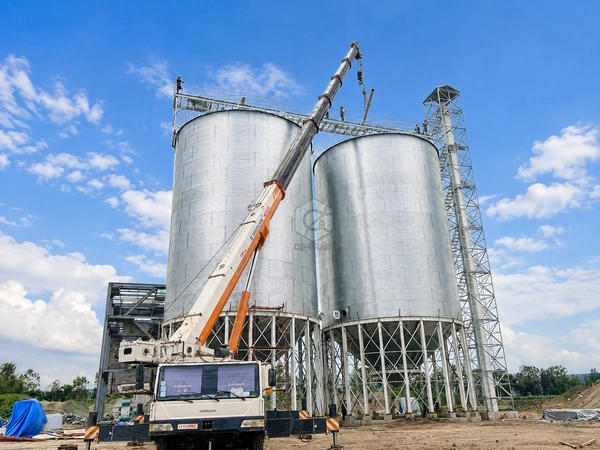
This is one of its strongest applications.
Typical system:
- Bucket Elevator
- Drag Chain Conveyor
- → Silo 1
- → Silo 2
- → Silo 3
- → Silo 4
Each silo can have a controlled discharge opening or gate along the conveyor route.
This allows one elevator and one top conveyor to serve multiple silos.
Because one enclosed conveyor can have several discharge points.
This provides:
- Simple routing
- Compact top-gallery layout
- Easy multi-silo integration
- Good dust containment
- Centralized distribution
For 4–8 silo projects, this arrangement is very common.
The same equipment can also work below multiple silos.
Typical layout:
- Silo 1 ↓ Silo 2 ↓ Silo 3 ↓ Silo 4 ↓
- → Common Drag Chain Conveyor
- → Bucket Elevator
This is a very effective multi-inlet collecting system.
Several silo outlets can discharge into the same enclosed conveyor.
The conveyor then moves the selected grain toward:
- Bucket Elevator
- Rice Mill
- Flour Mill
- Feed Mill
- Truck Loading
- Another storage system
This is one of the main differences between Drag Chain and Screw Conveyor applications.
A Screw Conveyor is usually better for:
- Short transfer
- Hopper feeding
- Compact local discharge
A Drag Chain Conveyor is generally better for:
- Longer horizontal route
- Multi-silo collection
- Multiple outlets
- Commercial grain flow
Simple rule:
Short + Compact → Screw
Longer + Multi-Point → Drag Chain
A Belt Conveyor is often better for:
- Longer horizontal distance
- Gentler grain handling
- Paddy or seed
- Outdoor long-distance transfer
A Drag Chain Conveyor is often better for:
- Enclosed compact routes
- Multiple inlets
- Multiple outlets
- Silo top / bottom integration
The two can be used together in one plant.
These machines have completely different duties.
- Drag Chain Conveyor
- → Horizontal transfer
- Bucket Elevator
- ↑ Vertical lifting
A common combination is:
Drag Chain Conveyor → Bucket Elevator
then:
Bucket Elevator → Drag Chain Conveyor
This creates both horizontal and vertical material movement.
Standard Drag Chain Conveyors are commonly used horizontally.
Selected designs can operate at limited inclination.
When the elevation change becomes larger, an Inclined Chain Conveyor or Bucket Elevator may be more appropriate.
The exact allowable inclination depends on:
- Chain design
- Flight design
- Grain
- Capacity
- Conveyor geometry
Do not assume the same capacity at all inclinations.
Depending on design, Drag Chain Conveyors can handle:
- Paddy
- Corn
- Wheat
- Barley
- Sorghum
- Soybean
- Other grains
The equipment should be checked for:
- Bulk density
- Moisture
- Flowability
- Grain damage sensitivity
before final selection.
For paddy, the conveyor can be used in:
- Receiving
- Dryer transfer
- Silo filling
- Silo discharge
However, paddy quality requires attention to:
- Chain speed
- Drop height
- Transfer chute
- Grain impact
- Number of transfer points
For very long gentle transfer, Belt Conveyor may be worth considering.
Large corn drying and storage facilities frequently use Drag Chain Conveyors.
Typical route:
- Truck Receiving
- → Drag Chain Conveyor
- → Bucket Elevator
- → Cleaner
- → Dryer
then:
- Dryer
- → Drag Chain Conveyor
- → Bucket Elevator
- → Large Grain Silos
This equipment is especially suitable for large storage projects.
Wheat projects also commonly use Drag Chain Conveyors for:
- Receiving
- Silo filling
- Silo bottom collection
- Dryer transfer
- Flour-mill raw grain handling
Longer inter-building routes may instead use Belt or Air Cushion Belt Conveyor.
Capacity is typically specified in:
- T/H
But actual capacity depends on:
- Grain type
- Bulk density
- Casing size
- Filling depth
- Chain speed
- Flight design
- Inclination
- Inlet loading
- Discharge condition
A proper proposal should always state the grain basis.
A conveyor moves a certain bulk volume.
Paddy, corn and wheat have different bulk densities.
Therefore:
- Same Conveyor Volume ≠ Same T/H for Every Grain
A conveyor advertised as a certain T/H should be evaluated according to the specific grain.
Wet grain can be more difficult to move because of:
- Reduced flowability
- Greater adhesion
- Higher resistance
- More impurities
This is especially important before a grain dryer.
The conveyor should be checked under the expected wet-grain condition, not only dry grain.
Longer conveyors require consideration of:
- Chain tension
- Drive power
- Casing alignment
- Wear
- Structural support
As distance increases, Belt Conveyor may also become a strong alternative.
The equipment choice should compare:
- Drag Chain vs Belt
for the actual route.
Increasing chain speed can raise capacity, but excessive speed may increase:
- Wear
- Grain impact
- Dust
- Mechanical load
The correct speed should therefore balance:
Capacity + Grain Quality + Reliability
rather than maximizing speed.
One of the major strengths of a Drag Chain Conveyor is multi-inlet operation.
Example:
- Silo 1 ↓
- Silo 2 ↓
- Silo 3 ↓
- → Drag Chain Conveyor
However, the control system should prevent total inlet flow from exceeding conveyor capacity.
If several gates open simultaneously, overload can occur.
Multiple outlet operation is equally important.
Example:
- Bucket Elevator
- Drag Chain Conveyor
→ Outlet 1 → Silo 1 → Outlet 2 → Silo 2 → Outlet 3 → Silo 3
The routing system should ensure grain enters the correct silo.
This may involve:
- Slide gates
- Route valves
- Position feedback
- Level sensors
- PLC interlocks
The enclosed casing helps contain dust.
But dust may still occur at:
- Inlet
- Discharge
- Transfer chute
- Inspection point
Possible dust-control measures include:
- Sealed connections
- Aspiration
- Dust collection
- Controlled grain drop
A complete grain route should be considered.
Depending on project requirements, monitoring can include:
- Chain speed / motion
- Bearing temperature
- Motor overload
- Blockage sensor
- Gate position
- Emergency stop
These signals can integrate with the plant PLC.
If the chain stops while upstream equipment continues feeding, grain can accumulate inside the conveyor.
This can result in:
- Upstream Feed Continues
- Chain Stops
- Grain Accumulation
- Blockage / Overload
A chain-motion or speed sensor can help detect this condition.
Consider:
Drag Chain Conveyor → Bucket Elevator → Pre-Cleaner
The downstream machine should generally be ready before upstream grain is released.
A simplified sequence may be:
- Start Pre-Cleaner
- Start Bucket Elevator
- Start Drag Chain Conveyor
- Start Grain Feed
Actual logic should follow the approved control system.
The opposite logic generally applies.
First:
- Stop Grain Feed
Then allow the conveyor route to clear.
This can reduce:
- Restart load
- Grain accumulation
- Blockage
Routine inspection should include:
- Chain
- Flights
- Sprockets
- Bearings
- Drive
- Wear liners
- Tensioning system
- Casing
- Inspection covers
- Sensors
Preventive maintenance is especially important in continuous grain storage plants.
Chains gradually wear over time.
Excessive elongation can affect sprocket engagement.
Flights may wear from continuous contact with grain and casing.
Possible causes include:
- Poor tension
- Worn chain
- Misalignment
- Foreign object
Possible causes:
- Excessive feed
- Downstream stop
- Wet grain
- Foreign material
Possible causes:
- Poor inlet loading
- Incorrect chain speed
- Grain buildup
- Outlet restriction
Useful practices include:
- Correct chain tension
- Stable feeding
- Avoiding overload
- Routine inspection
- Proper lubrication where applicable
- Replacing worn liners
- Maintaining alignment
Wear should be managed proactively rather than waiting for chain failure.
- Truck Receiving
- Receiving Pit
- Drag Chain Conveyor
- Bucket Elevator
This is a compact high-capacity receiving solution.
- Grain Dryer
- Drag Chain Conveyor
- Bucket Elevator
- Silo-Top Conveyor
- Storage Silos
This connects drying and storage.
- Bucket Elevator
- Drag Chain Conveyor
- → Silo 1
- → Silo 2
- → Silo 3
- → Silo 4
This is one of the strongest applications for Drag Chain Conveyors.
- Silo 1 ↓
- Silo 2 ↓
- Silo 3 ↓
- Silo 4 ↓
- → Drag Chain Conveyor
- → Bucket Elevator
This shows its strength in multi-inlet grain collection.
Consider a system with:
- 15 T/Batch Paddy Dryer
- 2 × 100 T Silos
- 60 T/D Rice Mill
A possible conveying arrangement is:
- Paddy Receiving
- → Drag Chain Conveyor
- → Bucket Elevator
- → Pre-Cleaning
- → Paddy Dryer
then:
- Dryer
- → Drag Chain Conveyor
- → Silo Elevator
- → Paddy Storage
then:
- Storage
- → Bottom Conveyor
- → Rice Mill
This demonstrates how Drag Chain Conveyor can appear at several positions in one complete project.
Consider it when:
- Enclosed horizontal transfer is required
- Several grain sources feed one conveyor
- One conveyor must feed several silos
- Silo-top distribution is required
- Silo-bottom collection is required
- Receiving pit discharge is required
- Dryer-to-storage transfer is relatively compact
- Distance is long
- Gentle handling is important
- Paddy or seed is sensitive
- Long outdoor transfer is needed
- Route is very short
- Hopper feeding is required
- Installation is compact
- Major vertical lift is required
The best project often combines several types.
Long routes may be better served by Belt Conveyor.
Several open silo gates can overload one conveyor.
Wet grain can increase resistance and blockage risk.
Distance, grain type and inclination also matter.
Chain, flights and liners need inspection.
Can cause grain damage and blockage.
Large commercial systems should consider speed and overload monitoring.
It is an enclosed conveyor that uses a moving chain with flights or paddles to transfer bulk grain horizontally or at a limited incline.
Typical uses include receiving pit discharge, dryer transfer, silo-top filling, silo-bottom collection and general enclosed grain transfer.
Yes. Multiple discharge points can direct grain into several silos.
Yes. This is one of its most common silo-bottom applications.
Yes, when correctly selected. Grain speed, transfer points and damage requirements should be considered.
Yes, but wet grain flowability and capacity should be checked under actual moisture conditions.
For longer commercial routes and multiple inlets or outlets, usually yes. Screw Conveyor is often better for short compact feeding.
Not universally. Drag Chain is strong for enclosed multi-point routes; Belt is often better for longer and gentler transfer.
Yes within approved limits. For large elevation changes, an Inclined Chain Conveyor or Bucket Elevator may be better.
Provide grain type, T/H, distance, inclination, moisture, number of inlets and outlets, and upstream/downstream equipment.
A Drag Chain Conveyor is especially valuable when a grain plant requires:
- Enclosed Transfer
- –
- Multiple Inlets
- –
- Multiple Outlets
- –
- Silo Integration
A simple way to remember its role is:
Receiving Pit → Drag Chain → Elevator
Elevator → Drag Chain → Multiple Silos
Multiple Silos → Drag Chain → Elevator
This makes it one of the most versatile horizontal conveying machines in commercial grain drying and storage systems.
Co-Grain selects Drag Chain Conveyors according to the actual grain route.
The equipment can be integrated into:
Grain Receiving → Pre-Cleaning
Wet Grain Buffer → Grain Dryer
Grain Dryer → Storage Silos
Silo Filling → Multiple Silos
Silo Discharge → Processing / Loading
Selection considers:
- Grain type
- Capacity
- Moisture
- Distance
- Inclination
- Multiple inlets
- Multiple outlets
- Grain damage
- Dust control
- Maintenance access
- Automation
The objective is to create a reliable enclosed transfer route that matches the complete grain handling system.