Paddy drying can directly influence the physical condition of rice kernels before milling. If moisture is removed too quickly or unevenly, internal stress may cause kernels to fissure. These fissures weaken the grain and can result in more broken rice during husking, whitening and polishing.
A properly controlled drying process aims to achieve:
Uniform Moisture + Controlled Drying + Reduced Kernel Stress + Stable Storage + Better Milling Performance
However, drying is only one factor affecting milling yield. Paddy variety, harvesting, storage, handling and rice mill settings also influence the final percentage of whole and broken rice.
Why Does Paddy Drying Matter to a Rice Mill?
For a rice mill, the performance of the milling machines is only part of the final result.
The condition of the paddy entering the mill is equally important.
Two batches of the same rice variety processed by the same rice milling line can produce different results if their post-harvest conditions are different.
One batch may have:
- Uniform moisture
- Few fissured kernels
- Stable storage history
Another may have:
- Large moisture variation
- More internal cracks
- Repeated wetting and drying
- Poor storage conditions
Even when the rice mill settings are identical, the second batch may produce more broken rice.
This creates an important relationship:
Paddy Quality → Drying → Storage → Milling → Finished Rice Quality
For this reason, a rice mill should not evaluate the drying section separately from the milling section.
What Is Broken Rice?
Broken rice consists of kernels that break during rice processing and are separated from whole or larger kernels during grading.
Breakage can occur during several stages:
- Paddy Handling
- → Husking
- → Paddy Separation
- → Whitening
- → Polishing
- → Grading
Some breakage is caused directly by mechanical processing.
However, kernels that were already weakened by fissures before entering the mill are more likely to break when exposed to mechanical forces.
Therefore:
A high broken rice rate does not necessarily mean the rice mill itself is the only problem.
The condition of the incoming paddy should also be investigated.
What Is Head Rice Yield?
Head rice yield generally refers to the proportion of milled rice that remains as whole kernels or meets the applicable minimum whole-kernel length criterion after milling.
For commercial rice processors, head rice yield is important because whole rice generally has a different market value from broken rice.
The objective of a rice mill is therefore not simply:
Produce as much milled material as possible.
It is also to maintain the desired balance of:
- Whole Rice + Broken Rice + Bran + Husk + Other By-products
This makes upstream paddy quality commercially important.
How Can Drying Cause Rice Kernels to Crack?
During drying, moisture moves from the inside of the rice kernel toward its surface.
If the outside of the kernel loses moisture much faster than the inside, a moisture gradient develops.
Conceptually:
- Wet Interior + Drier Exterior
- Internal Moisture Gradient
- Kernel Stress
- Fissuring / Cracking
A fissured kernel may remain intact while it is still paddy.
But once it enters the rice mill, the mechanical forces generated during husking, whitening and polishing can cause it to break along the weakened area.
This is how a drying problem can later appear as a milling problem.
- The Relationship Between Drying and Broken Rice
The relationship can be understood as a chain:
- Fresh Paddy
- Drying Conditions
- Moisture & Temperature Stress
- Kernel Fissuring
- Weakened Rice Kernels
- Husking & Whitening
- Kernel Breakage
- Higher Broken Rice Rate
This does not mean every broken kernel is caused by drying.
It means drying is one important upstream factor affecting the mechanical strength of the grain before milling.
Why Can Rapid Drying Increase Grain Stress?
Increasing drying intensity can remove moisture more quickly.
From a production perspective, this may appear attractive because it can shorten drying time.
But paddy is not simply bulk material containing removable water.
Moisture inside each kernel needs time to migrate toward the surface.
If surface moisture is removed much faster than internal moisture can redistribute, the difference between the outer and inner parts of the kernel becomes larger.
Therefore:
- Maximum Drying Speed ≠ Maximum Rice Value
For a rice mill, the better objective is:
Appropriate Drying Capacity + Controlled Moisture Reduction + Required Grain Quality
How Does Drying Temperature Affect Broken Rice?
Drying temperature influences the rate of moisture removal.
Higher drying temperatures may increase drying intensity, but the appropriate temperature depends on:
- Paddy variety
- Initial moisture
- Target moisture
- Dryer design
- Airflow
- Residence time
- Grain circulation
- Drying stages
- Required final quality
An excessively aggressive combination of temperature and drying time may increase kernel stress.
This is why paddy drying systems should provide process control rather than relying only on higher temperature to increase throughput.
Why Is Moisture Uniformity Important?
Average moisture alone does not tell the complete story.
Consider two paddy batches with the same average measured moisture.
Batch A
Most kernels are relatively close to the average.
Batch B
Some kernels are considerably wetter while others are considerably drier.
Both batches may produce the same average reading, but Batch B has greater moisture variation.
This can create problems during:
- Storage
- Tempering
- Husking
- Whitening
- Polishing
For rice mills, moisture uniformity can therefore be as important as average moisture.
What Happens When Paddy Is Over-Dried?
Over-drying can create several commercial disadvantages.
Higher Energy Consumption
Additional fuel and energy are required to remove moisture beyond the actual process requirement.
Reduced Product Weight
Removing unnecessary moisture reduces the total weight of grain.
Increased Grain Stress
Depending on the rice variety and drying conditions, excessive drying can contribute to brittle or stressed kernels.
Milling Performance
Over-dried or unevenly dried paddy may behave differently during husking and whitening.
The objective should therefore be:
- Target Moisture
rather than:
- Lowest Possible Moisture
Can Paddy That Is Too Wet Increase Broken Rice?
Excessively wet paddy can also create problems.
If paddy enters the rice mill at unsuitable or highly variable moisture, husking and whitening performance may become less stable.
Wet grain stored improperly before milling may also experience deterioration.
Therefore, neither extreme is desirable:
- Too Wet ✕
- Too Dry ✕
The goal is:
- Appropriate + Uniform Moisture ✓
for the intended storage and milling process.
Why Is Tempering Important?
Tempering gives moisture inside the kernel time to redistribute after a drying stage.
During drying:
Surface → Becomes Drier First
while:
Center → May Remain Wetter
During tempering, moisture can redistribute from the wetter interior toward the drier exterior.
The concept is:
Drying → Moisture Gradient → Tempering → More Uniform Moisture
For suitable applications, this can reduce internal moisture differences before further drying or processing.
The need for a separate tempering stage depends on:
- Dryer design
- Moisture reduction
- Paddy variety
- Drying strategy
- Required capacity
Not every plant requires a separate tempering silo.
Does Cooling Affect Rice Quality?
Yes, cooling is another part of the drying process that should not be ignored.
Paddy leaving a dryer may still be warm.
If grain experiences unsuitable temperature changes after drying, additional stress can occur.
Cooling should therefore be coordinated with:
- Final grain temperature
- Ambient conditions
- Storage requirements
- Dryer design
Before longer-term silo storage, both grain moisture and grain temperature should be considered.
Can Rewetting Cause Paddy to Crack?
Paddy can sometimes absorb moisture again after drying when exposed to humid conditions.
Repeated cycles of:
Drying → Moisture Absorption → Drying Again
can create dimensional changes and additional internal stress.
This is another reason properly dried paddy should be transferred and stored under appropriate conditions.
The dryer alone cannot protect grain quality if downstream storage allows uncontrolled moisture changes.
Drying Is Only One Cause of Broken Rice
This distinction is important for a technically credible article.
Broken rice can result from several stages before and during milling.
1. Rice Variety
Some varieties naturally have different kernel structures and resistance to breakage.
2. Harvesting
Harvest timing and mechanical harvesting conditions can influence grain quality.
3. Post-Harvest Handling
Repeated dropping, rough conveying or other mechanical handling may damage kernels.
4. Drying
Rapid or uneven moisture removal can contribute to fissuring.
5. Storage
Poor temperature and moisture management can deteriorate paddy condition.
6. Husking
Incorrect husker adjustment may increase breakage or reduce husking efficiency.
7. Whitening
Excessive pressure or unsuitable machine settings can increase kernel breakage.
8. Polishing
The polishing process must also be adjusted according to the rice condition and required finish.
Therefore, when a customer reports:
- “My broken rice rate is too high.”
the complete process should be investigated rather than simply changing one rice mill machine.
Paddy Drying and the Rice Milling Process
The connection becomes clearer when looking at the complete production chain.
Stage 1 — Paddy Receiving
Fresh paddy arrives from farms.
Important factors:
- Moisture
- Variety
- Impurities
- Harvest condition
- Stage 2 — Pre-cleaning
Straw, dust and other impurities are removed.
Stage 3 — Paddy Drying
Moisture is reduced under controlled conditions.
Stage 4 — Storage / Conditioning
Dried paddy is stored and managed before milling.
Stage 5 — Husking
The husk is removed.
Pre-existing fissures may begin to affect kernel integrity.
Stage 6 — Whitening
Mechanical forces remove bran layers.
Weak kernels may break during this stage.
Stage 7 — Polishing and Grading
Finished rice is polished and separated by size.
Broken kernels become clearly visible in the final product classification.
The actual relationship is therefore:
Drying Quality Today → Milling Result Later
- How to Reduce Broken Rice Through Better Paddy Drying
- 1. Measure Initial Moisture
Do not apply the same drying settings blindly to every incoming batch.
2. Define the Correct Target Moisture
The target should match the intended storage and milling requirements.
3. Avoid Excessive Drying Intensity
Do not sacrifice kernel condition simply to maximize apparent dryer throughput.
4. Maintain Uniform Airflow
Drying air should reach the grain as uniformly as the dryer design allows.
5. Maintain Stable Grain Flow
Uneven loading can lead to inconsistent residence time and drying.
6. Use Tempering Where Appropriate
Allowing moisture redistribution can help manage internal moisture gradients.
7. Control Cooling
Avoid treating cooling as an unrelated final step.
8. Verify Discharge Moisture
Check whether dried grain actually meets the target.
9. Check Moisture Uniformity
Do not rely only on one isolated measurement.
10. Store Dried Paddy Properly
Prevent uncontrolled rewetting and deterioration before milling.
- Why Pre-Cleaning Also Matters
Paddy arriving from the field may contain:
- Straw
- Leaves
- Dust
- Chaff
- Other impurities
These materials can interfere with:
- Grain flow
- Air distribution
- Dryer loading
- Heat transfer
A commercial paddy drying system should therefore normally consider:
Paddy Receiving → Pre-Cleaning → Wet Paddy Buffer → Dryer
rather than feeding heavily contaminated paddy directly into the dryer.
Why Does a Wet Paddy Buffer Silo Help?
Rice mills often receive paddy irregularly.
For example, several trucks may arrive at the same time.
But the dryer needs a controlled supply.
A wet grain buffer provides a separation between:
- Irregular Receiving
- Controlled Drying
The process becomes:
Truck Receiving → Cleaner → Wet Paddy Buffer → Paddy Dryer
More stable feeding can help the dryer maintain more consistent operating conditions.
Why Does Storage Matter After Drying?
Drying quality can be lost if the grain is poorly handled afterward.
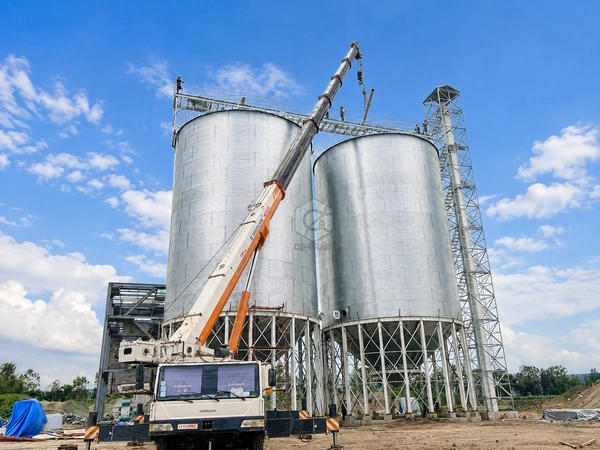
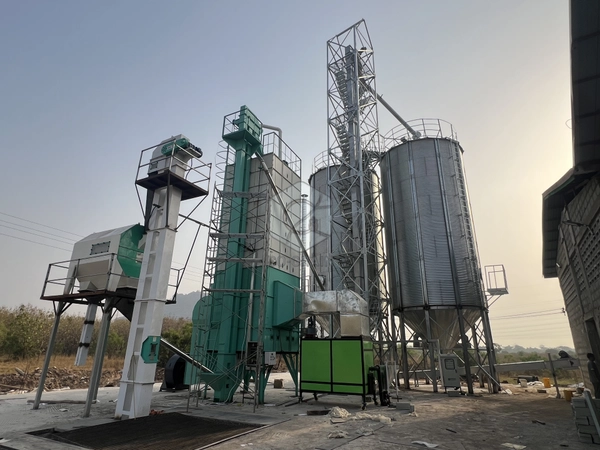
A complete system may therefore use:
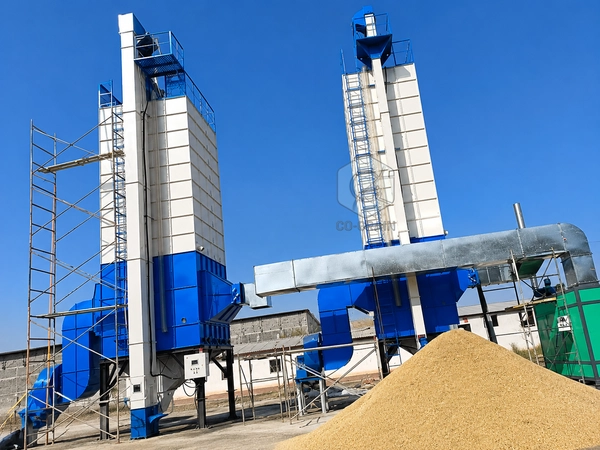
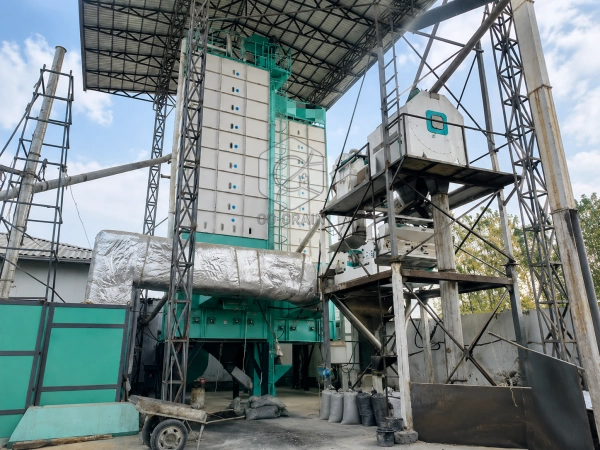
- Paddy Dryer
- Bucket Elevator
Silo Filling System
- Paddy Storage Silos
- Rice Mill
The silos provide a production buffer between drying and milling.
This means the dryer can operate according to its drying schedule while the rice mill draws prepared paddy according to its own production schedule.
- Dryer Capacity vs Rice Quality