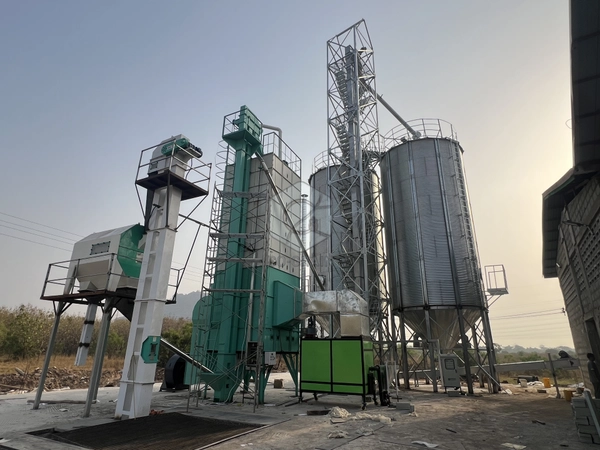
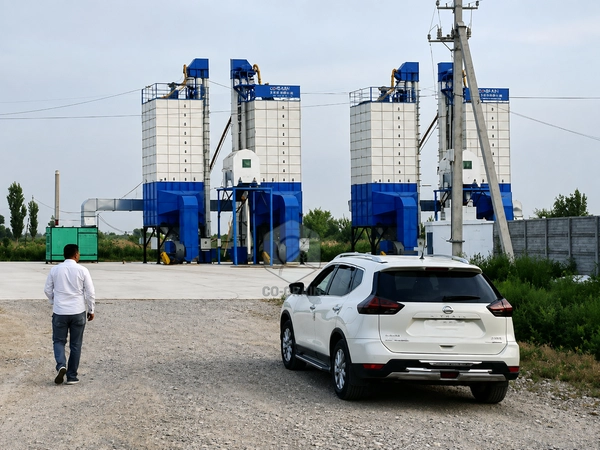
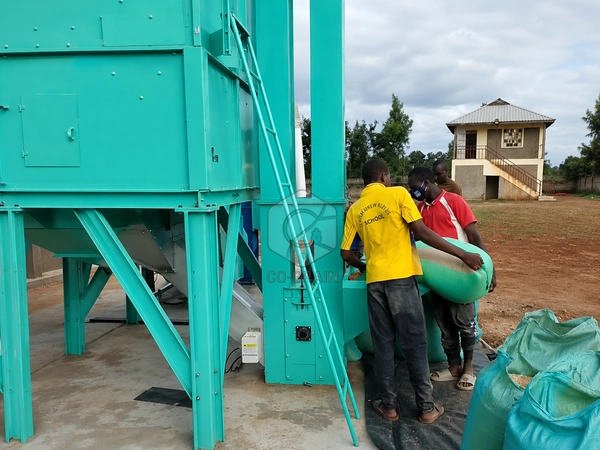
A grain conveying system transfers paddy, corn, wheat and other bulk grains between receiving, cleaning, drying, storage and processing equipment.
A commercial grain plant may combine different conveying technologies because no single conveyor is ideal for every route.
Typical equipment includes:
- Bucket Elevators for vertical lifting,
- Drag Chain Conveyors for enclosed horizontal transfer,
- Belt Conveyors for longer and relatively gentle transport,
Screw Conveyors for short-distance feeding and discharge, and
Air Cushion Belt Conveyors for selected high-capacity or long-distance applications.
A typical complete grain flow is:
Truck Receiving → Conveyor → Bucket Elevator → Pre-Cleaner → Wet Grain Buffer → Grain Dryer → Conveyor → Bucket Elevator → Silo Filling → Storage → Silo Discharge → Processing
The correct conveying system should therefore be selected according to the grain, capacity, distance, elevation, layout and upstream/downstream equipment.
What Is a Grain Conveying System?
A grain conveying system is a combination of mechanical equipment used to move bulk grain from one processing or storage point to another.
In a commercial grain plant, grain rarely moves directly from the truck to the final storage silo using only one machine.
Instead, the material passes through several stages.
For example:
- Truck Receiving
- Horizontal Transfer
- Vertical Lifting
- Cleaning
- Buffering
- Drying
- Storage
Each stage may require a different type of conveying equipment.
This means a grain conveying system is not simply:
One conveyor.
It is a coordinated network of:
Conveyors + Elevators + Chutes + Gates + Distributors + Supports + Sensors + Controls
that moves grain through the complete plant.
How Does a Grain Conveying System Work?
A grain conveying system moves grain horizontally, vertically or at an incline between processing and storage equipment.
Different machines perform different duties.
A typical flow may be:
- Receiving Pit
- → Drag Chain Conveyor
- → Bucket Elevator
- → Pre-Cleaner
- → Wet Grain Buffer Silo
- → Bucket Elevator
- → Grain Dryer
- → Belt / Chain Conveyor
- → Bucket Elevator
- → Silo-Top Conveyor
- → Storage Silo
The system works correctly only when all equipment is coordinated according to the same material-flow requirement.
Why Are Different Conveyors Used in One Grain Plant?
Because each conveying method has its own strengths.
For example:
A Bucket Elevator is very effective for vertical lifting but is not intended for long horizontal transport.
A Belt Conveyor can handle long horizontal routes but cannot replace a vertical elevator for major elevation changes.
A Screw Conveyor is compact and useful for short transfers but is not generally the first choice for every long-distance grain route.
A Drag Chain Conveyor is well suited to enclosed horizontal grain transfer and can support multiple inlets or discharge points in suitable layouts.
Therefore, the engineering question is not:
Which conveyor is best?
It is:
Which conveyor is best for this specific section of the grain route?
Main Types of Grain Conveying Equipment
The following equipment is commonly used in commercial grain handling systems.
1. Bucket Elevator
A Bucket Elevator is used mainly for vertical grain lifting.
It consists of buckets attached to a belt or chain operating inside an enclosed casing.
The basic process is:
- Grain Inlet at Boot
- Buckets Fill with Grain
- Vertical Lifting
- Head Section
- Grain Discharge
Typical applications include:
- Receiving pit to pre-cleaner
- Cleaner to buffer silo
- Wet grain buffer to dryer
- Dryer to storage silo
- Silo discharge to processing plant
Bucket elevators are particularly important in grain plants because large elevation changes occur frequently between equipment.
2. Drag Chain Conveyor
A Drag Chain Conveyor, also called an enclosed chain or en-masse conveyor in some applications, moves grain horizontally or at a confirmed inclination using a moving chain and flights inside an enclosed casing.
Typical process:
- Grain Inlet
- → Chain + Flights Move Grain
- → Discharge Point
Advantages can include:
- Enclosed conveying
- Multiple inlet possibilities
- Multiple discharge possibilities
- Suitable integration with silos
- Compact industrial layout
Typical applications include:
Receiving Pit → Bucket Elevator
Silo Top → Multiple Silos
Multiple Silo Bottom Outlets → Collecting Conveyor
Grain Dryer → Storage Transfer
This makes Drag Chain Conveyors particularly important in silo and grain drying systems.
3. Belt Conveyor
A Belt Conveyor moves grain on a continuous belt supported by rollers or another confirmed support arrangement.
It is commonly used for:
- Medium-distance transfer
- Long horizontal routes
- Grain yards
- Silo areas
- Dryer-to-storage transfer
- Truck loading
Paddy or seed handling where relatively gentle movement is useful
A typical arrangement is:
- Grain Feed Chute
- Moving Belt
→ → →
Discharge
Compared with chain conveying, a belt conveyor can be particularly attractive where longer horizontal distance and gentle handling are important.
4. Enclosed Belt Conveyor
An Enclosed Belt Conveyor uses a protective housing around the conveying route.
This can support:
- Weather protection
- Dust management
- Outdoor transfer
- Silo-top routes
- Plant-gallery conveying
However:
Enclosed does not automatically mean dust-free.
Loading and transfer points may still require:
- Sealed chutes
- Aspiration
- Dust collection
- Proper transition design
This is an important engineering distinction.
5. Air Cushion Belt Conveyor
An Air Cushion Belt Conveyor uses an air-support system beneath the carrying belt rather than relying primarily on conventional carrying rollers along the loaded route.
The basic principle is:
- Grain
- Belt
- Air Film
- Air Chamber
A fan supplies air to the chamber, creating a supporting air layer beneath the belt.
This type of conveyor can be considered for:
- Long silo galleries
- Commercial grain storage
- High-capacity transfer
- Grain terminals
- Dryer-to-storage connections
- Selected long-distance conveying routes
Its suitability depends on capacity, route length, layout and project requirements.
6. Screw Conveyor
A Screw Conveyor uses a rotating helical screw inside a trough or tubular casing to move grain.
Typical flow:
- Hopper / Bin
- Rotating Screw
→ → →
- Discharge
Screw conveyors can be useful for:
- Short-distance transfer
- Hopper discharge
- Bin feeding
- Compact layouts
- Selected silo-bottom duties
- Controlled feeding into downstream equipment
They are generally better suited to short or compact transfer duties than very long commercial grain routes.
7. Inclined Chain Conveyor
An Inclined Chain Conveyor combines enclosed chain conveying with elevation change.
Some configurations may include:
- Horizontal Feed Section
- → Transition Section
- ↗ Inclined Conveying
- → Elevated Discharge
Typical uses can include:
- Receiving pit to elevated cleaner
- Buffer bin to higher process equipment
- Grain transfer where space is limited
- Dryer feeding
It can sometimes reduce the need for separate horizontal and vertical machines in suitable layouts.
Vertical vs Horizontal Grain Conveying
One of the easiest ways to understand a grain handling system is to divide transport into:
- Vertical Conveying
Main equipment:
- Bucket Elevator
Typical duty:
Ground Level → Silo Top
Receiving → Cleaner
- Horizontal Conveying
Typical equipment:
- Drag Chain Conveyor
- Belt Conveyor
- Air Cushion Belt Conveyor
- Screw Conveyor
Typical duty:
Machine A → Machine B
Bucket Elevator → Multiple Silos
This simple distinction helps explain why several conveyor types are often combined in one plant.
- Grain Conveying in a Receiving System
A typical commercial receiving process is:
- Truck
- Receiving Pit
- Horizontal Conveyor
- Bucket Elevator
- Pre-Cleaner
The receiving system normally needs relatively high short-term capacity because several trucks may arrive during harvest peaks.
This is different from the more stable throughput required by a grain dryer.
The conveying equipment should therefore be coordinated with both:
- Peak Receiving Capacity
- Downstream Process Capacity
Which Conveyor Is Used Under a Receiving Pit?
Depending on layout and grain conditions, a receiving pit can connect to:
- Drag Chain Conveyor
- Belt Conveyor
- Screw Conveyor in suitable compact duties
- Other confirmed receiving equipment
For larger commercial grain plants, enclosed chain conveying is commonly worth evaluating because it can move large quantities horizontally toward a bucket elevator.
A typical route is:
- Truck Receiving Pit
- Drag Chain Conveyor
- Bucket Elevator
- Grain Conveying in a Pre-Cleaning System
After receiving, grain is often lifted to the pre-cleaner.
Typical flow:
- Receiving Conveyor
- → Bucket Elevator
- → Grain Pre-Cleaner
After cleaning:
- Cleaner
- → Conveyor / Elevator
- → Wet Grain Buffer
This means conveying equipment is closely integrated with grain-cleaning equipment.
The cleaner capacity and conveyor capacity should be coordinated.
- Grain Conveying Before a Grain Dryer
A typical grain drying plant uses:
- Receiving
- → Pre-Cleaner
- → Wet Grain Buffer Silo
- → Bucket Elevator
- → Grain Dryer
The buffer provides temporary storage.
The conveying equipment then feeds the dryer at a controlled rate.
Possible equipment can include:
- Bucket elevator
- Drag chain conveyor
- Screw feeder
- Belt conveyor
depending on layout.
The important requirement is:
- Stable Dryer Feeding
rather than simply maximum conveyor speed.
Why Stable Dryer Feeding Matters
A grain dryer is designed around a defined material-flow condition.
If conveying is unstable, the dryer may experience:
- Irregular loading
- Variable residence time
- Overloading
- Underfeeding
- Production interruptions
Therefore, the conveyor immediately before the dryer should be selected together with:
- Wet buffer outlet
- Dryer inlet
- Required feed rate
- Control system
This interface is more important than simply selecting a conveyor by catalog capacity.
Grain Conveying After a Grain Dryer
After drying, grain must normally move toward storage.
Typical process:
- Grain Dryer
- Horizontal Conveyor
- → Bucket Elevator
- Silo-Top Conveyor
- → Storage Silo
The equipment used depends on the physical layout.
For example:
- Chain conveyor for enclosed short/medium transfer
- Belt conveyor for longer horizontal transfer
- Air cushion conveyor for selected long routes
- Bucket elevator for vertical lifting
This creates the connection between:
- Drying
- Storage
- Grain Conveying for Silo Filling
One of the most important silo applications is:
Bucket Elevator → Silo-Top Conveyor → Multiple Silos
For example:
- Bucket Elevator
- Top Conveyor
- → Silo 1
- → Silo 2
- → Silo 3
- → Silo 4
The top conveyor may use:
- Drag chain conveying
- Belt conveying
- Air cushion belt conveying
depending on capacity, distance and project design.
Distributors, gates or discharge points direct the grain to the selected silo.
Can One Bucket Elevator Fill Multiple Silos?
Yes.
A common system is:
- One Bucket Elevator
- One Silo-Top Conveyor
- Multiple Silo Inlets
This arrangement can be efficient for a silo group.
The system must confirm:
- Elevator capacity
- Conveyor capacity
- Silo selection
- Discharge points
- Level sensors
- Routing logic
- Structural support
- Future expansion
This is the basis of a Silo Filling & Distribution System.
Grain Conveying for Silo Discharge
Grain must also leave the silo efficiently.
A typical flat-bottom silo process can be:
- Stored Grain
- Center / Intermediate Outlet
- Bottom Conveyor
- → Bucket Elevator
- → Processing / Truck Loading
Depending on layout, the bottom conveyor may be:
- Drag Chain Conveyor
- Screw Conveyor
- Belt Conveyor
For flat-bottom silos, a Sweep Auger may be used after primary gravity discharge to move remaining grain toward the outlet.
Silo-Top Conveyor vs Silo-Bottom Conveyor
These two routes perform different functions.
- Position Main Function
- Silo Top Fill and distribute grain
- Silo Bottom Collect and discharge grain
Typical top system:
Elevator → Conveyor → Silo
Typical bottom system:
Silo → Conveyor → Elevator / Processing
Drag Chain Conveyors are particularly versatile because they can be used in both types of application when appropriately designed.
How to Choose the Right Grain Conveyor
There is no single conveyor type suitable for every grain route.
The following factors should be considered.
- 1. Grain Type
Is the material:
- Paddy
- Corn
- Wheat
- Barley
- Sorghum
- Seed
Other grain?
Damage sensitivity and flow characteristics matter.
2. Required Capacity
How many tons per hour must be transferred?
3. Horizontal Distance
Longer routes may favor different equipment from short transfers.
4. Vertical Lift
Large vertical elevation normally requires a bucket elevator.
5. Inclination
Inclined routes affect equipment selection and actual capacity.
6. Grain Moisture
Wet grain may flow differently from dry grain.
7. Grain Damage Requirement
Paddy and seed applications may require relatively gentle handling.
8. Dust Control
Enclosed conveying and dust aspiration may be important.
9. Outdoor Conditions
Rain, wind and corrosion environment can influence enclosure and material selection.
10. Number of Inlets and Outlets
Multi-silo systems may need several discharge points.
- Quick Grain Conveyor Selection Guide
For preliminary selection:
Need Vertical Lifting?
Consider:
- Bucket Elevator
Need Enclosed Horizontal Bulk Transfer?
Consider:
- Drag Chain Conveyor
Need Long Horizontal / Gentle Transfer?
Consider:
- Belt Conveyor
Need Fully Protected Outdoor Belt Route?
Consider:
- Enclosed Belt Conveyor
Need Selected High-Capacity Long Silo-Gallery Transfer?
Evaluate:
- Air Cushion Belt Conveyor
Need Short Compact Feeding / Discharge?
Consider:
- Screw Conveyor
Need Combined Horizontal + Inclined Enclosed Transfer?
Evaluate:
- Inclined Chain Conveyor
This is only an initial selection framework.
Final equipment should be based on project calculations.
Drag Chain Conveyor vs Belt Conveyor
This is one of the most common grain conveyor comparisons.
- Drag Chain Conveyor
Strengths can include:
- Enclosed structure
- Multiple inlets
- Multiple discharge points
- Silo integration
- Compact routing
- Belt Conveyor
Strengths can include:
- Longer horizontal routes
- Gentle grain handling
- Higher conveying speed in suitable designs
- Outdoor covered configurations
A typical decision might be:
Silo Top with Multiple Discharges → Drag Chain
while:
Long Grain Yard Transfer → Belt Conveyor
But actual selection depends on project conditions.
Screw Conveyor vs Drag Chain Conveyor
These two are also often confused.
- Screw Conveyor
Better suited to:
- Short transfer
- Hopper outlet
- Compact feeding
- Limited-route applications
- Drag Chain Conveyor
Better suited to:
- Longer enclosed horizontal routes
- Higher commercial grain flow
- Multiple inlets
- Multiple discharges
- Silo systems
Therefore, a screw conveyor should not automatically replace a drag chain conveyor simply because both are enclosed.
Bucket Elevator vs Inclined Conveyor
If grain needs to move upward, two approaches may be considered.
- Bucket Elevator
Best suited to:
- Major Vertical Lift
- Inclined Conveyor
Can be useful for:
- Moderate Elevation Change + Horizontal Transfer
A bucket elevator often requires less horizontal footprint for large elevation changes.
An inclined conveyor may simplify certain layouts where space and process geometry allow.
- Why Conveyor Capacity Must Match the Whole Plant
Consider:
- Grain Dryer Capacity: 20 T/H
but:
- Bucket Elevator Capacity: 10 T/H
The practical system cannot continuously move 20 T/H through a 10 T/H elevator.
Therefore:
- Conveyor Capacity Can Become the Plant Bottleneck
The complete system should balance:
- Receiving
- → Cleaning
- → Buffering
- → Drying
- → Conveying
- → Storage
Equipment capacities do not necessarily have to be identical, but they must support the operating strategy.
What Determines Grain Conveyor Capacity?
Capacity depends on more than motor power.
Important factors include:
- Grain bulk density
- Conveyor width / cross-section
- Conveyor speed
- Filling ratio
- Chain or belt configuration
- Screw diameter and pitch where applicable
- Inclination
- Grain moisture
- Inlet design
- Outlet design
- Transfer-point conditions
Therefore, a conveyor model should not be selected from nominal T/H alone without confirming the material basis.
Wet Grain vs Dry Grain Conveying
Wet grain may be more difficult to handle because it can have:
- Reduced flowability
- More impurities
- Greater bridging tendency
- More adhesion
- Higher bulk resistance
For this reason:
Receiving → Cleaner → Wet Buffer → Dryer
requires special attention to:
- Hopper geometry
- Outlet design
- Conveyor loading
- Cleanout
- Blockage prevention
Dry grain may generally flow more easily, but dust control can remain important.
- How to Reduce Grain Damage During Conveying
Grain can be damaged by:
- Excessive conveying speed
- Large drop heights
- Aggressive transfer points
- Incorrect equipment selection
- Excessive recirculation
- Poorly designed chutes
For paddy, seed and other damage-sensitive materials, the system should minimize unnecessary impact.
Useful design considerations include:
- Controlled conveyor speed
- Reduced drop height
- Proper chute geometry
- Appropriate belt conveying
- Smooth transfer between equipment
- Avoiding unnecessary conveying stages
The shortest route is often not the only objective.
The quality of the route also matters.
Why Transfer Points Matter
Many conveying problems occur not inside the conveyor but at:
- Inlet and Discharge Points
Poor transfer design can cause:
- Blockage
- Grain leakage
- Dust generation
- Uneven loading
- Belt misalignment
- Grain damage
Therefore, conveyors should be designed together with:
- Chutes
- Gates
- Hoppers
- Feeders
- Dust aspiration
- Downstream equipment
Transfer-point engineering is a critical part of a reliable grain handling system.
- Grain Conveyor Dust Control
Grain conveying can generate dust at:
- Receiving pits
- Conveyor inlets
- Transfer chutes
- Bucket elevator heads
- Silo filling points
- Truck loading points
Possible control measures can include:
- Enclosed conveyor casing
- Sealed chutes
- Aspiration connections
- Dust collectors
- Reduced free-fall height
- Controlled feeding
A fully enclosed conveyor alone does not eliminate all dust.
The complete transfer system must be considered.
Conveyor Safety and Monitoring
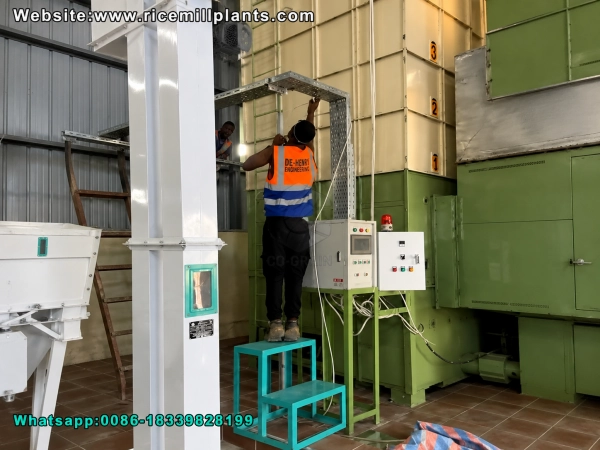
Commercial grain conveying systems may use monitoring such as:
- Belt misalignment
- Speed loss
- Zero-speed monitoring
- Chute blockage
- Bearing temperature
- Motor overload
- Emergency pull cord
- Silo level
- Gate position
These signals can be integrated into:
- PLC / HMI / Central Control
A fault in one conveyor can trigger an upstream stop to prevent continued grain feeding into a blocked downstream route.
- Why Start and Stop Sequence Matters
Imagine:
Conveyor A → Conveyor B → Bucket Elevator
When starting, downstream equipment should normally be available before upstream grain is released.
A simplified logic is:
- Start Downstream First
then:
- Start Upstream
When stopping:
- Stop Grain Feeding
then allow the system to clear appropriately.
The exact sequence depends on equipment and control design.
This helps reduce blockage and grain accumulation.
Typical Grain Conveying System for a Drying Plant
A commercial grain drying plant may use:
- Truck Receiving
- Receiving Pit
- Drag Chain Conveyor
- Bucket Elevator
- Pre-Cleaner
Wet Grain Buffer Silo
- Bucket Elevator
- Grain Dryer
- Drag Chain / Belt Conveyor
- Bucket Elevator
Silo Filling Conveyor
Grain Storage Silos
This is a good example of why several conveyor technologies work together.
Typical Grain Conveying System for a Rice Mill
For paddy processing:
- Paddy Receiving
- Bucket Elevator
- Paddy Cleaner
- Paddy Dryer
- Paddy Storage
- Bucket Elevator / Conveyor
- Rice Milling Plant
Inside the rice mill, additional elevators and conveyors transfer material between:
- Cleaner
- Destoner
- Husker
- Paddy separator
- Whitener
- Polisher
- Grader
- Packaging
Grain conveying therefore connects both the post-harvest and processing sections.
Typical Grain Conveying System for Commercial Silos
A large silo project may use:
- Receiving Pit
- Drag Conveyor
- Bucket Elevator
- Silo-Top Conveyor
- Multiple Storage Silos
and for discharge:
- Multiple Silos
- Bottom Collecting Conveyor
- Bucket Elevator
- Truck Loading / Processing
This is one of the most common complete grain-handling concepts.
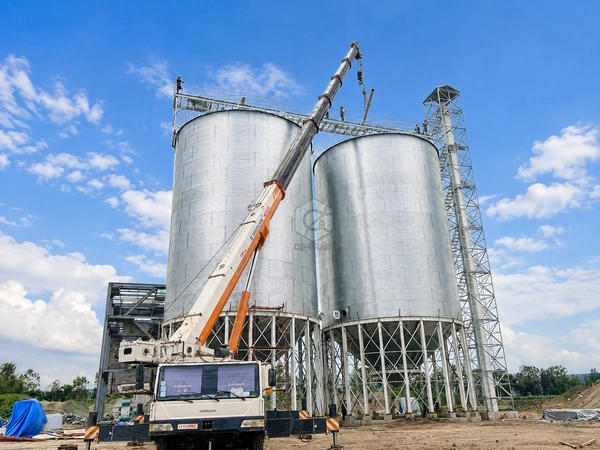
Example: Grain Drying & Storage Project
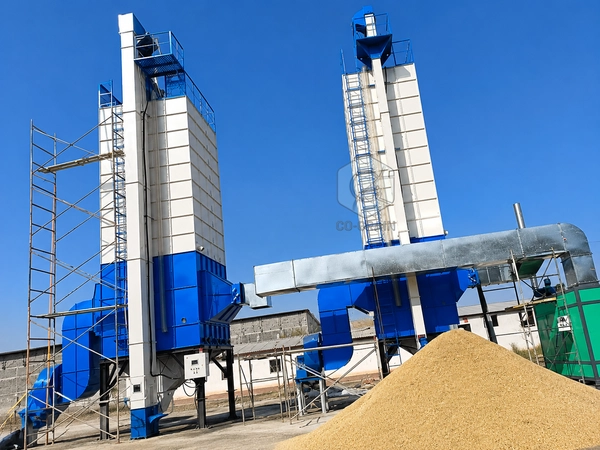
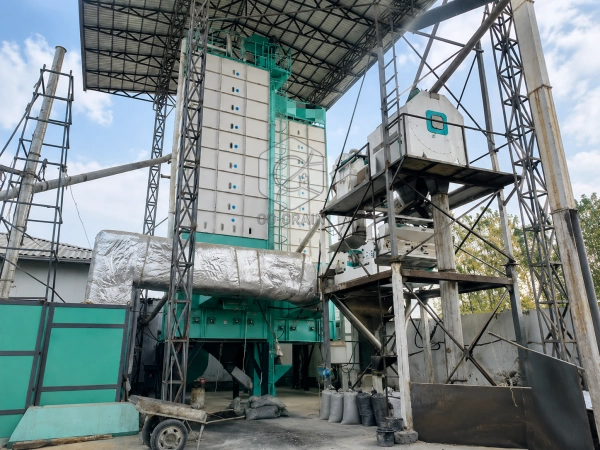
Consider a paddy project configured with:
- 15 T/Batch Paddy Dryer
- 2 × 100 T Grain Silos
- 60 T/D Rice Mill
The conveying system connects:
- Paddy Receiving
- → Pre-Cleaning
- → Dryer Feeding
- → Paddy Dryer
- → Silo Filling
- → Paddy Storage
- → Rice Mill
Without the conveying equipment, the dryer, silos and rice mill cannot function as one coordinated production system.
This shows why conveying should be considered during initial project design rather than added after the major machines have already been selected.
Common Grain Conveying System Design Mistakes
Mistake 1: Selecting Every Conveyor Independently
The entire route should be evaluated as one system.
Mistake 2: Undersizing the Bucket Elevator
It can become a bottleneck for the complete plant.
Mistake 3: Using Screw Conveyors for Routes That Are Too Long
Screw conveying is better suited to selected short-distance duties.
Mistake 4: Ignoring Grain Damage
Particularly important for paddy and seed.
Mistake 5: Too Many Transfer Points
Every transfer adds potential dust, damage and maintenance.
Mistake 6: Poor Chute Design
Can cause blockage and uneven loading.
Mistake 7: Ignoring Wet Grain Flowability
Wet grain may behave differently from dried grain.
Mistake 8: No Dust Aspiration
Enclosed conveying alone may not control dust at transfer points.
Mistake 9: No Maintenance Access
Conveyors require inspection and service.
Mistake 10: No Route Automation
Large multi-silo projects benefit from clear destination control and equipment interlocks.
Frequently Asked Questions
What is a grain conveying system?
A grain conveying system is a combination of elevators, conveyors, chutes, gates and control equipment used to move grain between receiving, drying, storage and processing sections.
Which conveyor is best for grain?
There is no single best conveyor. Selection depends on distance, elevation, capacity, grain type, moisture, dust control and layout.
What is the best conveyor for vertical grain lifting?
A bucket elevator is commonly used for major vertical lifting in commercial grain plants.
Which conveyor is best for silo top filling?
Drag chain, belt or air cushion belt conveyors may be considered depending on distance, capacity and silo layout.
Which conveyor is best under grain silos?
Drag chain conveyors are commonly used for multi-silo collecting routes. Screw or belt conveyors may also be appropriate for specific designs.
Can a screw conveyor move grain?
Yes. Screw conveyors are well suited to selected short-distance feeding and discharge applications.
What is the difference between a belt conveyor and a drag chain conveyor?
A belt conveyor carries grain on a moving belt, while a drag chain conveyor uses a chain and flights inside an enclosed casing. They suit different routes and operating requirements.
Is an air cushion belt conveyor better than a normal belt conveyor?
Not automatically. It can be advantageous for selected long-distance or silo-gallery applications, but suitability depends on project requirements.
Can one bucket elevator serve multiple grain silos?
Yes. One elevator can feed a top distribution conveyor that routes grain into multiple silos.
How do I calculate grain conveyor capacity?
Capacity should be based on grain bulk density, required T/H, equipment geometry, speed, filling ratio, inclination and transfer-point conditions.
Key Takeaway
A commercial grain conveying system is not a collection of random conveyors.
Each machine should perform the duty it is best suited for.
A practical selection logic is:
Vertical Lift → Bucket Elevator
Enclosed Horizontal Transfer → Drag Chain Conveyor
Long / Gentle Horizontal Transfer → Belt Conveyor
Selected High-Capacity Long Route → Air Cushion Belt Conveyor
Short Compact Feeding → Screw Conveyor
The complete objective is:
- Move the required grain
at the:
- Required Capacity
through the:
- Shortest Practical and Safest Route
while controlling:
- Grain Damage + Dust + Energy + Maintenance + Blockage Risk
- How Co-Grain Approaches Grain Conveying Systems
Co-Grain considers conveying equipment as part of the complete grain-processing system.
Depending on project requirements, the conveying scope can connect:
- Grain Receiving
- → Pre-Cleaning
- → Wet Grain Buffering
- → Grain Drying
- → Silo Filling
- → Grain Storage
- → Silo Discharge
- → Rice / Flour / Feed Processing
The equipment can include:
- Bucket elevators
- Drag chain conveyors
- Inclined chain conveyors
- Belt conveyors
- Enclosed belt conveyors
- Air cushion belt conveyors
- Screw conveyors
- Distributors
- Gates
- Chutes
Safety monitoring
Automation
The objective is not simply to select individual conveyor models, but to design a coordinated material-flow route for the complete plant.