Discover how a drag chain conveyor works, including its working principle, key components, and applications in modern grain handling systems. Learn how drag chain conveyors efficiently transport wheat, maize, paddy rice, barley, soybeans, and other bulk grains in grain storage silos, grain drying plants, rice mills, and grain processing facilities. Explore conveyor design, horizontal and inclined conveying, silo loading and unloading integration, and important selection factors such as conveying capacity, chain speed, material characteristics, power requirements, and maintenance. This guide will help you choose a reliable and efficient drag chain conveyor for your grain handling and storage project.
Grain Handling Technology
A Drag Chain Conveyor is an enclosed conveying machine used to move paddy, corn, wheat and other bulk grains horizontally or at a limited incline.
What Is a Drag Chain Conveyor?
It uses a continuous chain fitted with flights or paddles to move grain through an enclosed casing. It is widely used in commercial grain drying and storage systems.
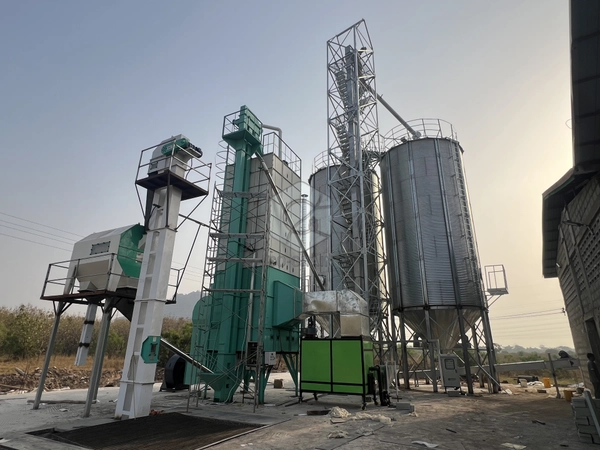
Typical applications include receiving pits, dryer transfer, silo-top distribution and silo-bottom collection.
How It Works
The drive unit pulls a continuous chain through the casing. Flights attached to the chain drag grain from the inlet toward the discharge point.
Depending on the design, the conveyor can operate horizontally or at a limited incline, with one or multiple inlets and outlets.
Main Components
Drive Section
Motor, gear reducer, drive sprocket, coupling and bearings provide the power needed to move the chain.
Chain and Flights
The chain provides traction. Flights carry or drag grain through the casing; their spacing, height and material affect conveying behavior.
Enclosed Casing
The casing contains grain and moving parts, protects against weather and helps control dust.
Inlet and Outlet
Inlets may connect to receiving pits, dryers, pre-cleaners, silos or bucket elevators. Outlets can feed one or several destinations.
Tail and Tensioning
Correct tension helps prevent derailment, excessive slack, sprocket wear and unstable operation.
Monitoring
Chain motion, motor overload, bearing temperature, gate position, blockage and emergency stop signals can connect to plant PLC control.
Typical Grain Handling Routes
Receiving Pit
Dryer to Storage
Multi-silo Distribution
One enclosed conveyor can distribute grain to several silos through controlled gates and outlet devices.
Drag Chain Conveyor Compared with Other Conveyors
| Equipment | Best suited for | Typical role |
|---|---|---|
| Drag Chain Conveyor | Enclosed routes, multiple inlets and outlets | Silo integration and commercial grain flow |
| Screw Conveyor | Short transfer and hopper feeding | Compact local discharge |
| Belt Conveyor | Longer routes and gentle handling | Paddy, seed and outdoor transfer |
| Bucket Elevator | Vertical lifting | Connecting different elevations |
Capacity and Grain Selection
Capacity depends on grain type, bulk density, casing size, filling depth, chain speed, flight design, inclination, inlet loading and discharge conditions.
Wet grain may have lower flowability, greater adhesion and higher resistance. The conveyor should be checked under the expected moisture condition, especially before a grain dryer.
Correct speed should balance capacity, grain quality and reliability rather than simply maximize speed.
Safety, Maintenance and Control
Start-up
Start downstream equipment first, then the bucket elevator, drag chain conveyor and grain feed according to the approved control logic.
Stop Sequence
Stop grain feed first and allow the route to clear before stopping the conveyor to reduce accumulation and restart load.
Routine Inspection
Check chain, flights, sprockets, bearings, drive, wear liners, tensioning, casing, covers and sensors.
Frequently Asked Questions
What is a Drag Chain Conveyor?
It is an enclosed conveyor that uses a moving chain with flights or paddles to transfer bulk grain horizontally or at a limited incline.
Can it serve multiple silos?
Yes. Multiple discharge points can direct grain into several silos, and multiple silo outlets can feed one common conveyor.
Is it suitable for paddy?
Yes, when chain speed, transfer points, drop height and grain impact are properly controlled.
Is it better than a Screw Conveyor?
For longer routes and multiple inlets or outlets, Drag Chain is often more suitable. Screw Conveyor is usually better for short compact feeding.
What information is needed for selection?
Provide grain type, capacity, moisture, distance, inclination, number of inlets and outlets, and upstream and downstream equipment.
Discuss Your Project
Need a Complete Grain Drying & Storage Solution?
Co-Grain provides turnkey grain drying plants, grain storage silos, cleaning, conveying, and automation systems for modern grain handling facilities. Our equipment includes batch and continuous grain dryers, paddy dryers, grain cleaners, bucket elevators, chain conveyors, and belt conveyors.
From engineering design and equipment manufacturing to installation and commissioning, we deliver reliable, customized solutions for paddy rice, maize, wheat, barley, sorghum, and other grains.
Talk to Co-Grain
Planning a new project or upgrading an existing facility? Contact us for a customized solution and free quotation.
Henan Co-Grain Machinery Engineering Co., Ltd.
Email: info@ricemillplants.com
WhatsApp: 0086 18339828199